
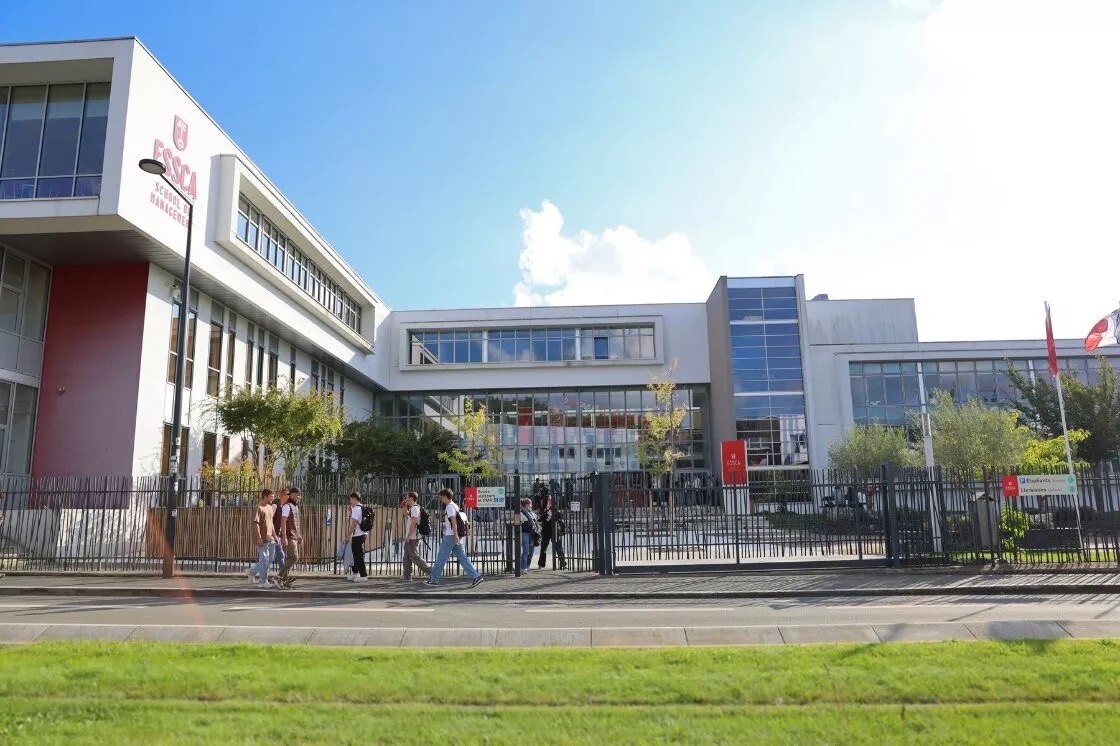

University in France
Angers, Pays de la Loire, France
University profile
ESSCA School of Management is a private, non-profit business school founded in Angers in 1909. It operates as an association under the French 1901 law, holds the EESPIG qualification (private higher-education institution of general interest, under contract with the State) and delivers its Programme Grande École as a diploma recognised by the French Ministry of Higher Education and Research (diplôme visé) with the grade of master. Its Bachelor en Management International carries the grade of licence.
The school teaches on ten campuses: Angers, Aix-en-Provence, Bordeaux, Lyon, Paris (Boulogne-Billancourt and rue de Sèvres) and Strasbourg in France, and Budapest, Luxembourg, Malaga and Shanghai abroad. Angers is the historic campus, in the Belle-Beille district. Around 8,000 students in initial and continuing education are supported by a team of more than 530 faculty and administrative staff, and the alumni network exceeds 24,000 graduates.
Teaching is organised around the Programme Grande École (five years, entry after the baccalauréat or through parallel admissions in year 2, 3 or 4), the three-year Bachelor en Management International, Masters and Masters of Science taught mostly in English, an Executive Master en management global and other continuing-education programmes. Academic departments include Economics, Law and Society; Finance, Accounting and Management Control; Marketing and Retailing; Operations Management and Decision Science; and Organization, Management and Human Resources. The common research theme is responsible leadership.
International experience is built into the curriculum: study or internship abroad is compulsory, exchange partners are located in 54 to 57 countries depending on the page, and the school's own campuses in Budapest, Luxembourg, Malaga and Shanghai host semesters. The community includes more than 30 nationalities. ESSCA holds the Bienvenue en France label (two stars) and runs Welcome Days on every campus. Student life is organised through student associations, wellbeing and prevention programmes with psychologists on all campuses, and a Career Centre.
ESSCA holds the triple international accreditation AACSB (2014), EQUIS (2016) and AMBA (2017, for the Programme Grande École), and the DD&RS sustainability label (2024). It is a member of the Conférence des Grandes Écoles, admitted in 1977 as the first post-baccalauréat school.
ESSCA is a private non-profit association whose resources come mainly from tuition fees; fees are the same for French and international students. For 2027/2028 the maximum tuition is 14,900 EUR for entry in the first cycle of the Programme Grande École (years 1 to 3), 16,100 EUR for Master-cycle entry (excluding alternance) and 12,500 EUR for the Bachelor. International students pay registration fees equal to 30% of first-year tuition to confirm their place. Mandatory additional costs: ESSCA Alumni contribution of 550 EUR, ESSCA student life contribution of 100 EUR or 60 EUR depending on entry level (not for Masters and MSc), and the CVEC (contribution vie étudiante et de campus) of 105 EUR per year for 2026-2027, which may change for 2027-2028.
Rewards students with an outstanding academic record and personal, associative, sporting or professional commitment. It reduces first-year tuition by 15% to 30% and can be combined with the Early Bird reduction up to a total reduction of 30%.
A 15% tuition reduction for international candidates who submit their application before 15 February 2027 and are admitted by 25 March 2027.
Tuition is modulated according to family income (N-2) for first-time first-year entrants whose tax household is based exclusively in France. For 2026/2027 fees range from 0 EUR (tranche 1) to 14,900 EUR (tranche 12) for the Programme Grande École and from 0 EUR to 12,500 EUR for the Bachelor; tuition is free for a family quotient calculated by ESSCA below 400 EUR. Modulation is not available for parallel-admission entrants and can be renewed in later years for those who entered in first year.
The school points international students to the France Excellence Eiffel scholarship programme for Master-level study, to Campus Bourses and to Campus France in the home country. Students on French campuses with French tax residence may qualify for CNOUS social-criteria scholarships and the CNOUS merit aid of 900 EUR per year, and a State-guaranteed student loan up to 20,000 EUR is available to French and EEA nationals resident in France for five years. Students in alternance have tuition paid by the employer. Students with a study visa may work up to 20 hours per week (964 hours per year).
Funding for international students | How to finance your studies
ESSCA Early Bird Tuition Reduction for International Applicants (2027-28) →
Browse the scholarships listed for ESSCA School of Management and check each award’s eligibility.
View scholarships for ESSCA School of Management →Entry after the baccalauréat is by competitive admission for candidates in France, via Parcoursup international routes for pupils in French schools or residing in France. The 2027 calendar is announced on the admissions page.
The international route is open to holders, or candidates about to obtain, a non-French diploma or equivalent ECTS credits. First-year entry (outside Parcoursup) is open to holders of a recognised international baccalauréat such as IB, A-Level or Abitur. Files go through an academic review, which can be eliminatory, followed by a remote motivation interview. For 2027 entry the first-year sessions have application deadlines of 15 December 2026, 15 February 2027 and 15 April 2027 (interviews by 8 January, 12 March and 5 May; results 20 January, 25 March and 15 May 2027). Documents: transcripts for the last two years of secondary school, baccalauréat results if obtained, CV, identity document, official English test score and, where applicable, French test score, and optional recommendation letters. Language tests are required according to the chosen language of instruction, except for applicants who studied at least one year in that language or whose mother tongue it is.
Third-year entry requires two years of higher education completed by July 2027 (120 ECTS or equivalent, or preparatory classes abroad), with the same sessions and a motivation letter. Master-cycle entry requires three years of higher education completed by July 2027 (180 ECTS or equivalent), with eight sessions between 15 October 2026 and 15 May 2027 (interviews and results scheduled after each deadline). Programmes in alternance are taught in French and applied for through the national route.
Second year: open to candidates with a first year of higher education or 60 ECTS, admission on file (15 places), registration opens 15 October 2026, with sessions closing on 29 April, 27 May and 9 July 2027; registration fee 50 EUR. Third year: open to holders of a French bac+2 or 120 ECTS and to students who completed two years of classes préparatoires; competition via Concours ACCÈS with a file and oral tests (20-minute individual interview and 15-minute interview in English), registration 9 November 2026 to 20 April 2027, fee 140 EUR (50 EUR for scholarship holders). Master 1: open to holders of a French bac+3/4 or 180 ECTS from any discipline, via Concours ACCÈS, registration from 13 November 2026 with sessions closing 14 January, 2 March and 15 April 2027, fee 140 EUR (100 EUR preferential rate for sessions 1 and 2, 50 EUR for scholarship holders). An official English test taken less than two years ago is required.
First-year entry after the baccalauréat is via Parcoursup for candidates in France. International candidates holding a non-French baccalauréat or equivalent apply outside Parcoursup: an academic file review and remote interview, eight sessions from 15 October 2026 (deadline) to 15 May 2027, application fee 100 EUR (non-refundable). Documents: transcripts for the last two years, baccalauréat results if obtained, motivation letter, CV, identity document and an official language test (French or English according to the language of instruction, with the same exemptions as above), optional recommendation letter. Second-year entry (60 ECTS) and third-year entry (120 ECTS in management or equivalent) are by Concours with a 20-minute individual interview and 15-minute interview in English and an official TOEIC or TOEFL score less than two years old; registration opens 15 October 2026 and closes 1 April 2027, fee 100 EUR (75 EUR before 1 March 2027, 50 EUR for scholarship holders).
Master programmes (such as Artificial Intelligence for Business, Finance and Data Analytics, Marketing Analytics and Artificial Intelligence) admit holders of a bac+3 (180 ECTS) in first year, and holders of a bac+4 (240 ECTS) or a bac+3 with at least three years of relevant professional experience in second year. The Masters of Science (Global Business Management with the IBSA double degree, International Luxury Management, EU-Asia Luxury Marketing, EU-Asia Digital Marketing and Business) require a bac+4 (240 ECTS) and CEFR B2 English for non-native speakers; the MSc in wealth management and private banking requires a bac+4 and is taught in French.
Student wellbeing spaces and psychologists are available on the campuses; housing support is provided through Studapart, Livinfrance and the CROUS residences.
Study programmes offered at ESSCA School of Management.
Experiences shared by students of ESSCA School of Management.
Studied here? Share your experience to help other applicants.

Book a free consultation with our expert counsellors and take the first step towards your dream university.
Copyrights © 2026 StudyMapped. All rights reserved.

Enter your credentials to continue.
Join us and start your study abroad journey.


