

University in United Kingdom
Birmingham, England, United Kingdom
University profile
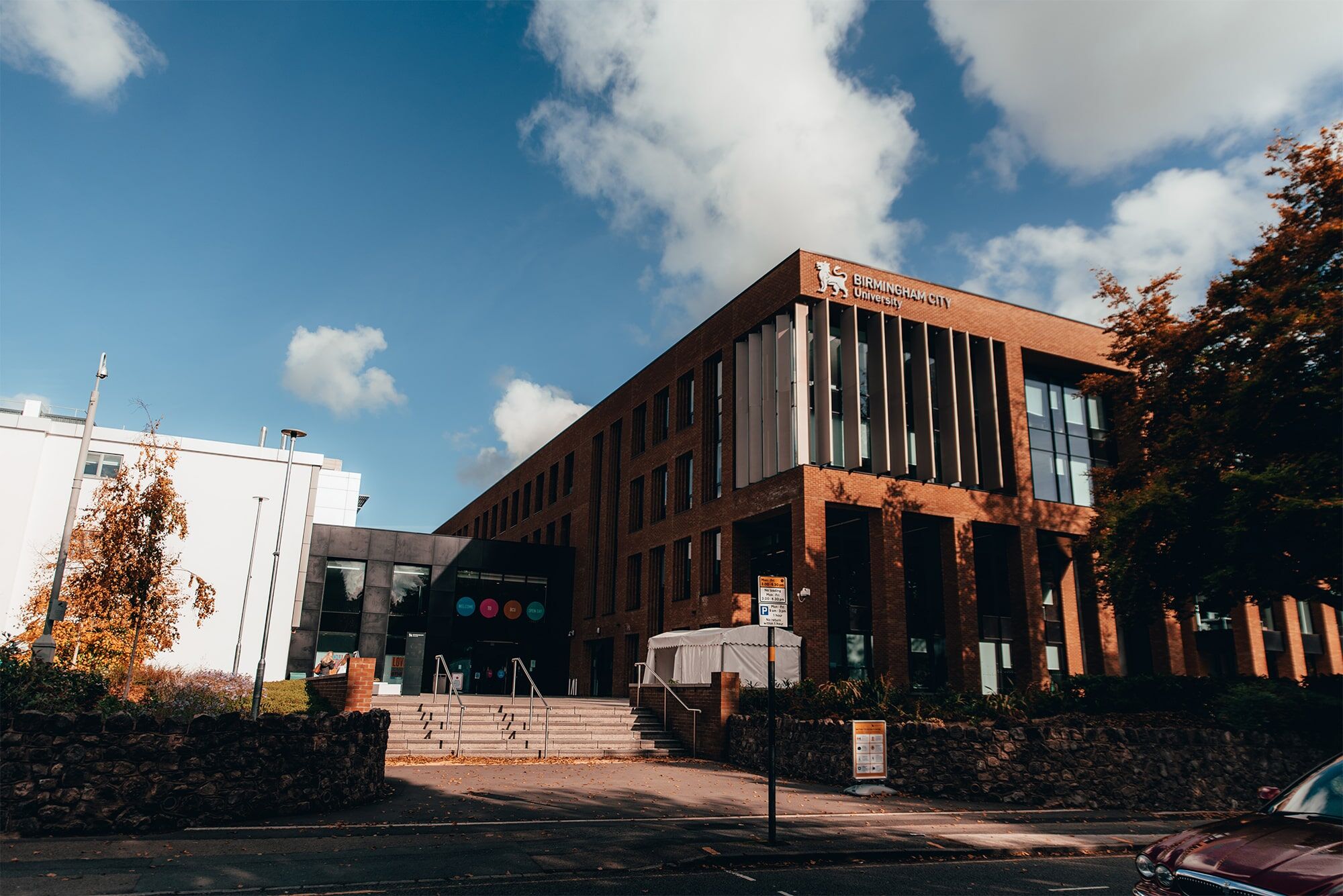
Birmingham City University (BCU) is a large public university in Birmingham, England, with around 31,000 students from 100 countries (HESA Student Record 2021/22). Its roots go back to the Birmingham Society of Arts and School of Design of 1843, and it describes itself as the “University for Birmingham”, a regional anchor and civic institution with a strong technical, creative and professional focus set out in its 2030 strategy, Rooted in Birmingham, Reaching Beyond.
The university has two main campuses: the City Centre Campus in the Eastside district, made up of eight buildings including Curzon, Parkside, Millennium Point, STEAMhouse, the Joseph Priestley Building, the Benjamin Zephaniah Building, the Research Hub and Royal Birmingham Conservatoire; and the City South Campus in Edgbaston for health, nursing, life sciences and social work. Specialist sites include the Grade I listed School of Art on Margaret Street, the School of Jewellery in the Jewellery Quarter, acting studios at Ruskin Hall in Bournville and in Digbeth, and sport science facilities at the Alexander Stadium in Perry Barr.
Teaching is organised in six schools and a conservatoire:
Notable facilities include the Parkside Building with Parkside Media House, simulated operating theatres, hospital wards and a birthing room at City South, the £57 million Royal Birmingham Conservatoire building, the £70 million STEAMhouse for computing and digital technology, and the School of Jewellery, the largest in Europe.
First-year students are guaranteed accommodation through partner halls across the city centre and near City South, with nine recommended options for 2026/27. The BCU Boost package offers a free West Midlands travel pass for eligible first-years and food and drink discounts on campus, and the Doug Ellis Sports Centre in Perry Barr has a fitness suite and sports hall. International students, staff and alumni come from more than 120 countries; the International Office is in the Curzon Building, and Birmingham City University International College (BCUIC) runs foundation, first-year and pre-Master’s pathway programmes.
Tuition fees are set per course and shown on each course page; they cover tuition, examinations and Students’ Union membership. Students classed as overseas pay the overseas fee, and fee status can be checked by completing a Fee Status Questionnaire. Self-funding students pay a 50% deposit before enrolment; postgraduate payment plans are available where fees are £1,500 or more.
Only one BCU scholarship can be held; students eligible for more than one receive the larger. Undergraduate scholarships | Postgraduate scholarships
BCU graduates can receive a 20% fee reduction on an eligible Master’s or PhD starting in 2026/27 or 2027/28. Other awards include PhD studentships (at least full standard UK fees, usually with a stipend), Aziz Foundation Scholarships, the Scott Trust Bursary for MA Data Journalism and the Bowater Financial Assistance Award for MA students. Government Master’s loans of up to £13,206 and Doctoral loans of up to £31,122 are available to eligible students. Postgraduate fees and funding
The Money and Childcare Advice Team runs a student pantry, an emergency fund for immediate hardship and a Financial Assistance Fund for serious financial difficulty, applied for online with supporting evidence. UK undergraduates may also be eligible for government student finance, through the Lifelong Learning Entitlement for courses starting after 1 January 2027.
BCU International Undergraduate Scholarship 2026/27 →
BCU International Postgraduate Scholarship 2026/27 →
Browse the scholarships listed for Birmingham City University and check each award’s eligibility.
View scholarships for Birmingham City University →Applications for September 2027 entry are made through UCAS from 1 September 2026. Key dates: 13 January 2027 UCAS application deadline (6pm, including references); 25 February 2027 UCAS Extra opens; 30 June 2027 last date for 2027 applications, after which applications go into Clearing; 2 July 2027 Clearing opens. Some full-time courses also start in January 2027.
Entry requirements vary by course and are set on each course page. The minimum GCSE pass accepted is grade 4 (grade C under the old system). T Level applicants usually need a Merit with grade B in the core component for degree entry, or a Pass with grade C in the core for foundation year entry, in a subject aligned to the course. Engineering courses require A Level Maths (Physics or Chemistry also accepted), and a pass in the practical element of science A Levels is required. Many art and design courses ask for a digital portfolio, and courses in Education, Social Work, Nursing and Midwifery and the Allied Health Professions have their own application guidance; some courses use interviews or auditions. Advanced entry to year two or three is possible for students transferring from another institution.
International students can apply directly to the university online, through an official in-country representative, or through UCAS. Applications need scanned certificates and transcripts, evidence of English, a one-page statement of purpose and a passport valid for at least six months from the course start; a reference may be requested after a gap of five years or more. Applicants under 18 need written parental consent and, where parents are outside the UK, a UK guardian. Students who do not meet direct entry requirements can take a foundation programme at BCU or one-, two- or three-semester pathway programmes at Birmingham City University International College (BCUIC), which has three intakes a year.
For most courses the requirement is IELTS Academic 6.0 overall with no band below 5.5; some courses require more. Other accepted tests include TOEFL iBT, PTE Academic (not PTE Academic Online), Cambridge C1 Advanced and C2 Proficiency, LanguageCert Academic, Trinity ISE, OET and the university’s own BCU English Proficiency Test (BCU EPT); results are generally valid for two years. Pre-sessional English courses are available for students who need to raise their level.
Most postgraduate courses are applied for directly through the course page. Applicants need copies of prior certificates and two references (one academic, one employer); conditional offers can be made before graduation. The recommended dates to apply are Friday 17 July for September starts and Friday 4 December for January starts, and some courses such as MSc Social Work, MSc Dietetics, MSc Speech and Language Therapy and MSc Physiotherapy have fixed deadlines. International applicants who completed their studies more than two years ago should include a CV. PGCE applications go through UCAS Teacher Training.
PhD, DBA and EdD applicants submit a research proposal and qualifications through the online portal; the Doctoral Research College checks supervision capacity and suitable candidates are invited to interview. International research applicants need IELTS Academic 6.5 overall with no band below 6.0 or equivalent, and may need an ATAS certificate.
Self-funded international students must pay 50% of the tuition fee before receiving their CAS.
The university has two main campuses and several specialist sites across Birmingham.
Accommodation: first-year students are guaranteed accommodation in partner halls such as Hamstead Campus, Beech Gardens, Queen’s Hospital Close, The Heights, University Locks, Lakeside, Bentley House, The Old Fire Station and Staniforth House, with 2026/27 weekly costs from £120 to £210 and bills included.
Study programmes offered at Birmingham City University.
Experiences shared by students of Birmingham City University.
Studied here? Share your experience to help other applicants.

Book a free consultation with our expert counsellors and take the first step towards your dream university.
Copyrights © 2026 StudyMapped. All rights reserved.

Enter your credentials to continue.
Join us and start your study abroad journey.


