
University in Germany
Stuttgart, Baden-Württemberg, Germany
University profile
The University of Hohenheim in Stuttgart, Baden-Württemberg, is the oldest university in Stuttgart. It traces its origins to an agricultural teaching, experimental and model institute founded on 20 November 1818 by King William I of Württemberg and Queen Catherine, in response to the famines of the early nineteenth century. It received university status in 1968. Its profile combines agricultural sciences, natural sciences, and business, economics and social sciences, and it describes itself as one of Germany's leading centres for agricultural and food research.
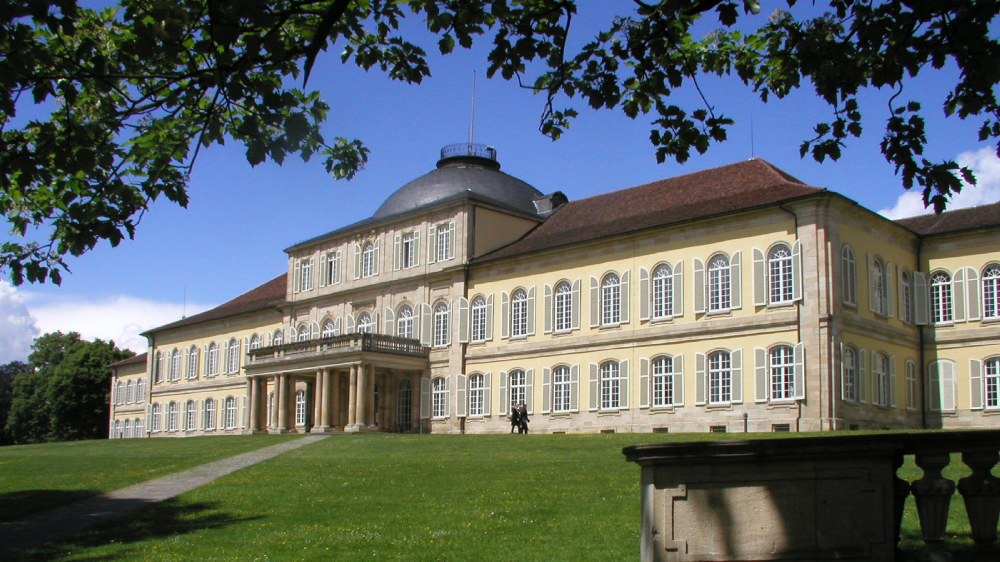
The campus is in the south of Stuttgart, around 10 km from the city centre and a few minutes from the airport and the Stuttgart Trade Fair Centre, reached by bus and U-Bahn. It is built in and around the late-Baroque Hohenheim Palace, which dates from the end of the eighteenth century, and includes the Hohenheim Gardens with more than 4,000 plant species. Lecture halls, institutes, the canteen, libraries, computer rooms and sports facilities are within walking distance of each other. The campus covers 108 ha, and the University's total property, including off-campus experimental stations, is 878 ha.
Teaching and research are organised in three faculties: the Faculty of Agricultural Sciences, the Faculty of Natural Sciences (biology, nutritional sciences, food sciences, chemistry, physics and meteorology, mathematics and statistics) and the Faculty of Business, Economics and Social Sciences. In winter semester 2025/26 the University had 8,838 students and offered 42 degree programmes, 15 at Bachelor's and 27 at Master's level. All Bachelor's programmes are taught in German; many Master's programmes are taught in English, including Bioeconomy, Crop Sciences, Earth and Climate System Science and Landscape Ecology.
Bioeconomy is a University-wide leading topic to which all faculties contribute, and the Agricultural Research Station provides large experimental areas for field research. Student life centres on the campus: the Mensa and cafés run by Student Services Tübingen-Hohenheim, around 120 sports courses in more than 60 types of sport through University Sports, learning spaces in the libraries and across campus, and student groups recognised by the Student Parliament. Student Services operates residence halls close to campus, with part of the rooms reserved for international students.
International students are supported by the Office of International Affairs, the International Students Organisation, the Language Center and housing mentors who help with finding private housing. In winter semester 2025/26, 1,601 students had an international background, and about 100 international partners are named for research and teaching, with strategic networks including the European Bioeconomy University, the EuroLeague of Life Sciences Universities, HERMES and EIT Food.
Baden-Württemberg charges tuition fees of EUR 1,500 per semester to newly enrolled international students from non-EU/EEA countries. German citizens, EU/EEA citizens, exchange students, refugees and students who gained their entrance qualification in Germany are exempt. A fee of EUR 650 per semester applies to a second degree (Zweitstudium) at a level already completed in Germany; the EUR 1,500 fee takes priority and the two are not combined. Separately, all students pay a semester contribution (Semesterbeitrag, not tuition) of EUR 174.50 for winter semester 2026/27, made up of an administrative fee of EUR 80.00, a Student Services fee of EUR 79.00 and a Student Parliament fee of EUR 15.50. See tuition fees and costs of studying.
Hohenheim students can apply for the Deutschlandstipendium, a merit-based national scholarship of EUR 300 per month, financed half by private donors and half by the federal government. In winter semester 2024/25 up to 1.5% of students (130 scholarships) could be funded, subject to donor funding. Selection looks at outstanding achievement as well as social commitment, willingness to take responsibility and biographical hurdles such as migration background. Contact: [email protected]. See the Deutschlandstipendium page.
The University advises that scholarships are more often awarded to advanced and graduate students than to first-year students, and names the DAAD and German political and religious foundations as sources, noting that success rates are low. It also states that it has no funds of its own to finance living costs, which it puts at at least EUR 992 per month, and that non-EU students may work up to 140 days or 280 half days per year. Doctoral candidates are advised on funding by the Graduate Academy. See financing your studies.
Deutschlandstipendium at the University of Hohenheim →
STIBET Short-Term Scholarship for International Students at the University of Hohenheim →
Browse the scholarships listed for University of Hohenheim and check each award’s eligibility.
View scholarships for University of Hohenheim →All Bachelor's programmes are taught in German. Applications are made online through the HohCampus application portal, where up to 3 degree programmes can be applied for. For programmes with limited places, applicants must also register with the dialogue-oriented service procedure (DoSV) of Hochschulstart. Since winter semester 2022/23 no additional application through uni-assist is needed. Documents are uploaded in the original language with a German or English sworn translation where needed. The Biology teaching programme (B.A.) is applied for through the University of Stuttgart.
Applicants need a recognised higher education entrance qualification (Abitur equivalent), proof of sufficient German skills unless the qualification was gained at a German-speaking school, and proof of a study orientation procedure, as required in Baden-Württemberg (the teacher orientation test for the Biology teaching and Education for Business and Economics programmes, the was-studiere-ich.de test recommended for others). Winter semester deadline: 15 July for Biology, Digital Business Management, Nutritional Science, Communication Science, Food Science and Biotechnology, Sustainability & Change, Information Systems, Education for Business and Economics, and Business Administration and Economics; 30 September for Agricultural Sciences, Agricultural Biology and Biobased Products and Bioenergy (15 July if a preparatory course must be attended). Summer semester: 15 January for higher semesters or where a preparatory course must be attended, and 31 March for first-semester entry to the three agricultural programmes.
Accepted proof includes TestDaF with at least TDN 4 in all four parts, DSH with at least DSH-2, DSD II, Goethe Certificate C2, or a degree from a German-language programme. The IB Diploma counts only with German A at Higher Level. Proof must be provided by the application deadline.
Required for Master's programmes taught in English or with English components, as set out in each programme's admission regulations. For example, Earth and Climate System Science requires at least B2, shown by TOEFL iBT 90, IELTS 6.5 or UNIcert II. Management requires B2, which is accepted as met with Abitur if English was taken in the last two school years.
Applications are made through HohCampus separately for each programme, with programme-specific deadlines (for example 15 September for winter semester in Agricultural Sciences, 15 June in Management, 15 March for non-EU applicants to several agricultural programmes). Typical requirements are a Bachelor's degree of at least three years (180 ECTS) in a relevant field, a minimum grade where stated (for example 2.5 or better in Agricultural Sciences unless aptitude is proven by other means, 3.0 or better in Earth and Climate System Science), subject-specific ECTS, a motivation letter where required, and German C1 where the programme is taught in German. Earth and Climate System Science requires an APS certificate for applicants from India, China and Vietnam. Management applicants may improve their chances with GTEBS or GMAT, which counts for 40% of the selection procedure.
Applicants first find a professor willing to supervise the project. The application for admission is submitted to the Graduate Academy, where the International Office checks certificates and the faculty decides. Formal conditions are an above-average university degree equivalent to a German diploma or Master's with thesis, acceptance by a Hohenheim professor, proof of German or English according to faculty regulations, and secured living costs or a scholarship. The Faculty of Agricultural Sciences offers a structured doctoral programme with 9 doctoral schools.
Citizens of countries outside the EU, EFTA and those with intergovernmental agreements need a visa for study purposes. Admission and proof of funding, for example a blocked account, must be submitted to the embassy. A tourist visa cannot be converted into a residence permit for study.
The University has a single main campus in the south of Stuttgart (Schloss Hohenheim 1, 70599 Stuttgart), with off-campus experimental stations used by the Agricultural Research Station.
Learning spaces include 189 places in the Departmental Library, 159 in the Central Library, 260 in the Mensa, the Green Classroom, LearnSpace, LernOase, and computer rooms. Student Services Tübingen-Hohenheim runs the Mensa (lunch 11 a.m.-2 p.m.), cafeteria and residence halls near the campus, and University Sports offers around 120 courses.
Study programmes offered at University of Hohenheim.
Experiences shared by students of University of Hohenheim.
Studied here? Share your experience to help other applicants.

Book a free consultation with our expert counsellors and take the first step towards your dream university.
Copyrights © 2026 StudyMapped. All rights reserved.

Enter your credentials to continue.
Join us and start your study abroad journey.


