
University in United States
Storrs, CT, United States
University profile
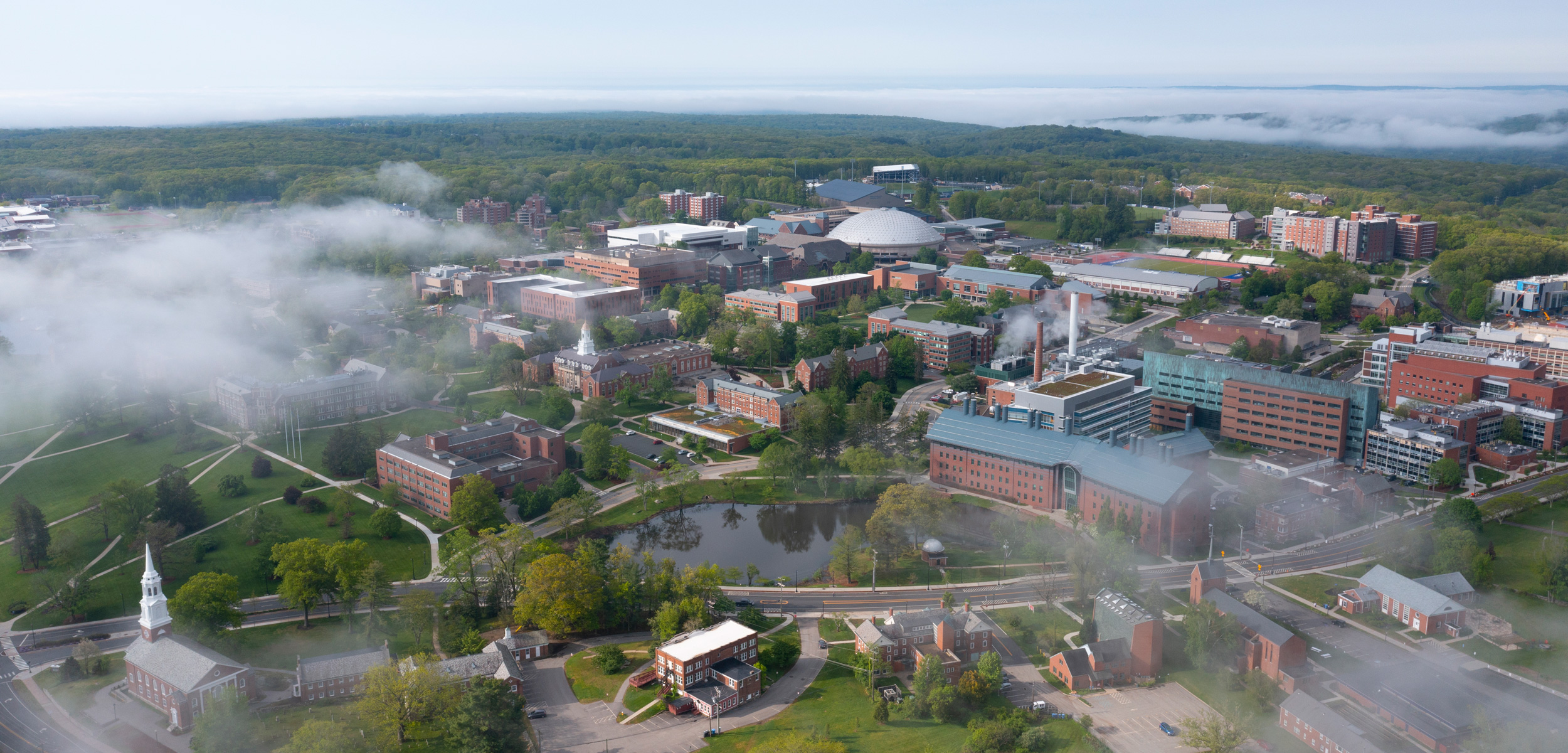
The University of Connecticut (UConn) is the state's flagship public university and a land-grant and sea-grant institution. Its mission describes it as Connecticut's public research university, dedicated to excellence in knowledge creation, graduate and professional education, and outreach. Its main campus is in Storrs, in the northeast of the United States, halfway between New York City and Boston, with four regional campuses and the professional schools in Hartford and Farmington.
UConn is organised into 14 schools and colleges: the Ratcliffe Hicks School of Agriculture, the College of Agriculture, Health and Natural Resources, the School of Business, the School of Dental Medicine, the Neag School of Education, the College of Engineering, the School of Fine Arts, The Graduate School, the School of Law, the College of Liberal Arts and Sciences, the School of Medicine, the Elisabeth DeLuca School of Nursing, the School of Pharmacy and Pharmaceutical Sciences and the School of Social Work. Students choose from more than 125 undergraduate majors and can design an individualized major with a faculty advisor. Graduate study spans 17 graduate degrees and six professional practice degrees (JD, LLM, MD, DMD, Pharm.D. and SJD).
Fall 2025 enrolment was 34,424 students, including 26,191 undergraduates (21,042 at the main campus and 5,149 at the regional campuses) and 8,233 graduate and professional students. International students make up 6% of undergraduates and 19% of graduate and professional students, drawn from 116 countries. About 21,000 undergraduates study at Storrs.
Student life at Storrs includes more than 700 clubs and organizations, 21 NCAA Division I athletics teams, seven cultural centers and programs, five on-campus theaters and three museums. UConn has one of the highest percentages of students living on campus of any public university, with residence halls, suites and apartments, Living/Learning Communities and special interest housing. Eight dining halls and six cafes serve resident students, including kosher, halal, vegetarian and gluten-free options.
UConn Honors Program enrols about 550 students in each entering class. The university offers undergraduate research funding such as the Summer Undergraduate Research Fund and UConn IDEA Grants, along with education abroad programs. International applicants may be placed in UConn's American English Language Institute (UCAELI) through conditional admission if they otherwise qualify but do not meet the English requirement. The School of Law is accredited by the American Bar Association and is a member of the Association of American Law Schools.
Tuition: $17,010 in-state, $39,678 out-of-state, $26,028 New England Regional. University and student fees: $4,564. On-campus housing (standard double) $8,288 and Value meal plan $6,896. Typical direct costs: $36,758 in-state, $59,426 out-of-state and $45,776 New England Regional. Waivable fees: health insurance $3,214 and Husky Book Bundle $570. See the Office of Student Financial Aid Services and the Bursar for regional campuses, graduate and professional rates.
Approximately 73% of undergraduates receive gift aid, with more than $327 million in gift aid annually. Offers can include scholarships, grants, loans and work-study. All first-year applicants are automatically considered for merit scholarships (except Nutmeg, Day of Pride and Stamps, which need a supplemental application). Need-based financial aid, including grants and loans, is available only to U.S. citizens and permanent residents; file the FAFSA (school code 001417) by February 15, or November 1 for Early Decision.
Other merit awards include the Academic Excellence Scholarship, Husky Achievement Award, Leadership Scholarship, STEM Scholarship and UConn Award (all open to in-state and out-of-state applicants), and Connecticut-resident awards (Nutmeg, Day of Pride, Presidential Scholars, Regional Student Success). Details: Merit Scholarships.
Browse the scholarships listed for University of Connecticut and check each award’s eligibility.
View scholarships for University of Connecticut →Applicants should attend an approved high school program and complete a minimum of 16 units, 15 of them college preparatory: 4 units of English, 3 of mathematics, 2 of social science or history, 2 of a single foreign language (3 strongly recommended), 2 of laboratory science and 3 electives. Nursing applicants need high school chemistry and biology; College of Engineering applicants need chemistry or physics. Review is holistic (rigor, performance, involvement, personal qualities, additional factors); the Office of Undergraduate Admissions recalculates each applicant's GPA so advanced coursework (AP, IB, Honors) in core classes is weighed consistently. UConn is test-optional for the foreseeable future; SAT/ACT scores are not required for merit scholarship or Honors consideration. Middle 50% of admitted students who submitted scores for fall 2026: Storrs SAT 1320-1460 and ACT 29-34; regional campuses SAT 970-1250 and ACT 19-28. Institutional codes: SAT 3915, ACT 0604. Two optional recommendation letters are accepted and a 250-650 word essay is required.
Apply with the Common Application or the Coalition Application; the application fee is $80 (non-refundable). Early Decision: November 1 (notifications from mid-December). November 1 for Special Programs in Medicine, Dental Medicine and Law. December 1: priority deadline for merit and Honors consideration. January 15: Storrs campus deadline (decisions from early March). May 1: regional campus deadline (rolling decisions). Spring 2027 entry: October 1 for all campuses, rolling decisions from early November. Enrolment fee for regular decision applicants is due May 1.
Students who have enrolled full-time at a post-secondary institution and completed 12 or more credits after high school apply as transfers. Fall deadlines vary by program: January 5 (Pharmacy, via PharmCAS), January 15 (Neag teaching majors), February 1 (Diagnostic Genetic Sciences, Dietetics, Exercise Science, Medical Laboratory Sciences, Fine Arts, Nursing, Sport Management), February 15 (Social Work), April 1 (most other programs including Business, Engineering and Liberal Arts and Sciences), May 1 (regional campuses). Spring deadline: October 1. SAT/ACT scores are not required for transfer applicants aged 21 or over or with 24 transferable college credits.
International first-year applicants have completed secondary school (equivalent to U.S. grades 9-12) and must be eligible to enter a university in their home country; Engineering applicants need secondary-level physics and chemistry. Official transcripts must come directly from the school with certified English translation of any other-language documents; country-specific credential requirements are set out for Ghana (transcripts for Junior Secondary year 3 or BECE and Senior Secondary years 1-3 plus WASSCE results), the UK (GCE A Levels; at least three Advanced or International Advanced Level courses), IB, Caribbean (CSEC/CAPE) and many other systems. English proficiency is required unless waived: TOEFL iBT 79 out of 120 (new scale 4.5), IELTS 6.5, Duolingo 110, LanguageCert Academic 70, PTE Academic 60. Waivers include native English speakers, two or more years at a U.S. secondary school, SAT Evidence-Based Reading and Writing 510 or higher, ACT 24 on English, Reading and Composite, IB HL English 5 or higher, and an English-medium degree. Applicants who otherwise qualify may receive conditional admission with UCAELI. After admission, the I-20 is requested through the ISSS Portal with a copy of the passport, a signed Financial Declaration Form, evidence of funding for the first year and the admission offer letter. International transfer applicants follow the domestic transfer requirements; spring applications are not accepted from international students.
The Graduate School offers more than 250 degrees and programs. Applicants need a bachelor's degree from an accredited institution (or an equivalent, generally a 4-year degree; some 3-year degrees qualify under stated conditions) and a GPA of 3.0 or higher for the full prior degree, or 3.0 over the last two years or 3.5 over the last year of full-time undergraduate study. GRE or GMAT requirements are set by each program. Third-party credential evaluations (NACES or AICE members) are required for non-U.S. transcripts unless the program has opted out. English minimums: TOEFL iBT 79 (4.5 new scale), IELTS 6.5, PTE 60, Duolingo 110. Application fee $75. Programs in Dental Medicine, Law and Medicine use their own applications.
The campuses total about 3,938 acres (Storrs and regionals) plus about 210 acres at UConn Health. UConn housed approximately 14,000 students in residence halls in 2025.
Study programmes offered at University of Connecticut.
Experiences shared by students of University of Connecticut.
Studied here? Share your experience to help other applicants.

Book a free consultation with our expert counsellors and take the first step towards your dream university.
Copyrights © 2026 StudyMapped. All rights reserved.

Enter your credentials to continue.
Join us and start your study abroad journey.


