
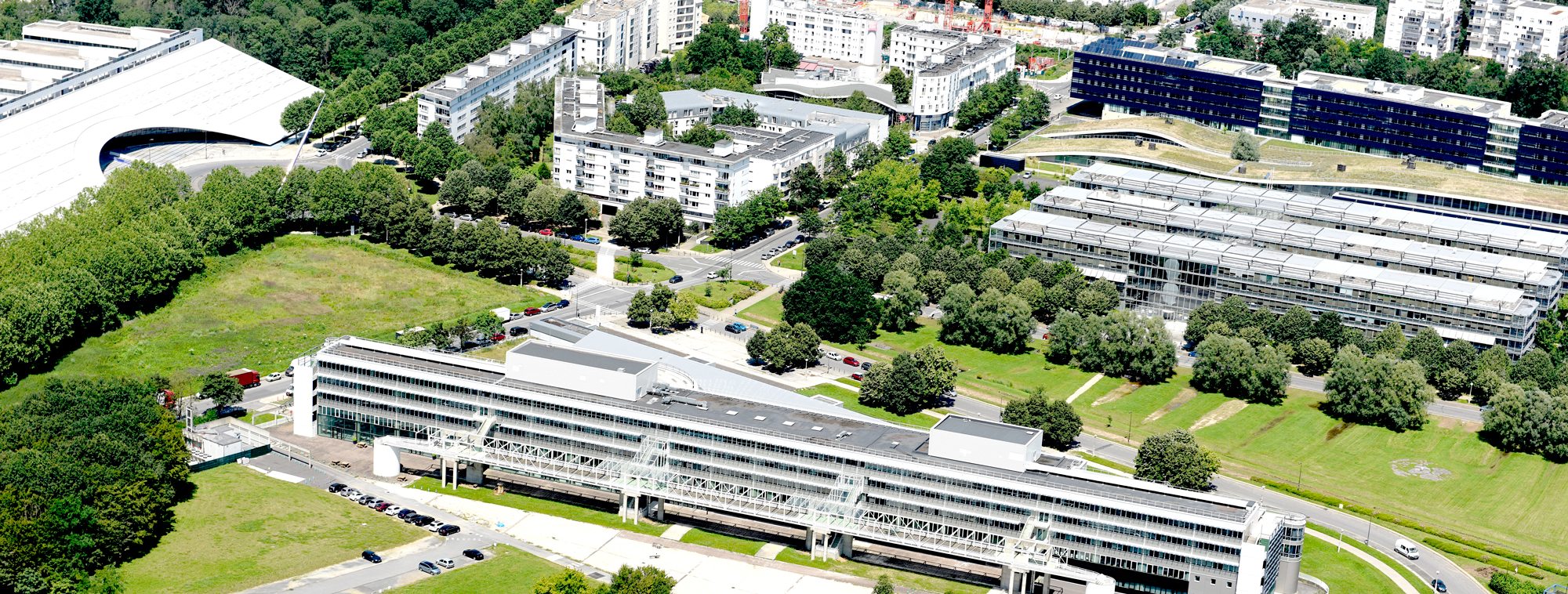

University in France
Champs-sur-Marne, Île-de-France, France
University profile
Université Gustave Eiffel is a French public university created in 2020 on an experimental model that brought a university, a research institute and several schools into one institution. It is the only multi-disciplinary institution in France to combine the missions and skills of a university, a research organisation, a school of architecture and three engineering schools, all centred on the issues facing the cities and regions of tomorrow. It leads the I-SITE FUTURE scientific ambition for the sustainable transformation and adaptation of cities and territories.
The headquarters are at Champs-sur-Marne on the Cité Descartes in Marne-la-Vallée, about 20 minutes from Paris, where more than 16,000 students study. The university also has campuses in Paris, Versailles, Lyon, Nantes, Lille and the Mediterranean (Aix-Marseille), with further sites at Belfort, Brussels, Bordeaux, Grenoble, Meaux and Val d'Europe. In total it brings together nearly 17,000 students.
Teaching runs through the university's own Bachelor, Technical Bachelor (BUT), professional Bachelor and Master programmes, doctoral studies, and four member schools: ESIEE Paris (engineering), Géodata Paris (ENSG) (geomatics engineering), EIVP (engineering of the city, in Paris) and the École d'architecture de la ville & des territoires Paris-Est. Other components include the IUT de Marne-la-Vallée (Champs-sur-Marne and Meaux), IAE Paris-Est, and IFIS at the Val d'Europe campus.
Work-study education is a defining feature: close to 25% of students are on apprenticeships, which makes it the leading French university for apprenticeship training, with more than a hundred work-study courses from BUT to Master and engineering degrees. Entrepreneurship is supported through the Pépite programme. The university obtained the DD&RS label (sustainable development and social responsibility) in 2025.
Student life centres on the Marne-la-Vallée campus, with student associations supported by the FSDIE solidarity and initiatives fund, a university health service and social action department, a disability centre, sport facilities and five university libraries. More than 10% of students are international; exchange students and individual-mobility students are welcomed by the International Relations Department, with a mentoring scheme, an online welcome desk and free French as a Foreign Language courses. Accommodation is arranged through CROUS and partner residences and platforms.
Public-university registration fees are set nationally by the arrêté of 19 April 2019. For 2026/2027: Licence, professional Licence, BUT and DAEU €178 (reduced rate €118); Master €255 (reduced €167); engineering diploma €630 (reduced €420); doctorate €398 (reduced €265). The reduced rate applies to a gap year or a second national diploma in the same institution. Apprentices pay no registration fees and scholarship holders are exempt.
For 2026/2027 the university renews its partial exemption from differentiated enrolment fees for newly arrived non-EU international students, introduced in 2019/2020, so that the amount due is aligned with the fees applicable to European students for each degree. Students enrolled in member schools should consult the school's own pages.
The CVEC is a separate annual contribution of €105 payable to CROUS before enrolment. Scholarship students, refugees, asylum seekers and beneficiaries of subsidiary protection are exempt; Erasmus+ exchange students, continuing-education students, HDR candidates and CLEAR-Doc doctoral students do not pay it. It funds student support in social, health, cultural and sporting areas, including access to the university sports service.
Students in difficulty can request exemption from registration fees from the general registrar's office, bourses and diplomas section ([email protected]) using the exemption form. Exemption committees meet on 12 October and 17 November 2026; a successful request leads to a refund of fees, but not of the CVEC.
The Graduate School GP-DS offers support scholarships to host international students and selected French students entering four Graduate Programmes: URBAN FUTURE, DIGIS, BÉZOUT and CODS. The CLEAR-Doc programme funded 30 three-year doctoral contracts (15 from 1 October 2022 and 15 from 1 October 2023) with compulsory mobility of at least six months. Campus France Eiffel Excellence Grants, set up by the French Ministry for Europe and Foreign Affairs, run for up to ten months at around €1,400 per month for PhD mobility; Campus France publishes a catalogue of other grants at campusbourses.campusfrance.org.
The social action department offers appointments with a social worker on grants based on social criteria, housing, energy vouchers, solidarity transport and health insurance. Details: health and social services; fees: administrative enrolment.
Bourse Excellence Eiffel (Fondation Université Gustave Eiffel) →
Browse the scholarships listed for Université Gustave Eiffel and check each award’s eligibility.
View scholarships for Université Gustave Eiffel →First-year applicants (Bachelor, Technical Bachelor BUT, BESTm, ESIEE Paris engineering degree, geometrician training) apply through Parcoursup. EU/EEA, Swiss, Monaco and Andorra nationals with a French or European baccalauréat, an access diploma, a non-EU foreign diploma or the international baccalaureate also use Parcoursup; the 2027 window runs from 18 January to 11 March 2027. Entry to the 2nd or 3rd year of a Bachelor, a Master 2 or an engineering course goes through the eCandidat platform, with the portal opening in February 2027; professional Bachelor and university diplomas also use eCandidat.
Applicants living in a Études en France (CEF) country, including Ghana, Nigeria, Cameroon, Senegal, India, China, Brazil, the United States and the United Kingdom among others, must apply online through the Campus France website of their country by 15 December 2026 and must not submit a separate application on the university platform. For these countries only the CEF procedure can be used to obtain a visa. Applicants from non-CEF countries applying to the 1st year of a Bachelor use the Demande d'admission préalable (DAP, Dossier Blanc) through the French embassy; those already living in France use the DAP Dossier Vert, applying to three universities. For years other than the 1st year of a Bachelor, applicants from non-CEF countries register on the Campus France website and also apply on eCandidat. Documents not in French must be translated.
DAP candidates take the TCF DAP test, held at the university on 2 February 2027, with registration by 15 December 2026 and a fee of €74. A score of 300/699 (level 3) is needed for the application to go to the teaching committee. Exemptions apply to nationals of French-speaking states, students from French bilingual institutions and holders of DALF C1/C2, DELF B2 or TEF with at least 14/20 in the written test. Exchange students need language level B1, B2 or C1 depending on the discipline, and B2 French or C1 English for Master's programmes in Urban Planning.
First-year Master applicants apply on the national Mon Master platform, from 15 February to 22 March 2027. Admission to Master 2 and some other years is through eCandidat. Some jointly run courses have their own procedure, described in each course brochure in the training catalogue.
Engineering and architecture applicants use eCandidat and follow the school's own procedure for ENSA Paris-Est, EIVP, Géodata Paris (ENSG), ESIEE Paris and ESIPE.
PhD candidates hold a two-year Master's or equivalent with proven research experience, apply through the Adum platform and are attached to a doctoral school through a research unit; international candidates meet the same scientific requirements as French candidates. To benefit from thesis funding, the Master's must allow enrolment in a doctoral school before October of the year. A PhD usually takes three years.
Exchange students are nominated by their home university under an inter-institutional agreement and then apply online with passport or identity card, photo, transcripts, cover letter, CV, language proof, learning agreement (Erasmus+) or course list, and a letter of recommendation where required. 30 ECTS credits validate a semester.
Admitted students pay the CVEC and obtain a certificate, then enrol online, upload supporting documents (identity document or passport, CVEC certificate, photo, baccalauréat transcript and prior higher-education results) and pay the fees. Newly arrived international students receive support with residence permits from the International Relations Department.
Libraries: Georges Perec (arts, languages, humanities, urban planning, sociology, STAPS, management, economics, science and technology), Arts and Multimedia, Tourism-Management, and IUT libraries at Champs-sur-Marne and Meaux, plus school libraries at ESIEE Paris and EIVP.
Study programmes offered at Université Gustave Eiffel.
Experiences shared by students of Université Gustave Eiffel.
Studied here? Share your experience to help other applicants.

Book a free consultation with our expert counsellors and take the first step towards your dream university.
Copyrights © 2026 StudyMapped. All rights reserved.

Enter your credentials to continue.
Join us and start your study abroad journey.


