
University in France
Montpellier, Occitanie, France
University profile
The Université de Montpellier (UM) is a large public research university in Montpellier, in the Occitanie region of southern France. It is a public experimental institution (établissement public expérimental, EPE) with legal personality and pedagogical, scientific, administrative and financial autonomy, led by an elected president. It was formed on 1 January 2015 by the merger of the universities Montpellier 1 and Montpellier 2, and it traces its roots to the medieval medical school and to the university founded in 1289. It enrols more than 51,000 students across 17 faculties, schools and institutes.
Teaching covers law, economics, management and political and social sciences, and science, technology and health. The eight faculties are Droit et science politique, Économie, Éducation, Médecine, Odontologie, Pharmacie, Sciences, and STAPS (sport sciences). The seven institutes are IPAG, INSPE, IAE, Montpellier Management, and the IUTs of Béziers, Montpellier-Sète and Nîmes. Two schools (OREME and Polytech Montpellier) and one component institution, the École nationale supérieure de chimie de Montpellier (ENSCM), complete the structure. Polytech Montpellier and ENSCM are engineering schools accredited by the CTI (Commission des Titres d'Ingénieurs).
Research is organised in five research poles: Agriculture, Environment and Biodiversity; Biology-Health; Chemistry; Mathematics, Computer Science, Physics and Systems; and Social Sciences. The university has held the I-SITE excellence label since 2017 (made permanent in 2022), built around food security, environmental protection and human health. Its Graduate School links eight collegiums, five research poles and nine doctoral schools, and runs the IDIL programme of English-taught master's tracks with laboratory immersion.
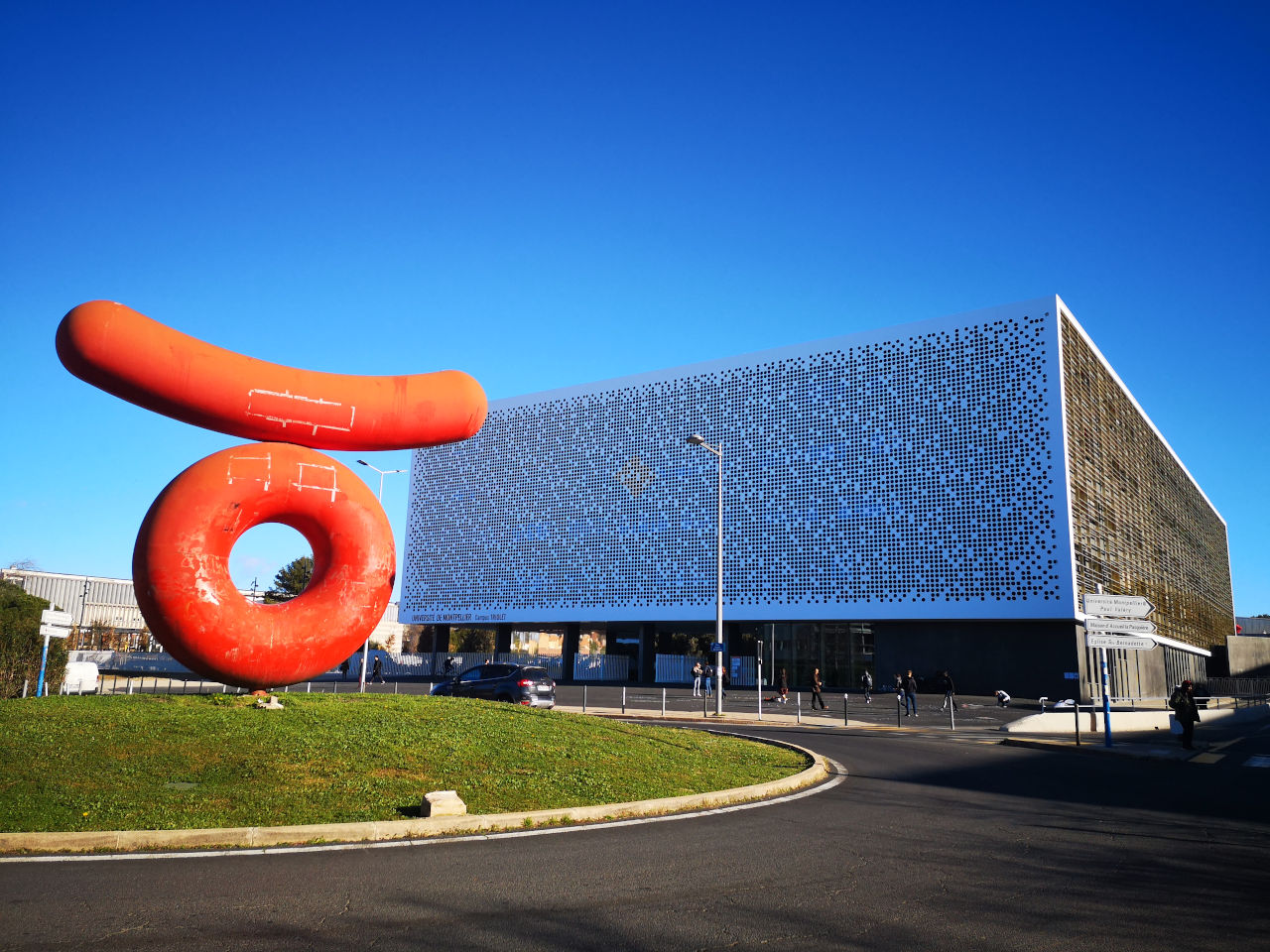
The campuses are spread across Montpellier, notably Triolet (sciences, Polytech) and Richter (economics and management), with sites in Sète, Béziers, Nîmes, Carcassonne and Mende. Student life is supported by the Bureau de la Vie Étudiante, the university sports service SUAPS (around 50 sports, free to registered students), the Service de médecine préventive and the Centre de soins universitaire, and the Handiversité service for students with disabilities. Housing is handled through CROUS Montpellier.
The UM is labelled Bienvenue en France for its welcome of international students and has a Welcome Desk. It reports more than 10,000 international students from over 150 countries, French-as-a-foreign-language courses (levels A0 to B2) and programmes taught fully in English from bachelor's to doctorate. It is a member of the CHARM-EU European university alliance (since 2019) and holds the European HR Excellence in Research label.
Fees are fixed nationally by ministerial order: 178 EUR for a licence, 255 EUR for a master and 398 EUR for a doctorate or HDR. These apply to students from the EU, EEA, Switzerland, Monaco, Andorra and Quebec, and to some non-EU students: doctorate, HDR or third-cycle health students, CPGE students, students repeating the same mention and cycle as in 2025-2026, Études en France applicants with an admission letter dated before 20 May 2026, students fiscally domiciled in France for more than two years, holders of certain residence cards, and refugees or beneficiaries of subsidiary protection.
Under the decree of 19 May 2026, differentiated fees apply from 2026-2027 to non-EU students not covered by the situations above: 2,902 EUR for a licence and 3,950 EUR for a master (3,950 EUR for the short third cycle in dentistry or pharmacy). The university previously exempted most of these students but the decree strongly limits exemptions. Students on CROUS scholarships (boursiers) and wards of the Nation are exempt as of right; Lebanese nationals resident in Lebanon are fully exempt for 2026 on presentation of a Campus France certificate. Fees can be paid online by Visa or Mastercard, in three instalments from 100 EUR for national degrees. The university provides personalised guidance on differentiated fees.
Separately from registration fees, students must obtain a CVEC certificate on cvec.etudiant.gouv.fr before registering. The flat contribution is 105 EUR unless the student is exempt (for example scholarship holders); the certificate is compulsory in both cases and the contribution is due only once per year when enrolling in several programmes. CVEC funds support welcome, health, cultural and sports activities.
The FSDIE social is a university fund, financed by part of the CVEC, giving one-off help to students in serious financial difficulty (food, housing, travel for internships or mobility, health costs, study costs) after an interview with the CROUS social service and examination by a commission. The university's social and family economy adviser (CESF) supports students not eligible for CROUS aid, doctoral candidates without a university contract, students over 35, DU students and continuing-education trainees. Weekly food distributions, laptop loans from the libraries and a Microsoft 365 licence paid by the university are also available. Scholarship and housing applications are handled by CROUS Montpellier through the Dossier Social Étudiant (crous-montpellier.fr/bourses); a scholarship notification with a level exempts the holder from registration fees.
Information on scholarships for international students is available through Campus France (campusfrance.org). Exchange students under Erasmus+ or bilateral agreements are exempt from registration fees at the host university. Doctoral funding sources named by the university include Open 4 Research, ANDès, the ANR and ADUM. The IDIL graduate programme also funds mirror doctoral projects each year.
More: International students 2026-2027 and Financial and social support.
FSDIE social - Aide financière ponctuelle de l'Université de Montpellier →
Browse the scholarships listed for Université de Montpellier and check each award’s eligibility.
View scholarships for Université de Montpellier →First-year applicants coming from French secondary education apply through Parcoursup and must follow the national pre-registration calendar; the admission must be confirmed on Parcoursup before administrative registration. International applicants from countries covered by Campus France must first apply through the Études en France procedure (via the Campus France office in their country) before the University of Montpellier can consider registration; applicants from other countries should contact the faculty, school or institute concerned. Applicants admitted through Études en France contact the registrar's office (scolarité) of the host faculty for registration.
Entry to the first year of master is through the national platform MonMaster, according to the national calendar for responses to admission offers. Some programmes recruit through the university's own eCandidat application. Entry requirements, prerequisites and the documents to submit are set by each faculty, school or institute. English-taught master's tracks (including the IDIL graduate programme and the CHARM-EU master's "Global Challenges for Sustainable Development") do not require prior knowledge of French.
Each faculty, school or institute sets the level of French and any certification (DELF, DALF or equivalent) required for its programmes. The university offers French as a foreign language courses from level A0 to B2. Programmes taught entirely in English are available from bachelor's to doctorate.
Polytech Montpellier and ENSCM are public engineering schools accredited by the CTI. ENSCM trains chemical engineers under student or apprentice status, with eight options; Polytech Montpellier awards engineering degrees in several specialities, some by apprenticeship. Admission routes are set by each school.
Candidates must hold a master's degree or another degree conferring the master's grade showing aptitude for research; exceptions are possible by decision of the president on the proposal of the doctoral school council. Registration is authorised by the president on the proposal of the director of the doctoral school, after the opinion of the thesis supervisor and the research unit director; the admission procedure is set by each of the nine doctoral schools. A doctorate normally lasts three years full-time, and at most six years in other cases. International doctoral candidates register using the doctoral registration guide and calendar of the Collège doctoral.
Registration opens in early July. Applicants admitted through Parcoursup, eCandidat or MonMaster register online with the Primoweb application (using the 10-character OPI identifier); returning students use the re-registration application through the ENT. Supporting documents are uploaded on PJWeb (JPEG, JPG, PDF or PNG, up to 4 MB per file). Required documents typically include an identity document, the CVEC certificate, civil liability insurance certificate, diplomas and transcripts, and the admission notification. Non-EU students also need a residence permit (via ANEF) and a visa through France-Visas where applicable; students who are new to French higher education and not yet affiliated must register for student social security.
The UM is spread across Montpellier and the east of Occitanie.
Facilities include the university libraries (Service commun de documentation) at Sciences, Richter, Pharmacie, Triolet and Médecine Nîmes, loan of laptops, the Centre de soins universitaire, the Service de médecine préventive, student houses at Triolet and Richter, and the university sports facilities of SUAPS.
Experiences shared by students of Université de Montpellier.
Studied here? Share your experience to help other applicants.

Book a free consultation with our expert counsellors and take the first step towards your dream university.
Copyrights © 2026 StudyMapped. All rights reserved.

Enter your credentials to continue.
Join us and start your study abroad journey.


