

University in France
Cayenne, Outre-mer, France
University profile
The Université de Guyane (UG) is the public university of French Guiana and, by its own description, the only French and European university located in South America. It was created in 2015 and presents itself as a young institution rooted in the Amazonian territory, with a stated ambition to become a reference for higher education and research in Amazonia and to promote the value of Amazonian biodiversity.
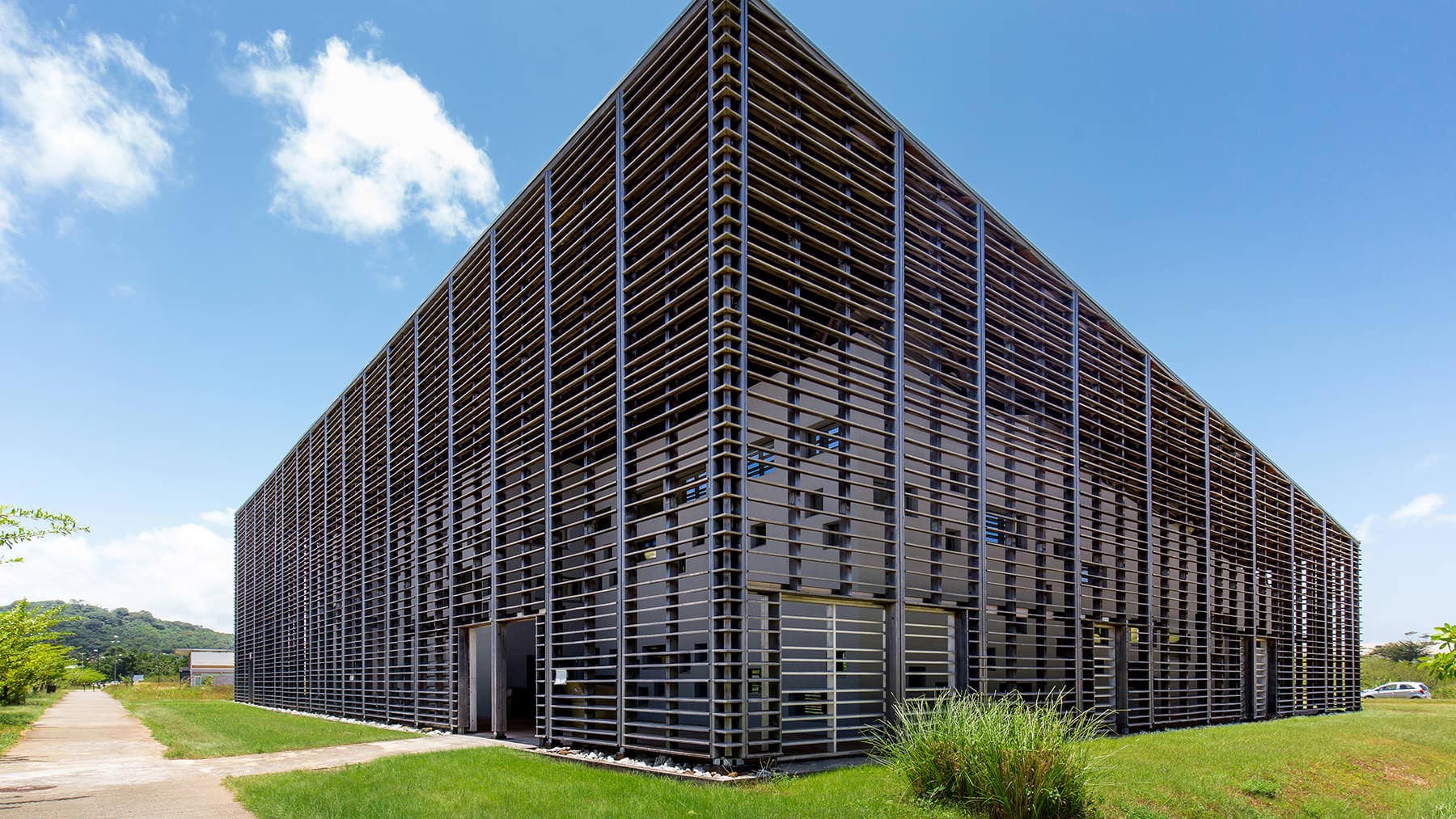
The administrative and main campus is Troubiran in Cayenne (BP 20792, 97337 Cayenne Cedex). Teaching is also delivered in Kourou, where the IUT is based, in Saint-Laurent-du-Maroni and in Saint-Georges de l'Oyapock, where a DAEU-A access diploma (literary and legal option) is offered. The 2026-2027 academic year opened on 2 September 2026 on the Cayenne and Kourou campuses.
Teaching is organised in departments of training and research (DFR) and institutes: Lettres et Sciences Humaines, Sciences et Technologies, Sciences Juridiques et Économiques, the Santé faculty (UFR Santé), the INSPÉ (teacher education institute) and the IUT de Kourou, together with the DFPU for continuing education and work-study programmes and Doctoral School 587. Degrees include licences in law, AES, LEA English-Spanish and English-Portuguese, LLCER English, mathematics, life and earth sciences, STAPS and engineering sciences (EEA), BUT programmes at Kourou, professional licences and university diplomas, and masters in law, economics, management, energy, civil engineering, computer science (ACAI), civilisations and interculturality, and teacher training (MEEF).
Research is built around the Amazonian setting. The AIBSI programme (Amazonian Institute of Biodiversity and Sustainable Innovation) focuses on sustainable food, global health and sustainable construction, and the ADUG project (2023 to 2033) is funded with 2,094,018 euros from the Agence Nationale de la Recherche to develop continuing professional education and fundraising through the university foundation, created in 2020.
Student life includes the university library (Tatou catalogue and digital collections), a language resource centre, the SUAPS sports service with gymnasiums and a fitness space, cultural activities, student associations and the FSDIE student initiatives fund. A student health service offers nursing, midwife, nutrition and free psychological consultations. The university does not run student housing on campus but helps newcomers find accommodation.
International students are welcomed through Erasmus+ (the university holds an Erasmus charter for 2021-2027), Campus France and the « Études en France » procedure. The university sits at the meeting point of the MERCOSUR, CARICOM and European Union zones and works with partners in Brazil, Suriname and elsewhere in the Americas, Europe and Africa, and participates in the Erasmus Mundus master TROPIMUNDO.
For 2026-2027 the national registration fees applied are 178 euros or 255 euros depending on the level. Students charged the differentiated fees of 2,902 euros or 3,950 euros are charged these provisionally and may request an exemption online through the student portal before 7 October 2026; once the commission has examined the request, the national fees of 178 euros or 255 euros apply. Enrolment stays active and students can attend classes while the decision is pending. Request page: univ-guyane.fr.
The Contribution de Vie Étudiante et de Campus (CVEC) is a separate national contribution payable by all students in initial education before administrative registration, at cvec.etudiant.gouv.fr. Scholarship holders and students on international mobility are among those exempt. The amount is set annually by the government.
The Fonds de Solidarité et de Développement des Initiatives Étudiantes funds student or staff projects for students, through the Appel à Idées (individuals or small groups) and the Appel à Projets (student associations based at the university). The first 2026-2027 campaign opened on 14 September 2026 with a deadline of 14 October 2026 (applications by email to [email protected]).
Students leaving on Erasmus+ (at least 60 ECTS validated and B1 in the language of instruction) receive individual support of 786 euros per month plus a travel allowance of 820 to 1,500 euros. Scholarship holders may also receive the AMI international mobility aid. Details: Partir à l'étranger.
The best applicants to the TROPIMUNDO master may receive an Erasmus Mundus scholarship covering tuition, travel and a monthly allowance. See TROPIMUNDO.
Browse the scholarships listed for Université de Guyane and check each award’s eligibility.
View scholarships for Université de Guyane →Applying is compulsory before registering, except for students already enrolled in the same course the previous year. First-year applicants (PASS, L1 and BUT 1) apply through Parcoursup. Applicants for L2, BUT 2, BUT 3, L3 and professional licences apply through eCandidat.
This procedure concerns applicants of foreign nationality, with a baccalaureate obtained outside the European Union, who have never been enrolled in a French university. Those residing outside the European Union apply through the Études en France (Campus France) procedure for entry to licence, master, BUT and continuing education, whatever the level. Those residing in French Guiana, the EU or countries not covered by Études en France follow the dedicated procedure for L1, and use eCandidat for L2, BUT 2 and Master 2 and Mon Master for Master 1.
Master 1 applications are made through Mon Master and Master 2 applications through eCandidat. Results of the 2026 application round were announced on the platforms by 3 July 2026 at the latest. A one-stop admissions assistance desk helps applicants create Parcoursup, Mon Master and eCandidat accounts and scan documents, at Building E, Troubiran campus (Tuesday to Friday 9am to 12pm, afternoons by appointment).
Once admitted, students pay the CVEC and obtain their certificate, complete the online administrative registration, upload supporting documents, then complete pedagogical registration and create their digital account. The final 2026-2027 registration campaign ran from 26 August to 15 September 2026; no registration is accepted outside the period or without the CVEC certificate. Payment must be made online.
The home university nominates the student (name, email, year of study, faculty and field). The Université de Guyane then contacts the student, who completes administrative and pedagogical registration on arrival. Required documents are the Learning Agreement, an information sheet, a complete registration file, an identity photograph and a valid passport copy.
The doctoral project begins by contacting a laboratory of the university or a partner laboratory of Doctoral School 587 to identify a thesis supervisor and define the subject. Candidates with foreign qualifications must provide a certificate of comparability of their diploma. Admission to first-year doctoral studies rests on an online application file, with the favourable opinion of the supervisor, any co-supervisor and the host laboratory director, and requires funding through employment, a doctoral contract or a CIFRE agreement. Administrative registration follows a favourable opinion of the restricted council of the Doctoral School and includes payment of fees and the CVEC. Funded thesis positions have included contracts financed by the ministry, by AIBSI and by CNES.
Facilities: university library with the Tatou catalogue and digital collections, language resource centre (CRL), gymnasiums and fitness space, student health service with psychological support, and digital services.
Experiences shared by students of Université de Guyane.
Studied here? Share your experience to help other applicants.

Book a free consultation with our expert counsellors and take the first step towards your dream university.
Copyrights © 2026 StudyMapped. All rights reserved.

Enter your credentials to continue.
Join us and start your study abroad journey.


