
University in France
Le Havre, Normandie, France
University profile
Université Le Havre Normandie (ULHN) is a public multidisciplinary university in the port city of Le Havre, in Normandy, France. It is a public scientific, cultural and professional institution (établissement public à caractère scientifique, culturel et professionnel), created administratively on 27 August 1984, and brings together a community of close to 10,000 people made up of academics, researchers, teachers, students and administrative, technical, library and health staff. Its academic offer covers more than one hundred degrees and qualifications from undergraduate to doctoral level, built around international openness and professionalisation.
The university is organised into five components. The UFR des Sciences et Techniques (created in 1970) combines the basic sciences with engineering sciences: mathematics, computing, physics, electrical engineering, mechanical engineering, civil engineering, chemistry and biology. The UFR Humanités & Sociétés covers letters, history, geography-planning-urbanism and sociology. The Faculté des Affaires Internationales (founded in 1972) teaches more than 2,100 students from over 20 nationalities across five departments (AES, economics and management; English; law; languages; Pôle International de Management), with 17 mentions and 28 parcours. The Institut Universitaire de Technologie (IUT) runs ten BUT specialities, and the Institut Supérieur d'Études Logistiques (ISEL), founded in 1994, is a public engineering school internal to the university, associated with the Polytech network since 2020 and delivering CTI-accredited engineering diplomas.
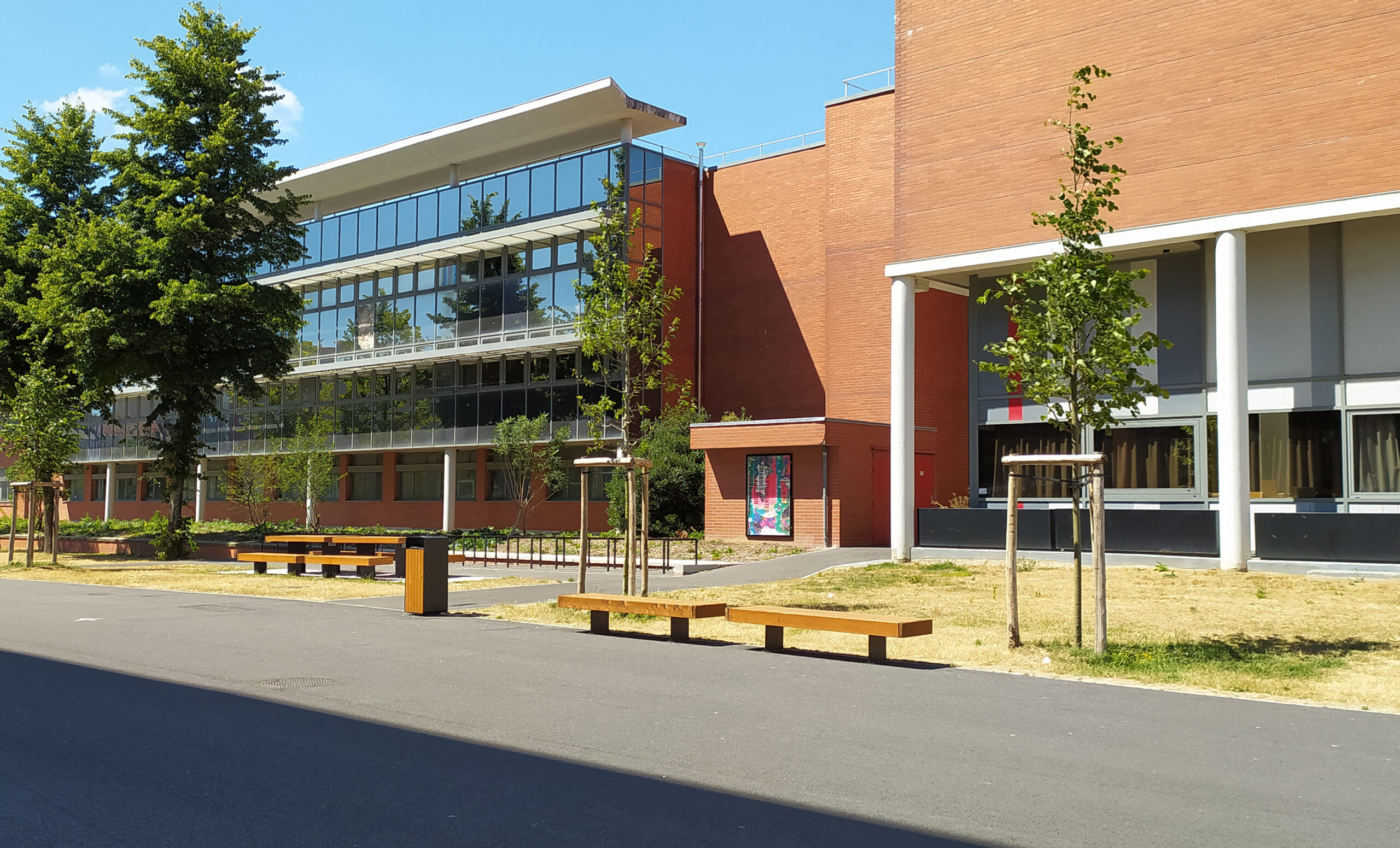
Teaching takes place on three university sites in Le Havre (Lebon, Caucriauville and Frissard), with ISEL tracks also on the Vernon and Puteaux campuses. The rebuilt city centre, designed by Auguste Perret, has been a UNESCO World Heritage site since 2005. The university inaugurated its Campus Polytechnique des Territoires Maritimes et Portuaires in January 2025.
The strategic project aims at student success and employment in the region, research in service of society and an open, sustainable environment, around three themes: maritime and port challenges, the city of tomorrow, and transitions, risks and hazards. The university is a founding member of Normandie Université and coordinates the EUNICoast European University alliance.
Student life and international students. The university has 174 partner higher-education institutions worldwide and students of 85 nationalities. Students can use the university libraries (BU Centrale and BU Caucriauville), a student health service staffed by a doctor and nurses on all three sites, the SUAPS sports service with weekly tournaments, a cultural service with free events and workshops, a social worker and a Culture Card. Housing is available in CROUS halls of residence and certified private accommodation through the AHLOET association. Degree-seeking international students apply individually; exchange students come through Erasmus+, EUNICoast, ISEP or bilateral agreements. Two programmes (Renewable Energy and Renewable Energy in Civil Engineering) are taught entirely in English.
Tuition at the university is set nationally as registration fees (droits d'inscription). For 2025/2026 the fees are 178 euros for a bachelor's degree, DUT, BUT, professional licence or engineering preparatory cycle, 254 euros for a Master and 628 euros for an engineering diploma. Non-EU students enrolling for the first time in 2025/2026 pay differentiated fees of 2,895 euros for a Licence, BUT, professional licence or engineering preparatory cycle and 3,941 euros for a Master or engineering diploma; non-EU students enrolled in 2024/2025 who request it may benefit from a partial exemption bringing their fees to the EU level, and some categories of student are not concerned by differentiated fees. The CVEC (contribution vie étudiante et de campus) is a separate contribution paid in addition to registration fees.
The French Eiffel programme attracts international Master and PhD students in science and technology and in the humanities and social sciences. Applications from the university go through the International Relations Department ([email protected]) as a single PDF (CV, cover letter or career plan, transcripts of the last three years with official translation if needed, and proof of class ranking); for the 2025 call the deadline was 14 November 2025. Candidates must be non-French nationals, aged at most 29 for a Master and 35 for a doctorate. Applications sent directly to Campus France are rejected.
Students on Erasmus+, EUNICoast, ISEP or bilateral agreements study at the university under their home institution's exchange arrangements; applications go to [email protected] before 30 April (first semester or full year) or 30 November (second semester).
Students may apply for CROUS student grants online, before receiving exam results, by 31 May; the CROUS provides an eligibility simulator and can be reached on 02 35 42 30 28. The university social worker can help with financial, administrative, food, health or housing difficulties (02 32 74 44 83, [email protected]). Housing aids such as the CAF allowances (APL, ALF, ALS), the Loca-Pass advance and the Visale guarantee are available to students renting privately.
Differentiated fees for non-EU students | International students and Eiffel programme | Scholarships and grants
Browse the scholarships listed for Le Havre Normandie Université and check each award’s eligibility.
View scholarships for Le Havre Normandie Université →First-year applicants (L1, BUT 1, ISEL preparatory cycle) apply through Parcoursup. Non-EU applicants living in a country covered by the Études en France procedure apply through the Études en France platform. Non-EU applicants living in another country apply for a first-year Licence through a Demande d'Admission Préalable (white file) with the French embassy of their country of residence; for a BUT 1 they use Parcoursup. Non-EU applicants already living in France and never enrolled in French higher education apply for a first-year Licence through a Demande d'Admission Préalable (green file) with the university of their first choice or the one nearest to their residence. Returning students re-register through apoweb.
Students enrolled in French higher education, European students and non-EU students living in a country outside the Études en France procedure apply through the eCandidat platform; non-EU applicants from Études en France countries must apply through the Études en France platform. Licences professionnelles generally require a Bac+2 (BTS, BUT or validated L2) and select on file.
Entry to Master 1 requires a French Bac+3 diploma or equivalent. Applicants enrolled in French higher education, and European or non-EU applicants living outside the Études en France procedure, apply through Mon Master; non-EU applicants living in an Études en France country must apply through the Études en France platform. Entry to Master 2 is by right for students who validated Master 1 of the same programme at the university; otherwise it requires a French Master 1 or equivalent (Bac+4) and an application through eCandidat or Études en France. Programmes select on file and often by interview; some require a stated English level (for example B2 for the Master Droit international des affaires, TOEIC 750 or equivalent for the Renewable Energy Master 2) or French at DELF B2 / DALF or TCF B2/C1 (Master Tourisme).
The ISEL preparatory cycle recruits after the baccalauréat on Parcoursup: general baccalauréat holders with mathematics and a scientific specialty enter through the Geipi Polytech competitive exam, while mixed-profile general baccalauréat and STI2D holders are selected on file. Entry to the engineering cycle is automatic for ISEL preparatory-cycle graduates, through e3a-Polytech for CPGE MP, PC, PSI and MPI students, and by competition on file and interview through eCandidat for other CPGE, BUT or Licence profiles. Études en France candidates follow a separate calendar.
A doctoral student must be affiliated with a research laboratory and registered with an institution. Registration is decided by the head of the institution on the proposal of the doctoral school director, after the opinion of the thesis supervisor and the director of the research unit, on the basis of a registration proposal file. Eight doctoral schools are attached to the university.
Most Licence and Master programmes are taught in French; the Renewable Energy (REN) and Renewable Energy in Civil Engineering (RECEng) Master 2 programmes are taught entirely in English. Exchange students must be pre-selected by their home institution under an Erasmus+, EUNICoast, ISEP or bilateral agreement and send an application form, learning agreement and supporting documents to the International Relations Department ([email protected]) before 30 April for the first semester or the full year and before 30 November for the second semester.
Facilities include the BU Centrale and BU Caucriauville libraries, computer rooms and digital spaces, a student health service, the SUAPS sports service, cultural programming and CROUS-managed residences in Le Havre.
Study programmes offered at Le Havre Normandie Université.
Experiences shared by students of Le Havre Normandie Université.
Studied here? Share your experience to help other applicants.

Book a free consultation with our expert counsellors and take the first step towards your dream university.
Copyrights © 2026 StudyMapped. All rights reserved.

Enter your credentials to continue.
Join us and start your study abroad journey.


