
University in Germany
Köln, Nordrhein-Westfalen, Germany
University profile
The German Sport University Cologne (Deutsche Sporthochschule Köln, known as Spoho or GSU) is Germany's only university dedicated to sport. Where sport science is usually one sub-discipline at other universities, here it is the centre of research and teaching. The university was founded in 1947 and today has more than 6,000 students from over 85 countries and around 1,000 staff members.
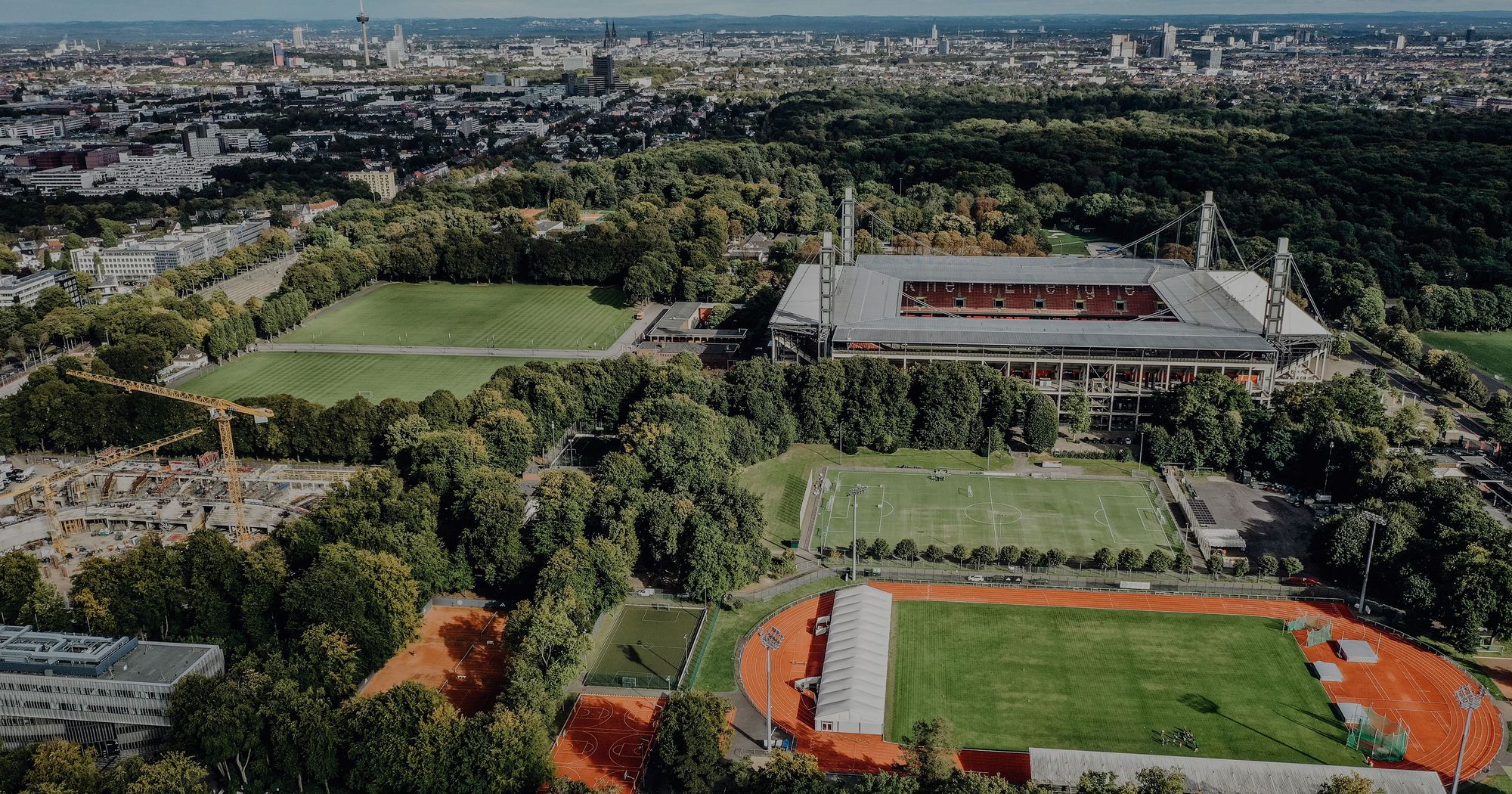
The campus lies in the Müngersdorf district in the west of Cologne, within the Müngersdorf Sports Park and the city's outer green belt, next to the RheinEnergieStadion. The campus area is around 187,000 square metres, of which roughly 61,000 square metres are sports facilities, and the compact layout keeps lecture theatres, laboratories and training areas a few steps apart.
Teaching and research are organised through 19 academic institutes, four affiliated institutes and five transfer centres rather than faculties. The institutes cover movement therapy and prevention, movement and neurosciences, gerontology, biochemistry, biomechanics and orthopaedics, cardiology and sports medicine, psychology, sociology and gender studies, sport history, sport law, sport economics and management, communication and media research, outdoor sports and environmental science, pedagogy and philosophy, sport didactics, European sport development and leisure studies, dance and movement culture, and exercise training and sport informatics.
The range of study includes five Bachelor's programmes in sport science (Sports Science and Performance; Sport and Health in Prevention and Therapy; Sports Management and Sports Communication; Sports Journalism; Teaching Sport and Physical Activity in Leisure and Grassroots Sport), teacher training in Physical Education for five school types, eight consecutive Master's programmes (four taught in English and four in German), Master of Advanced Studies programmes, doctoral studies and continuing education.
Student life centres on the campus. Four halls of residence (A to D) with 77 accommodation units sit beside the canteen, which is run by the Cologne Student Union, and the Wohnturm tower run by the Cologne Student Services Organisation (357 places) is on the campus and is being refurbished. The general university sports programme, together with the University of Cologne under the UniSport umbrella, offers around 500 hours of university sport per week close to the campus across more than 120 sports and activities. The International Office advises international and exchange students, and the university has more than 60 partner universities for exchange.
The university is a state higher education institution under the North Rhine-Westphalia Higher Education Act, and its Bachelor's programmes are subject to admission restrictions with a physical aptitude test.
The Semesterbeitrag (semester contribution) is not tuition. For winter semester 2026/27 it is 353.30 euros: 110.00 euros for the Cologne Student Services Organisation (KStW) and 243.30 euros for student self-administration, which includes the Deutschland-Semesterticket (226.80 euros), AStA costs (14.00 euros), student sport (1.00 euro) and administration of tickets and exemptions (1.50 euros). A late re-registration fee of 10.00 euros applies. See the re-registration page.
The university has taken part since 2011. For every 1,800 euros raised from private donors, the Federal Ministry of Education and Research matches the amount; a scholarship pays 300 euros per month for at least one year. A seven-member jury selects students with strong academic or school performance and potential such as social engagement, including competitive athletes, students with chronic illness or disability, students with family obligations, students with an immigrant background and those from lower socioeconomic backgrounds. Applications run in the summer (13 July to 6 September in the latest round) through an online form and a document upload link. See Deutschlandstipendium.
Together with the Sportstiftung NRW, the university supports female federal junior squad athletes studying at Spoho with 300 euros per month over two semesters. See NRW-Sportstiftungs-Stipendium.
The university points students to BAföG, the German National Academic Foundation (self-application in the first or second semester, or professor nomination from the third semester for the top 10 per cent of a year group), the other recognised foundations for gifted students, the Hildegardis-Verein loans for women and KfW student loans of up to 650 euros monthly. For doctoral candidates, funding routes are a university staff position, external employment or a PhD scholarship, and internal research funding (HIFF) is available. See funding for studies.
Browse the scholarships listed for German Sport University Cologne and check each award’s eligibility.
View scholarships for German Sport University Cologne →Applicants need a recognised university entrance qualification, usually the German Abitur or an equivalent school-leaving certificate that qualifies for university study in the home country. Recognition follows the guidelines of the Conference of Ministers of Education (KMK) and the Central Office for Foreign Education (ZAB). The Fachabitur is generally not sufficient. International applicants apply in the same way as German nationals, and documents not in German or English must be uploaded in the original with a certified translation. Admission is restricted, and the exact Abitur mark required (the NC mark) is only known after the process ends.
All five Bachelor's programmes in sport science and the teacher training programmes require a passed physical aptitude test, valid for three years. It comprises 19 tests across athletics, gymnastics, swimming, team sports, racket sports and endurance; 17 of the 19 must be passed, with no more than one shortfall per sport, and the endurance run must be completed in the set time. Registration is online with a medical certificate, a photograph and an aptitude test fee of 60 euros. The test is usually held twice a year; in May 2026, 583 of 960 participants passed.
Application periods for Bachelor's and teacher education programmes are 1 June to 15 July for the winter semester and 1 December to 15 January for the summer semester, made online through the mySpoho portal.
German-taught programmes require C1: DSH-2, TestDaF (minimum TDN 4) or telc C1 Hochschule, valid for two years and submitted with the application. No certificate is needed with a German-language entrance qualification, a pass in the Studienkolleg assessment exam, the German Language Diploma (DSD II), education completed in Germany, or for applicants from Luxembourg, Austria, Switzerland and the German-speaking Community of Belgium.
Consecutive Master's programmes (M.Sc. and M.A., four semesters) start in the winter semester only. Applicants need a relevant academic Bachelor's degree of at least six semesters or a first professional qualification, with the degree certificate and transcript of records (certified translations if not in German or English) showing the final grade, GPA or credits and the grading scale. Spoho converts the grade to the German system, and the final grade should not be lower than German 2.5. A CV and letter of motivation covering interest in the programme, reasons and medium-term career goals are uploaded in the programme language. The physical aptitude test is not required.
Application periods: 25 April to 31 May for non-EU applicants (all documents must be uploaded by the deadline) and 1 June to 15 July for EU applicants (degree documents and language proof may follow by 31 August). Applications go through mySpoho.
English-taught Master's programmes (Sport Management, Human Technology in Sports and Medicine, Psychology in Sport and Exercise, International Sport Development and Politics) require C1: TOEFL iBT at least 95, IELTS Academic at least 7.0, or Cambridge Certificate C1. Best Score and One Skill Retake results are not accepted. Native speakers and graduates of fully English-taught Bachelor's programmes in an EU member state or an English-speaking country are exempt with a signed letter or proof of the language of instruction. German-taught Master's programmes require DSH-2, TestDaF TN4 or telc C1 Hochschule, no more than two years old.
Applicants need a degree qualifying for doctoral study of at least eight semesters in total (Diploma, Magister or Master's), with the degree and thesis both graded at least good. A supervisor is required: all professors and Privatdozent*innen may supervise, and applicants contact them with a CV and research proposal. Applications may be made at any time online via mySpoho, followed by signed forms and certified degree certificates sent to the Doctoral Office. All candidates complete the doctoral study programme (170 working units) alongside the dissertation under the doctoral regulations (Promotionsordnung).
After admission, enrolment is online through mySpoho within the deadline in the admission notice, with the entrance qualification, German proof for international applicants and, for Master's applicants, the degree certificate and any English proof. Non-EU nationals should check visa requirements with their German embassy.
The university has a single campus in the Müngersdorf district of Cologne (Am Sportpark Müngersdorf 6, 50933 Cologne), in the Müngersdorf Sports Park next to the RheinEnergieStadion and the Stadtwald.
Experiences shared by students of German Sport University Cologne.
Studied here? Share your experience to help other applicants.

Book a free consultation with our expert counsellors and take the first step towards your dream university.
Copyrights © 2026 StudyMapped. All rights reserved.

Enter your credentials to continue.
Join us and start your study abroad journey.


