
University in United Kingdom
Leicester, England, United Kingdom
University profile
De Montfort University (DMU) is a public university in the centre of Leicester, England. It traces its origins to the Leicester School of Art, founded in 1870, and took its present name in 1992, when Leicester Polytechnic was awarded university status. The name commemorates Simon de Montfort, Earl of Leicester. DMU teaches most courses through block teaching, in which students study one module at a time with regular assessment rather than end-of-year examinations, and every graduate is guaranteed an offer of employment.
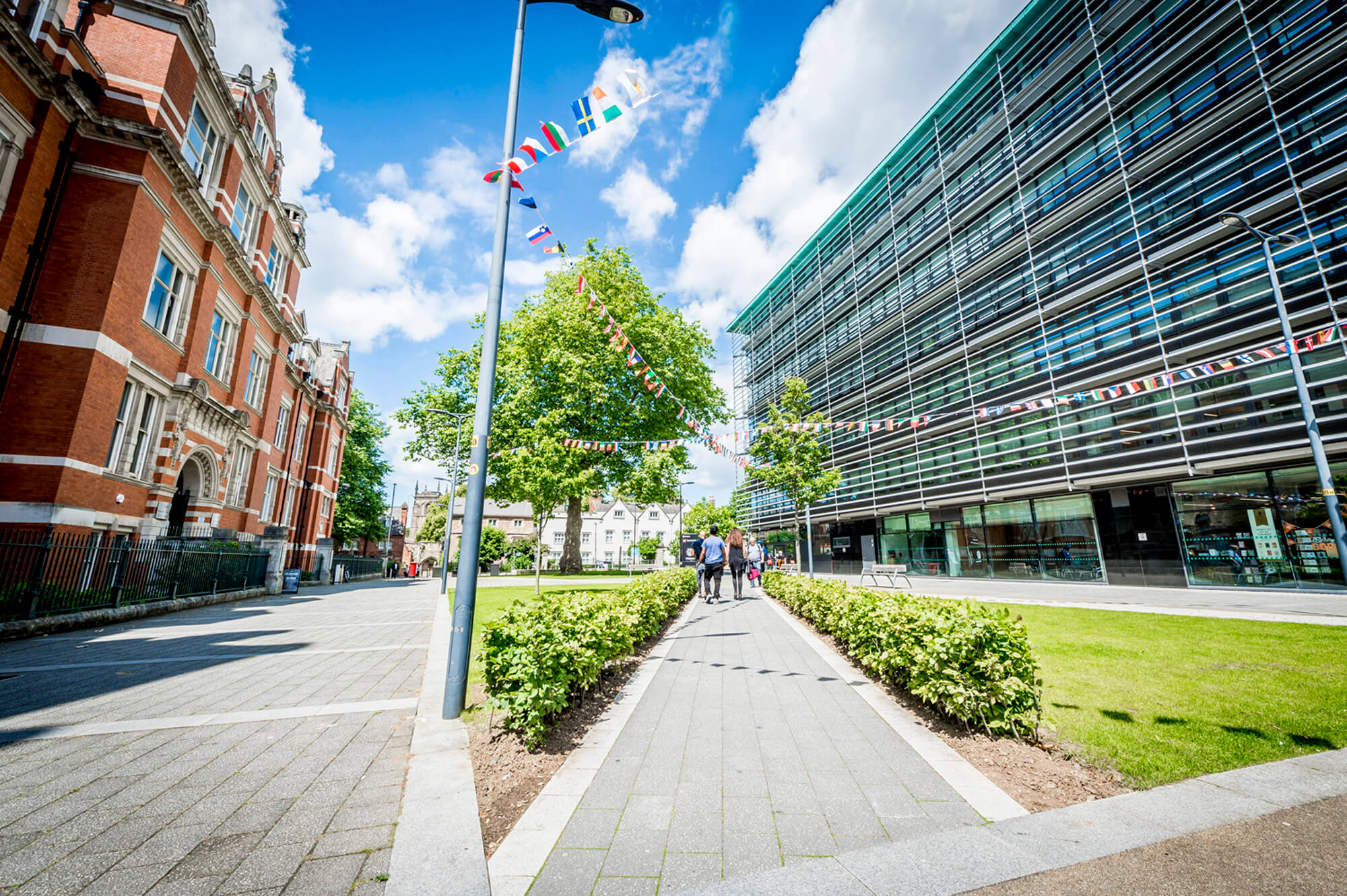
The main campus sits in Leicester city centre around the Newarke and Gateway area, combining historic buildings such as the Hawthorn Building, Trinity House and the Great Hall of Leicester Castle with newer buildings including the Hugh Aston Building, the Vijay Patel Building and the Queen's Building. DMU also runs DMU London, a Zone 1 campus in Whitechapel offering business, finance and computing degrees taught over two fixed days a week, and DMU Dubai in Dubai Internet City, which offers foundation, undergraduate and postgraduate courses.
Teaching is organised in three faculties:
Long-standing strengths reflect the institution's roots in training for Leicester's industries: art and design, pharmacy (the Leicester School of Pharmacy dates from 1909), fashion and Contour Fashion (begun as the School of Corsetry in 1947), footwear, architecture and computing, which has been taught since 1958. DMU holds the United Nations role of lead university for Sustainable Development Goal 11, Sustainable Cities and Communities, appointed in 2025 for three years.
First-year students are guaranteed accommodation, with around 1,000 beds in halls a short walk from campus, including the DMU-managed Bede Hall and New Wharf Hall. Sport and fitness are based at the QEII Leisure Centre, the Watershed and Beaumont Park, and the Kimberlin Library is the main library. International students come from more than 130 countries; the Centre for English Language Learning, accredited by the British Council, runs pre-sessional English courses. DMU holds a Silver rating in the Teaching Excellence Framework.
For UK home students starting in September 2026, full-time undergraduate fees are £9,790 a year for BA, BEng, BSc, MEng and MPharm degrees; £5,760 for classroom-based Year Zero and Foundation Years; £6,525 for HNDs and foundation degrees; £1,955 for a placement year; and £1,465 for a full study abroad year. Part-time home fees for 2026/27 are £7,335 a year (four-year course), £4,890 (six-year course) and £2,445 per 30 credits. For 2027/28 the standard full-time undergraduate fee is £10,050. International undergraduate fees range from £17,600 to £18,600 a year; international postgraduate fees range from £8,496 to £20,900 (Business and Law), £18,300 to £19,600 (Technology, Arts and Culture) and £7,800 to £21,000 (Health and Life Sciences). See undergraduate tuition fees and international tuition fees.
Students from countries on the UKVI Differential Evidence Requirement list pay a minimum £4,000 pre-CAS deposit; others pay at least 50% of the first-year net tuition fee. Students from Nepal, Sri Lanka and Nigeria, and from Punjab, Uttar Pradesh and Gujarat in India, pay the full first-year fee minus any DMU scholarship. Remaining 2026/27 fees can be paid in two instalments, in November 2026 and January 2027. After a genuine visa refusal, fees are normally refunded less a £500 administration fee.
International students starting full-time undergraduate or postgraduate taught study in October 2026 or February 2027 are automatically awarded the scholarship if they pay their deposit before the deposit deadline: £2,000 for each year of undergraduate study, and £3,000 off postgraduate taught fees (£3,500 for the Global MBA). A further £500 full-fee payment discount applies in the first year to students who pay their full net fees before the deposit deadline. Global Access Scholarship.
Worth £8,500 towards first-year tuition fees for undergraduate and postgraduate taught applicants who are nationals of Canada, Chile, Indonesia, Malaysia, Mexico, Peru, Singapore, South Korea, Taiwan, Thailand or the USA (MPharm excluded). Applicants must hold a DMU offer, apply through the scholarship form and pay a £4,000 deposit within 10 days of the confirmation letter. Awards are made on a rolling basis. Empowering Excellence Scholarship.
Eligible EU students pay reduced fees of £12,000 a year for undergraduate or £13,000 for postgraduate study from 2026 (EU Access Scholarship), and £11,950 or £12,950 from 2027 (Europe Access Scholarship). International scholarships.
The Postgraduate Alumni Scholarship gives DMU graduates a 20% tuition fee discount, and the Leicester Postgraduate Partnership with the University of Leicester gives graduates a 20% discount on selected postgraduate taught courses. Funded PhD scholarships cover tuition fees and a living stipend.
UK undergraduates can apply for government Tuition Fee and Maintenance Loans; for courses starting in September 2027 this is through the Lifelong Learning Entitlement. Enquiries go to the Transitions team ([email protected]) or [email protected]. Scholarships and bursaries.
Empowering Excellence Scholarship →
Europe Access Scholarship (2027/28) →
Browse the scholarships listed for De Montfort University and check each award’s eligibility.
View scholarships for De Montfort University →Applications for full-time undergraduate courses are made through UCAS (institution code DEM, D26). Applicants choose a course, register on UCAS Hub, complete the form with a personal statement and reference, and submit by 14 January for equal consideration. The UCAS fee is £20 for a single choice and £26 for two to five choices. Offers are usually made using UCAS Tariff points from passes in at least two A levels or equivalent qualifications such as BTEC, IB and OCR Nationals; most undergraduate degrees require at least 104 UCAS Tariff points, and HND and foundation degree courses at least 48 points from at least one A level. Applicants normally need five GCSEs at grade C/4 or above including English and, where specified, Maths; some courses ask for six GCSEs or specific subjects at grade B/6. Course pages set the exact offer. Creative courses may require a portfolio.
Eligible applicants automatically receive a contextual offer with a reduction of one to two grades (for example BBC instead of a standard BBB). Eligibility covers free school meal recipients, care leavers, applicants from low-participation areas (POLAR or IMD quintiles 1 and 2), service children, estranged students, refugees and asylum seekers, young parents, and completers of the DMU Aspire Progression Programme or qualifying IntoUniversity courses. Mature applicants, usually aged 21 or over, with five or more years of relevant industry experience may be considered on individual merit.
Foundation-level entry includes the Art and Design Foundation Diploma (applied for directly through the DMU Online Portal), Engineering Year Zero and Year Zero Laboratory Sciences courses integrated with Biomedical Science, Medical Science, Pharmaceutical and Cosmetic Sciences, and Forensic Science.
International applicants can apply directly through the DMU Online Portal, through a contracted agent in their region, or through UCAS. Country-by-country entry criteria set out accepted school qualifications; where a national school-leaving certificate is not accepted for direct entry, applicants need one year of a bachelor's degree or a recognised foundation programme. Entry to year 2 or 3 may be possible and is assessed case by case. Applications need transcripts, a personal statement of about 500 words, English language evidence, a reference from an official email address and a passport copy. Undergraduate applicants with a two-year education gap, and postgraduate applicants with a five-year gap, must complete an Enhanced Personal Statement.
Applicants whose first language is not English need IELTS or an equivalent. Typical undergraduate requirements are IELTS 6.0 for Art and Design, Business, Computing and Engineering; 6.5 for Law; 6.0 to 6.5 for Humanities and Media; and 6.5 to 7.5 for Science. Typical postgraduate requirements are IELTS 6.0 for Business and Computing; 6.0 to 6.5 for Art, Design and Engineering; and 6.5 for Humanities, Media, Law and Science. Equivalent scores are accepted from PTE Academic (61 overall with no component below 59 for IELTS 6.5), TOEFL (79 overall for IELTS 6.5), Duolingo (120 overall for IELTS 6.5), LanguageCert Academic, Oxford ELLT and qualifications such as GCSE or IGCSE English at grade C. The Centre for English Language Learning offers pre-sessional English courses.
Applicants new to DMU apply through the DMU Online Portal; current students and graduates since 2015 apply through DMU Hub using the New Course Application tile. Applications include transcripts and certificates, a personal statement (with GPhC number for pharmacy courses), a reference where required and a portfolio for some creative courses. Entry requirements vary by course, typically a 2:1 or 2:2 honours degree or international equivalent. Some engineering MSc courses, such as Mechanical Engineering and Aeronautical Engineering, require an ATAS certificate.
Research degree applicants need a UK honours degree with at least an upper second (2:1), a master's degree, or an equivalent qualification plus sector experience, and must show competence in English. Self-funded applicants contact a potential supervisor before applying, submit a research proposal, certificates and transcripts and two academic references, and apply through the Admissions Portal. Intakes run in October, January and April; the MA/MSc by Research has one October intake.
Applications are usually answered within five working days. International students must normally pass a credibility assessment interview before a Confirmation of Acceptance for Studies (CAS) is issued, unless their country is on the UKVI Differential Evidence Requirement list, and must pay a pre-CAS tuition deposit. For the October 2026 intake the application deadline was 31 July, the CAS issuance deadline 27 August and teaching began on 5 October. Registration is completed online and then in person on campus after arrival.
Facilities. Halls of residence near the Leicester campus include the DMU-owned or managed Bede Hall and New Wharf Hall and the privately owned Castle Court, Liberty Park, Newarke Point, The Glassworks and The Grange, priced from £95 to £165 per week, all self-catered with bills included. Sport and leisure facilities comprise the QEII Leisure Centre, the Watershed and Beaumont Park. Other facilities include the Kimberlin Library, specialist laboratories and studios, a commercial flight simulator and the Digital Tech Learning Hub, The Venue @ DMU, and the Centre for English Language Learning.
Study programmes offered at De Montfort University.
Experiences shared by students of De Montfort University.
Studied here? Share your experience to help other applicants.

Book a free consultation with our expert counsellors and take the first step towards your dream university.
Copyrights © 2026 StudyMapped. All rights reserved.

Enter your credentials to continue.
Join us and start your study abroad journey.


