
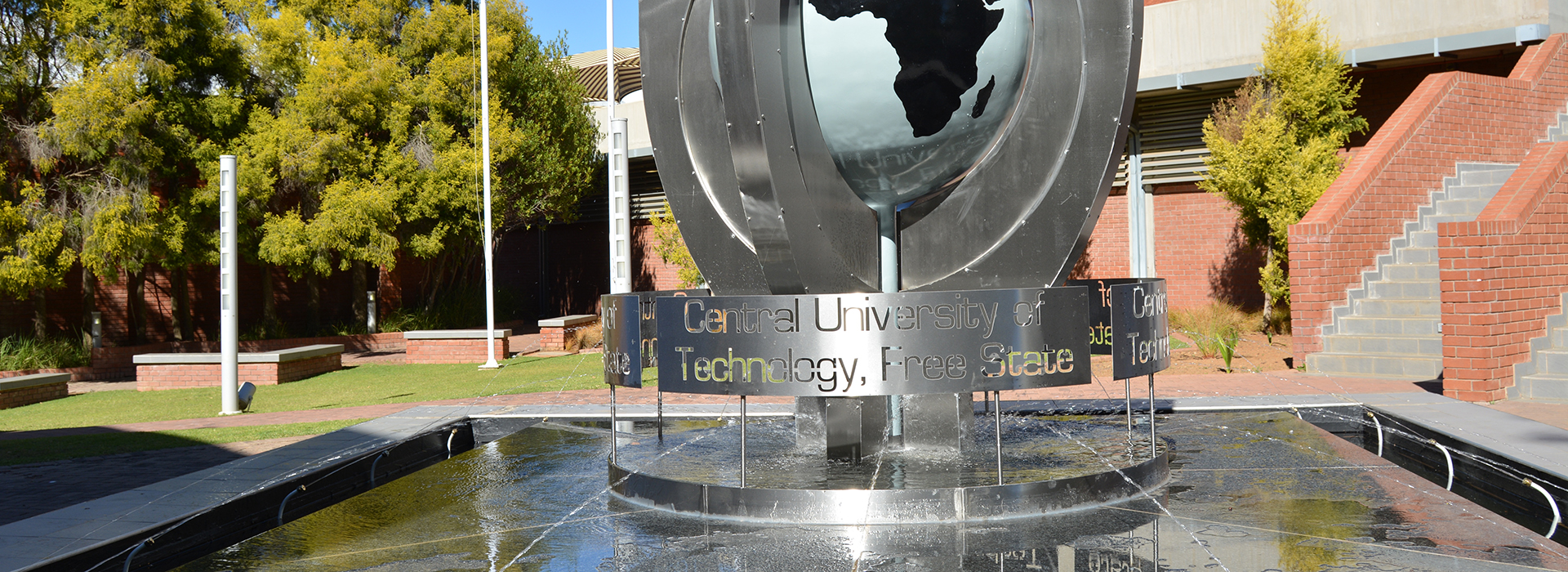

University in South Africa
Bloemfontein, Free State, South Africa
University profile
The Central University of Technology, Free State (CUT) is a university of technology in the heartland of South Africa. Its main seat is in Bloemfontein, the judicial capital, with a second campus in Welkom, about 160 kilometres north-east in the Free State goldfields. It was formed in January 2004 when Technikon Free State and the Welkom campus of Vista University merged. Its strategic direction is Vision 2030.
As a university of technology, CUT delivers technology (STEM) and workplace-focused programmes, makes Work-Integrated Learning (WIL) compulsory and does applied research. Qualifications run from certificates and diplomas to advanced diplomas, postgraduate diplomas, master's and doctoral degrees.
Study is organised in four faculties: Health and Environmental Sciences, Humanities, Engineering, Built Environment and Information Technology, and Management Sciences. Departments include Life Sciences, Health Sciences, Clinical Sciences and Agriculture; Communication Sciences, Design and Studio Art and the education departments; Built Environment, Civil, Electrical, Electronic and Computer, and Mechanical and Mechatronic Engineering, Information Technology and Mathematical and Physical Sciences; and Accounting and Auditing, Business Management, Business Support Studies, Government Management, Hospitality Management and Tourism and Event Management, plus an Entrepreneurship Development Unit.
Notable research strengths include the Centre for Rapid Prototyping and Manufacturing (CRPM), a pioneer of additive manufacturing (3D printing) in Africa, which received ISO 13485 certification for 3D printing of medical devices; the Centre for Quality of Health and Living; and the Centre for Applied Food Security and Biotechnology. The Product Development Technology Station, Centre for Sustainable Smart Cities, Research Centre on Human-Technology Interaction, Centre for Diversity in Higher Education Research and Centre for Enterprise and Entrepreneurship Studies are also listed.
Student life includes about 2 000 on-campus residence beds, a Wellness Centre with free counselling, social work, chaplaincy and a Medical Centre, libraries on both campuses, and sport including athletics, rugby, soccer, netball, cheerleading, volleyball, boccia and e-sports; CUT teams enter competitions such as the FNB Varsity Cup. Engineering Technology programmes are ECSA-accredited, and construction and quantity surveying programmes are accredited by SACPCMP and SACQSP.
CUT lists academic merit bursaries for first-year students entering full-time diploma or degree study after Grade 12, calculated on the six highest final symbols, with criteria and amounts reviewed annually. Academic recruitment bursaries are considered automatically for qualifying first-years: Category A pays R1 000 per A symbol on Higher Grade and R600 per A symbol on Standard Grade; Category B pays R1 000 to a student with an A symbol in Engineering or Health and Environmental Sciences; Category C (Top-Ten) goes to the ten best first-year entrants with at least 42 points on the CUT scale.
Leadership bursaries require at least 27 points and a qualifying role such as head boy or girl, chairperson or vice-chairperson of the learner representative council, hostel head, national subject Olympiad or expo winner, or Presidentverkenners or Springbok Scouts member. Sport recruitment bursaries reward promising sportspeople who compete in a league sport in the name of CUT at provincial level or higher; development bursaries are available for up to 3 nominated candidates. Apply annually; the closing date is 31 October, with forms from Operational Sport.
CUT points Teacher Education students to the DHET Funza Lushaka merit bursary, presently worth R48 000 per annum, applied for online at the DHET website. The page also lists NSFAS, SETAs mapped to its faculties, NRF, science councils, loans and bursary portals as external options; CUT guides and verifies donor funding but these are managed by the funders.
On 27 May 2026 CUT launched a scholarship initiative for financially vulnerable students with the SRC, and the event hosted bursary providers including W&RSETA, ETDP SETA, NTCSA, the MQA and HWSETA.
NSFAS and most South African bursaries fund South African citizens only; CUT advises international students to seek home-country, government and international awards, and postgraduate applicants to ask faculties about funded research projects.
Official pages: Fees, Bursaries and Loans, Tuition, International students.
CUT Academic Merit Bursary (First-Year) →
Browse the scholarships listed for Central University of Technology, Free State and check each award’s eligibility.
View scholarships for Central University of Technology, Free State →CUT explains three pass types. A certificate pass leads to a higher certificate. A diploma pass requires passing 6 of 7 subjects, four of them at 40% (level 3) or better, including the home language at 40% and 30% in the language of learning and teaching (LOLT), excluding Life Orientation. A bachelor's pass requires passing 6 of 7 subjects, four at 50% (level 4) or better excluding Life Orientation, home language at 40% and 30% in the LOLT.
Applicants need at least 27 points on the CUT scoring scale, subject to the requirements of the chosen programme. Scale: 30-39% = 2, 40-49% = 3, 50-59% = 4, 60-69% = 5, 70-79% = 6, 80-89% = 7, 90-100% = 8. Life Orientation counts for a maximum of 1 point and at least level 4 (50-59%) is required in it. A score of 21 or less is not admitted; 22 to 26 points requires a selection test.
English is the language of learning and teaching. A mark of 50% in English Home Language or First Additional Language is considered sufficient, and other proof of proficiency is also considered. All applicants must write the National Benchmark Tests (NBT) and are advised to book well in advance at the NBT website. Applicants may also be asked to attend an interview, selection test or written presentation. First-year students write the Academic Language Proficiency (ALP) test, and those needing support complete the Academic Literacy and Communication Studies module.
You cannot apply directly for an ECP: apply for the standard programme and CUT may channel you into the ECP, which adds one year to the qualification. ECP streams are listed for IT, Computer Networking, Construction Management, Quantity Surveying, Somatology, Clinical Technology, Medical Laboratory Science, Radiography, Environmental Health, Design and Studio Art, Hospitality Management, Accountancy and Internal Auditing.
CUT accepts a Grade 12 certificate or equivalent but may exempt a person on the outcome of an individual Recognition of Prior Learning (RPL) assessment. RPL applicants must first seek guidance from Academic Structure and Enrolment Services or a Head of Department, complete the RPL form and submit a portfolio of evidence in person; the faculty RPL committee meets monthly. Applicants not selected may be reconsidered at a later selection opportunity.
Foreign applicants complete the application for international students and are assessed under the same regulations when qualifications are considered equivalent by SAQA. For certificates and diplomas no SAQA evaluation or USAf exemption is required and the APS conversion table is used. For first degrees a USAf certificate of exemption is required. Postgraduate applicants need a SAQA evaluation and should contact the Head of Department or Assistant Dean to discuss their research proposal. Upload certified copies of qualifications, your passport and the SAQA certificate where applicable. A South African study visa, valid medical insurance and proof of funds are required; the Centre for Global Engagement issues support letters. International students pay a registration fee, an international administration fee and a tuition deposit at registration; amounts are in the financial registration guidelines.
Advanced diplomas, honours and postgraduate diplomas (NQF 7-8) follow the standard admission cycle. Master's and doctoral research applicants must first contact the faculty Assistant Dean: Research, Innovation and Engagement or the Head of Department to refine a proposal and identify a supervisor. Applicants not recently in study may be invited to an interview, test or written presentation, and offers are made in writing.
Applications are made online through the CUT portal for new, returning and continuing students; a first and second programme choice must be selected. For the 2027 cycle, applications for undergraduate, advanced diploma, honours and structured master's programmes closed on 30 September 2026; research master's and doctoral applications close at the end of March. No late or walk-in applications are accepted. Current matriculants upload final Grade 11 or Grade 12 June results; certified copies must be certified within the last 3 months. CUT states there is no application fee and no authorised external consultants. Tuition may be paid in monthly instalments (nine months for year students; four months per semester), a 10% discount applies if fees are paid in full upon registration, and family household discounts of 15% (second student) and 25% (third and fourth students) are published.
CUT operates as one institution; specialised academic and administrative functions are shared across both campuses.
Study programmes offered at Central University of Technology, Free State.
Experiences shared by students of Central University of Technology, Free State.
Studied here? Share your experience to help other applicants.

Book a free consultation with our expert counsellors and take the first step towards your dream university.
Copyrights © 2026 StudyMapped. All rights reserved.

Enter your credentials to continue.
Join us and start your study abroad journey.


