
University in Canada
Sydney, Nova Scotia, Canada
University profile
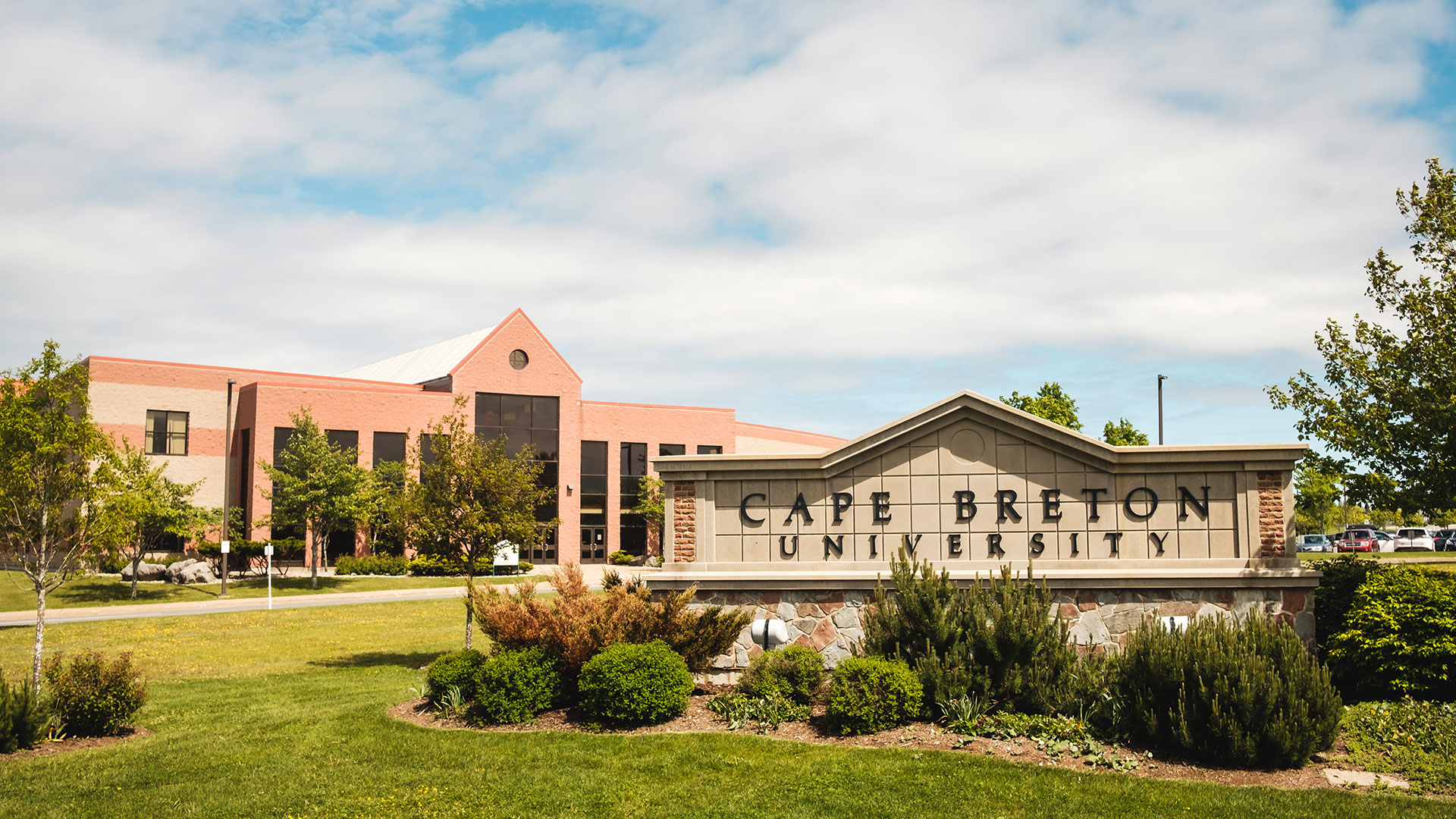
Cape Breton University (CBU) is a public university at 1250 Grand Lake Road, Sydney, on Cape Breton Island, Nova Scotia, located in Mi'kma'ki, the ancestral and unceded territory of the Mi'kmaw people. It serves nearly 7,000 students from more than 70 countries and offers liberal arts, science, business, health and professional programs, with a stated emphasis on experiential learning and undergraduate research.
Academic work is organised in five schools: the School of Arts and Social Sciences, the School of Education and Health, the School of Nursing, the School of Science and Technology and the Shannon School of Business. Programs are grouped into eight fields: Arts, Social Sciences and Culture; Business; Community Economic Development; Education; Engineering and Technology; Health and Well-Being; Nursing; and Sciences. Degrees include the BA, BBA, BSc, Bachelor of Science in Nursing, Bachelor of Education, Bachelor of Social Work, Bachelor of Hospitality and Tourism Management and Bachelor of Engineering Technology, with graduate programs including the MBA in Community Economic Development, Master of Artificial Intelligence and Business Analytics, Master of Digital Marketing, Master of Healthcare Leadership and Innovation, and Master of Education programs in Curriculum, Teaching and Learning and in Holistic School Health and Well-Being.
Indigenous initiatives are led through Unama'ki College. Dedicated awards support Indigenous students, African Nova Scotian students and former Nova Scotia youth in care. The Beaton Institute is the archive for Cape Breton Island's historical records, and the campus hosts the Boardmore Playhouse, the CBU Art Gallery and the annual Ovation creative arts festival. Student recreation includes drop-in sport, intramural leagues, club sports and outdoor activities, and varsity teams compete as the Capers.
International students make up a large part of the community, and International Student Services runs from the Marvin Harvey building with arrival advising, orientation, regulated immigration advisors, help registering for provincial medical coverage (MSI) and English Academic Preparation through the Cape Breton Language Centre. The university lists housing options on campus (residence and meal plans) and off campus.
About $2.6 million a year goes to incoming students in scholarships and bursaries. Students entering directly from high school are considered on academic grades, based on the five required Grade 11 courses (no failures in Grade 11); an official transcript must accompany the application. Awards range from $500 to $5,000 per year, and accepted students can apply until March 1. Major entrance scholarships (limited number): Chancellor's $30,000 total ($7,500 a year), President's $20,000 ($5,000), Deans' $10,000 ($2,500), Fitzgerald $20,000 ($5,000), Schwartz $14,000 ($3,500) and W.M. Reid $11,500. Many named donor awards are also offered, including the MacLeod-Matheson Bursaries, Wanda Robson Scholarships and Harrison McCain Scholarship/Bursary. Transfer students may receive renewable scholarships up to $5,000 and entrance scholarships up to $1,000 with full-time registration.
Students without a renewable scholarship who complete at least 9 credits with an overall average of 80% or higher in a fall or winter term receive $500 (15 credits), $400 (12 credits) or $300 (9 credits) automatically, with no application. Not available to B.Ed., BSW or MBA students.
Need-based entrance bursaries open in January and close in March; in-course bursaries open each November. Applicants complete the Entrance or In-Course Bursary Form and provide income tax assessments. An International Student Bursary is available to Nova Scotia high-school graduates: 5 renewable bursaries equal to the international differential fee for four years for NSISP graduates, and 10 non-renewable first-year bursaries for any Nova Scotia high-school graduate.
Former Nova Scotia youth in care receive a 100% waiver of tuition and compulsory fees after admission. Indigenous students can apply through Unama'ki College; African Nova Scotian students through the Wanda Robson Scholarship Fund; tourism professionals through the Tourism Leadership Scholarship Program. Contact: [email protected].
CBU Major Entrance Scholarships →
Browse the scholarships listed for Cape Breton University and check each award’s eligibility.
View scholarships for Cape Breton University →Applicants must be at least 16 years old; those aged 16 to 18 should consult the Academic Calendar guidance on studying in Canada as a minor. An overall average of 65% is required for most credit programs, and some programs have additional prerequisites. Admission is subject to available space. Applications completed after August 1 are not guaranteed processing for September registration. Students who have not chosen a program may register in No Specific Program.
Students in good standing at another post-secondary institution may transfer. Credit is awarded for completed courses that closely match a CBU course and may cover up to 50% of the course requirements of a CBU degree; credits do not expire. Transfer credits are assessed after acceptance, and Advanced Standing follows articulation agreements or Admissions review. Non-traditional learners who do not enter directly from high school may also apply. Official transcripts are normally sent directly from the previous institution. Transfer enquiries: [email protected].
General programs: IELTS Academic overall 6.5 with no band below 6.0; TOEFL iBT 80 with no score below 20 (tests taken before 21 January 2026) or 4.5 with no section below 4.5 (after that date); Duolingo 120 with no score below 105; PTE Academic 59 with no score below 50; Michigan English Test 58; CAEL 60 with no score below 50; Oxford ELLT 7 with no score below 6.
BScN and Master of Healthcare Leadership and Innovation: IELTS 7.0 with no band below 6.5; TOEFL iBT 91 with no score below 20 (before 21 January 2026) or 5.0 with no score below 4.5 (after); Duolingo 130 with no score below 120; PTE 66 with no score below 59; Michigan 62; CAEL 70 with no score below 60; Oxford ELLT 8 with no score below 7.
Applicants who completed at least two years of recognised secondary school, or at least 30 credit hours at a recognised post-secondary institution taught in English, may be exempt (proof such as a medium of instruction letter is required); exemption does not apply to BScN or MHLI. Students who have not met the requirement can take English Academic Preparation at the Cape Breton Language Centre.
Applications are made through a CBU Future Student Account (Ellucian portal). Fees, non-refundable and payable by Visa or Mastercard: $40 CAD for Canadian applicants and permanent residents, $80 CAD for international undergraduate applicants, and $100 CAD for graduate applicants. Transcripts, language scores and, where applicable, a Letter of Intent are uploaded to the account; B.Ed., BSW, MBA and M.Ed. applicants also complete a reference request section. Offers are accepted through the account.
Undergraduate and MBA: January 2027 intake, October 15, 2026; May or July 2027, February 15, 2027; September 2027, May 15, 2027. Master's programs: September 2027, May 15, 2027. Programs may close early if seats fill.
The main campus is at 1250 Grand Lake Road, Sydney, Nova Scotia.
Study programmes offered at Cape Breton University.
Experiences shared by students of Cape Breton University.
Studied here? Share your experience to help other applicants.

Book a free consultation with our expert counsellors and take the first step towards your dream university.
Copyrights © 2026 StudyMapped. All rights reserved.

Enter your credentials to continue.
Join us and start your study abroad journey.


