


STEM
BA Biochemistry
Arizona State University, United States
- Degree
- Bachelor's
- Next intake
- Entry terms: Fall and Spring semesters plus Summer; the estimator lists Fall 2026, Spring 2027 and S

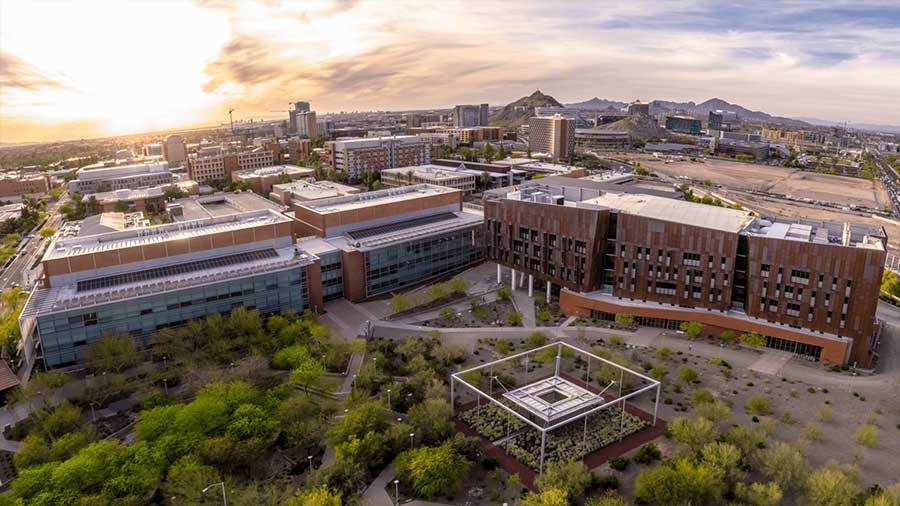

STEM
Arizona State University, United States
The Master of Science program in computational life sciences introduces you to a burgeoning new field. Huge leaps in processing technologies have thrown open the doors for new research techniques and exciting opportunities for interdisciplinary collaborations, focusing heavily on genomics data generation, analysis and interpretation.
Faculty: The College of Liberal Arts and Sciences | Department: School of Life Sciences | Duration: 30 credit hours | Study mode: full-time | Intake: Fall, Spring, Summer | Location: Tempe, AZ, United States
30 credit hours including the required applied project course (BIO 593), or 30 credit hours including the required capstone course (BIO 597) Required Core (1 credit hour) BIO 511 Big Data in Context (1) or BIO 610 Introduction to Responsible Conduct of Research (RCR) in Life Sciences (1) Restricted Electives (18-20 credit hours) Choose two computing in life sciences courses for six to seven credit hours: BIO 539 Computing for Research (3) BIO 591 Topic: Quantitative Methods in Conservation and Ecology (4) BIO 598 Topic: Medical Genetics and Genomics (3) BIO 598 Topic: Transcriptomics (3) Choose two statistics and mathematics courses for six to seven credit hours: BIO 514 Statistical Models for Biology (4) BIO 579 Data Analysis and Visualization in R (3) BIO 598 Topic: High-Throughput Genomics Analysis and Visualization (3) BIO 598 Topic: General Linear Models for Biology (3) Choose two biology courses for six credit hours: BIO 543 Molecular Genetics and Genomics (3) BIO 544 Discovering Biodiversity (3) EVO 601 Principles of Evolution (3) MCB 540 Functional Genomics (3) Electives or Research (6--8 credit hours) Culminating Experience (3 credit hours) BIO 593 Applied Project (3) BIO 597 Capstone (3) Additional Curriculum Information For restricted electives, students complete two computing in life sciences courses, two statistics and mathematics courses, and two biology courses.
Career opportunities for graduates include: academic research labs and teaching institutions biotechnology and pharmaceutical companies environmental and conservation organizations hospitals and medical research centers public health agencies and nonprofit research institutions Median salaries in computational life sciences-related positions are significantly higher than the overall workforce median, reflecting the high demand for professionals with this hybrid expertise in biology and data science.
Applicants must fulfill the requirements of both the Graduate College and The College of Liberal Arts and Sciences. Applicants are eligible to apply to the program if they have earned a bachelor's or master's degree in biology, statistics or a related field from a regionally accredited institution. Applicants must have a minimum cumulative GPA of 3.00 (scale is 4.00 = "A") in the last 60 hours of their first bachelor's degree program or a minimum cumulative GPA of 3.00 (scale is 4.00 = "A") in an applicable master's degree program. Applicants are required to submit: graduate admission application and application fee official transcripts personal statement professional resume proof of English proficiency Additional Application Information An applicant whose native language is not English must provide proof of English proficiency regardless of their current residency.
Domestic applicants: USD 13,327 a year (2026-27). Arizona resident tuition. Tuition only for the graduate on-campus (Tempe/Downtown Phoenix/Polytechnic/West Valley) rate band in the ASU tuition estimator, 2026-27: Fall 2026 plus Spring 2027 term tuition summed (full-time flat rate; part-time credit loads Source
International applicants: USD 24,780 a year (2026-27). International tuition. Tuition only for the graduate on-campus (Tempe/Downtown Phoenix/Polytechnic/West Valley) rate band in the ASU tuition estimator, 2026-27: Fall 2026 plus Spring 2027 term tuition summed (full-time flat rate; part-time credit loads ar Source
Entry terms: Fall, Spring and Summer; the terms available for each programme are listed in Degree Search.
Graduate application deadlines are set by each programme office and listed in Degree Search; the application opens almost a year before the start term. The nonrefundable application fee is $75 for U.S. citizens, permanent residents, DACA and international online students outside the U.S., and $120 for international students on a nonimmigrant visa studying in the U.S. Apply with ASU's graduate application (Law applicants use the law college's site); GRE/GMAT requirements vary by programme.
Apply through the official page: https://admission.asu.edu/apply/graduate/admission
STEM
Arizona State University, United States
STEM
Arizona State University, United States
STEM
Arizona State University, United States
STEM
Arizona State University, United States
STEM
Arizona State University, United States
STEM
Arizona State University, United States
STEM
Arizona State University, United States
STEM
Arizona State University, United States

Book a free consultation with our expert counsellors and take the first step towards your dream university.
Copyrights © 2026 StudyMapped. All rights reserved.

Enter your credentials to continue.
Join us and start your study abroad journey.