
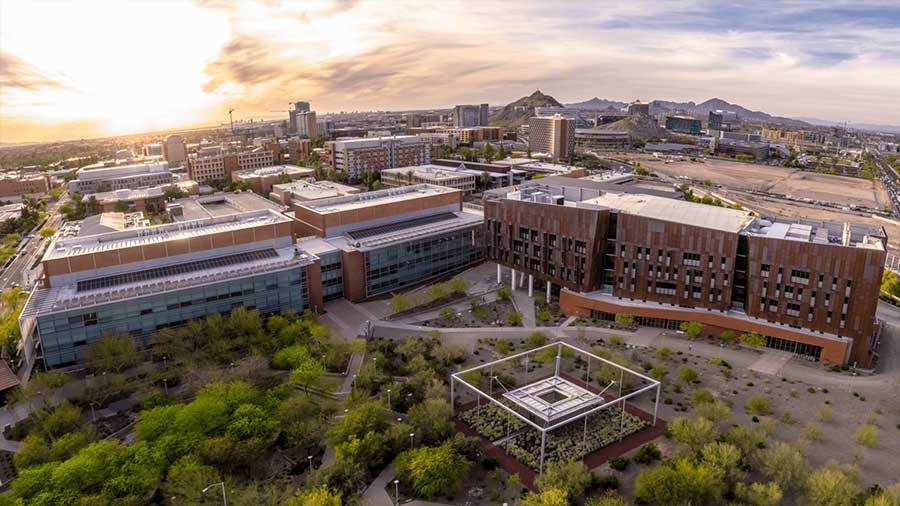

University in United States
Tempe, AZ, United States
University profile
Arizona State University (ASU) is a public research university in metropolitan Phoenix, Arizona. It describes itself as the "New American University", a model built on its 2014 charter that measures the institution by whom it includes and how they succeed. ASU is a member of the Association of American Universities and holds the Carnegie Foundation's Opportunity University designation. Total 2025-26 annual enrollment is over 203,700, including more than 158,000 undergraduates and more than 45,700 graduate and professional students, with students from 174 countries.
ASU is "one university in many places": four campuses across metro Phoenix (Tempe, Downtown Phoenix, Polytechnic and West Valley), learning centres around Arizona, the ASU California Center in Los Angeles, a Washington, D.C. centre, research facilities in Hawaiʻi, ASU London, and ASU Online. In fall 2026 enrolment was 51,200 at Tempe, 10,800 at Downtown Phoenix, 5,500 at Polytechnic, 5,200 at West Valley and 600 at other locations.
Academics are organised into colleges and schools including W. P. Carey School of Business, Herberger Institute for Design and the Arts, Ira A. Fulton Schools of Engineering, Rob Walton College of Global Futures, Thunderbird School of Global Management, Graduate College, College of Health Solutions, Barrett, The Honors College, College of Integrative Sciences and Arts, New College of Interdisciplinary Arts and Sciences, Walter Cronkite School of Journalism and Mass Communication, Sandra Day O'Connor College of Law, College of Liberal Arts and Sciences, the Edson College of Nursing and Health Innovation, Watts College of Public Service and Community Solutions, Mary Lou Fulton Teachers College, and University College. A medical school, the John Shufeldt School of Medicine and Medical Engineering, is set to open in fall 2026. ASU offers more than 450 undergraduate programmes and more than 400 master's programmes, plus more than 300 online degree and certificate programmes. There are more than 5,600 faculty and a student-to-faculty ratio of 18 to 1.
Research is a major strength: ASU passed $1 billion in annual research expenditures in fiscal year 2024 and ranks fifth in the United States for research expenditure among universities without a medical school (National Science Foundation HERD survey). Distinctive units include the Julie Ann Wrigley Global Futures Laboratory, the Rob Walton College of Global Futures with its Schools of Sustainability, Complex Adaptive Systems and Ocean Futures, and the Center for Meteorite Studies, which holds the Nininger Meteorite Collection. ASU also hosts the PBS station KAET.
International students make up more than 15,100 of the student body, drawn from over 150 countries. Support includes the International Students and Scholars Center, intensive English programmes and ASU-USA Pathways through Global Launch, and the Mastercard Foundation Scholars Program for African students. University Housing provides on-campus housing, with first-year and continuing-student options. 40% of undergraduates are first-generation college students and four out of five undergraduates receive merit and/or need-based aid. U.S. News & World Report has ranked ASU the most innovative school in the country for twelve consecutive years, and 75 programmes are ranked in the top 25 nationally by the same publication.
International students do not qualify for federal and state financial aid unless they are eligible noncitizens. Undergraduate rates are based on 12 credits per semester and graduate rates on 9 credits.
Merit-based, awarded automatically to admitted full-time, on-campus international first-year, transfer and graduate students who remain self- or family-funded; no separate application. First-year awards by international GPA: 4.0+ President $17,500; 3.81-3.99 Provost $15,500; 3.41-3.80 Dean $13,500; 3.11-3.40 University $12,000; 3.01-3.10 Academic Achievement $10,000. First-year recipients can hold the award for eight consecutive semesters and transfer recipients for four, subject to renewal criteria. Students are evaluated on international GPA and English proficiency scores; ACT/SAT scores are optional. See the official page.
Colleges and departments offer scholarships and assistantships with varying criteria. The Mastercard Foundation Scholars Program supports high-achieving African students with financial need (programme page). Admitted and current students can search internal and external scholarships in Scholarship Universe. Domestic students use the FAFSA; ASU's FAFSA priority date for 2027-28 is 15 January 2027. In 2023-24, 7,542 students received donor-funded scholarships totalling $32.3 million.
New American University Scholarship (International) →
Mastercard Foundation Scholars Program at ASU →
Browse the scholarships listed for Arizona State University and check each award’s eligibility.
View scholarships for Arizona State University →Required coursework: 4 years of math, 4 years of English (non-ESL/ELL), 3 years of laboratory science (one year each from biology, chemistry, earth science, integrated sciences or physics), 2 years of social science including 1 year of American history, 2 years of the same second language, and 1 year of fine arts or career and technical education. Applicants also need one of: top 25% of the high school graduating class; 3.00 unweighted GPA in competency courses; ACT 22 (24 for nonresidents); or SAT 1120 (1180 for nonresidents). Admission may be granted with one deficiency in no more than two competency areas, never in both math and laboratory science, with at least 2.00 in each subject area. Some degree programmes, including business, engineering and nursing, have higher requirements.
ACT or SAT scores are not required for admission but can be submitted for course placement and are encouraged for merit scholarships. Apply with the ASU Application for Admission or the Common Application (only one); no essay or personal statement is required. Priority admission date is 1 November. Barrett, The Honors College requires a separate application. Application fees (nonrefundable): Arizona residents $55, domestic nonresidents $85, ASU Online $75, international nonresidents $90; Arizona residents who qualify can have the fee waived through questions in the application.
A transfer applicant has completed 12 or more transferable semester credits after high school (grade C- or higher, from a regionally accredited institution). With 12-23 credits: 2.50 cumulative transfer GPA plus first-year requirements. With 24 or more credits: 2.50 cumulative transfer GPA. With an associate degree or higher: 2.00 cumulative GPA. Apply with the ASU application or the Transfer Common Application.
First-year applicants need a 3.00 GPA (B or better) from secondary school, three years of high school coursework and a completed diploma or certificate, plus four years of math and three years of laboratory science. English proficiency minimums for general programmes: TOEFL iBT 61 (3.5 overall under the scoring used for exams from 21 January 2026), IELTS Academic 6.0, PTE 53, Duolingo 95, Cambridge English 170. Higher minimums apply to Fulton Schools of Engineering (IELTS 6.5, PTE 58, Duolingo 105), Bachelor of Science in Nursing (IELTS 6.5, Duolingo 100, PTE not accepted) and the Cronkite School (IELTS 7.0, PTE 73, Duolingo 120). Conditional admission, valid for up to three semesters, is available to applicants who meet academic requirements but not the English requirement. International transcripts must be in the original language with an official English translation.
Applicants need a bachelor's degree (or equivalent) from a regionally accredited US institution or an officially recognised international institution. Competitive applicants typically have a 3.00 GPA in the last 60 semester hours. Programmes may also consider GRE or GMAT scores, coursework, recommendation letters and other materials; deadlines are set by each programme. Application fee: $75 for US citizens, permanent residents and certain others; $120 for international students on a nonimmigrant visa studying in the US. International applicants must provide proof of English proficiency (TOEFL, IELTS or PTE) and, after admission, a graduate financial guarantee for the visa.
ASU's sustainability record includes 82 LEED-certified buildings, 56.7 MWdc-equivalent of solar capacity and carbon neutrality for campus operations reached in 2020.
Reasons students choose Arizona State University for their study abroad journey.
Study programmes offered at Arizona State University.
Experiences shared by students of Arizona State University.
Studied here? Share your experience to help other applicants.
A glimpse of campus life and the academic environment.




Book a free consultation with our expert counsellors and take the first step towards your dream university.
Copyrights © 2026 StudyMapped. All rights reserved.

Enter your credentials to continue.
Join us and start your study abroad journey.


