

University in United States
Blacksburg, VA, United States
University profile
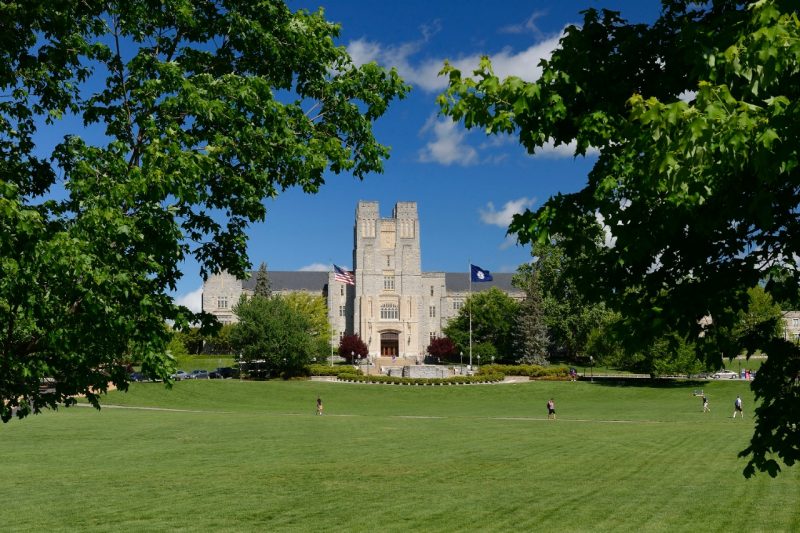
Virginia Tech, formally Virginia Polytechnic Institute and State University, is a land-grant university based in Blacksburg, Virginia, in the New River Valley, 38 miles southwest of Roanoke. Its motto is Ut Prosim (That I May Serve). The university describes itself as the commonwealth's most comprehensive university and a leading research institution, offering about 280 undergraduate and graduate degree programs to more than 38,000 undergraduate, graduate and professional students (fall 2025: nearly 39,000 on and off campus, 80 percent undergraduate and 20 percent graduate).
The 2,600-acre Blacksburg main campus holds more than 200 buildings, an airport, Lane Stadium, Cassell Coliseum and the Center for the Arts, with a corporate research center alongside. Beyond Blacksburg the university has a Health Sciences and Technology Campus in Roanoke, the Institute for Advanced Computing in Alexandria in Northern Virginia, sites in Newport News and Richmond, a 1,800-acre agriculture research farm near the main campus and the Steger Center for International Scholarship in Riva San Vitale, Switzerland.
Teaching is organised in colleges and schools: the College of Agriculture and Life Sciences; the College of Architecture, Arts, and Design; the Pamplin College of Business; the College of Engineering; the College of Liberal Arts and Human Sciences; the College of Natural Resources and Environment; the College of Science; the Virginia-Maryland College of Veterinary Medicine; and the Virginia Tech Carilion School of Medicine in Roanoke. The Graduate School, the Honors College and the Corps of Cadets, a leadership programme at the university since 1872, complete the structure. There are 110+ undergraduate majors and 120+ master's and doctoral programmes, and a student-to-faculty ratio of 13 to 1 (fall 2023).
Student life centres on Hokie traditions, more than 22 living-learning programmes, 48 on-campus residence halls housing about 10,500 students, and NCAA Division I athletics in the Atlantic Coast Conference. First-year students are guaranteed university housing and are required to live in the residence halls unless a transfer student or an exception is approved. The libraries include Carol M. Newman Library, the Art & Architecture Library and the Veterinary Medicine Library.
International students come from more than 100 countries represented across the university's alumni and student body; the Cranwell International Center provides immigration advising, pre-arrival webinars, orientation and cultural programming. International students make up nearly 40 percent of the graduate population in Blacksburg and over 30 percent across all campuses. The Language and Culture Institute offers English study for admitted applicants who have not yet met the English proficiency requirement.
Scholarships are awarded by the Office of University Scholarships and Financial Aid (USFA) and by colleges and departments. For maximum consideration, submit the FAFSA (school code 003754) and the General Scholarship Application by January 22 each year. Incoming students apply through the Applicant Portal without waiting for an admission decision; continuing students use Scholarship Central. Students are automatically considered for scholarships such as Beyond Boundaries, the Presidential Scholarship Initiative and VT Scholars based on academic merit, financial need and other application factors.
Virginia Tech Advantage provides additional scholarships and financial aid for in-state undergraduates, including growth of the competitive, renewable, four-year Presidential Scholarship Initiative.
Financial aid requires a valid FAFSA (U.S. citizens and eligible noncitizens) or a Virginia Alternative State Aid (VASA) application. International students, whether or not they can file a FAFSA, may apply for college and departmental scholarships through Scholarship Central after submitting their admission application. Students without a valid FAFSA or VASA can consider private educational loans and outside scholarships. Graduate students: over 70 percent of full-time degree-seeking graduate students receive graduate assistantships covering most or all of the cost of education; tuition varies by programme, campus and residency.
Virginia Tech University Scholarships (USFA, General Scholarship Application) →
Presidential Scholarship Initiative (PSI) →
College and Departmental Scholarships for International Students →
Browse the scholarships listed for Virginia Tech and check each award’s eligibility.
View scholarships for Virginia Tech →Applications are made through the Common App and opened August 1. Early Action closes November 15 (reply by May 1; decisions in late February); Regular Decision closes January 15 (reply by May 1; decisions in mid-March). The Self-reported Transcript and Academic Record System (STARS) record or transcripts are due December 1 for Early Action and January 24 for Regular Decision. The General Scholarship Application and FAFSA are due January 22 for maximum scholarship and aid consideration.
Applicants who have attempted 12 or more credit hours after high school are transfer applicants and apply through the Common App. Deadlines: October 1 for spring (reply by December 1) and March 1 for summer/fall (reply by May 15 for summer, June 1 for fall). Each available transfer major has required or recommended coursework set out in Admissions Transfer Roadmaps; competitive applicants have mostly As and Bs. Around 1,100-1,400 students transfer in each year.
Applicants who are not U.S. citizens or permanent residents apply through the Common App on the same deadlines. Required academic units: 3 units of math (including algebra I and II), 2 units of laboratory science (biology, chemistry or physics) and further academic units, with foreign language highly recommended; some majors require more. Most admitted students have at least a B+ average. Submit a STARS record or copies of secondary transcripts and all exam results by December 1 (Early Action) or January 24 (Regular Decision).
English proficiency minimums (one required unless exempt; tests taken within two years): TOEFL iBT 80 or higher with no subsection below 16 (exams from January 21, 2026); IELTS 6.5 with no sub score below 6.5; PTE 59; Duolingo 115; Cambridge English 176; SAT Evidence-based Reading and Writing 550; ACT English 24; IGCSE/GCSE/GCE grade A, B or C (or 6-9) in English; IB English A score 5. Students with four years of secondary study in an English-medium country on the university's list (including Ghana, Kenya, Nigeria, South Africa, Zambia and Zimbabwe) with no ESL courses are exempt. The SAT and ACT are optional for international applicants (CEEB code 5859, ACT code 4420). Credit is awarded for German Abitur, A Levels, International Baccalaureate and AP courses.
Students on F-1 or J-1 visas must show sufficient funds for the first year of study before the I-20 or DS-2019 can be issued. Off-campus work requires approval from the International Student Advisor and/or USCIS.
Applications go to the Graduate School, with the degree awarded by an individual college and department. Deadlines vary by department; applicants seeking assistantship funding should apply by January 15 for August admission. The GRE or GMAT is not required by the Graduate School but may be required by the programme. Admission is holistic, considering work experience, service, leadership, research and barriers overcome. F-1 and J-1 applicants may apply only to the Blacksburg and greater Washington, D.C. area campuses and not to executive master's or virtual programmes; financial and immigration documents are submitted after admission.
Facilities include 48 residence halls (about 10,500 students), laundry rooms in every hall, the Graduate Life Center at Donaldson Brown for graduate and professional students, and libraries with more than 1 million e-books and Special Collections.
Study programmes offered at Virginia Tech.
Experiences shared by students of Virginia Tech.
Studied here? Share your experience to help other applicants.

Book a free consultation with our expert counsellors and take the first step towards your dream university.
Copyrights © 2026 StudyMapped. All rights reserved.

Enter your credentials to continue.
Join us and start your study abroad journey.


