

University in Germany
Würzburg, Bayern, Germany
University profile
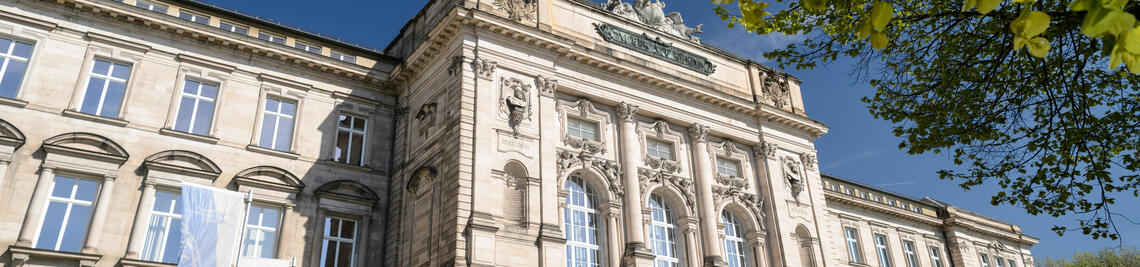
The Julius-Maximilians-Universität Würzburg (JMU), or University of Würzburg, is a comprehensive research university in Würzburg, Bavaria, founded in 1402. It is the oldest university in Bavaria and describes itself as one of the leading comprehensive research universities in Germany, working under the motto "Science for Society". About 25,000 students were enrolled in the winter semester 2025/26, including 3,078 international students, and the university has around 5,000 employees including 479 professors.
The university has ten faculties: Biology; Chemistry and Pharmacy; Human Sciences; Catholic Theology; Mathematics and Computer Science; Medicine; Arts (Philosophy); Physics and Astronomy; Law; and Management and Economics. Degree programmes run from Bachelor, Master and state examinations (such as Medicine, Dentistry, Pharmacy, Law and teaching degrees) to doctorates. Recent additions include Artificial Intelligence and Data Science, Computer Science and Sustainability, Diversity, Ethics and Religions, and Mathematical Data Science.
Teaching and research are spread over several sites in the city: the historic Sanderring and Röntgenring areas, the Hubland campus on the eastern edge of the city (with Hubland Süd and Hubland Nord, the latter opened in 2011 on a 39-hectare area), and Campus Medizin. Wilhelm Conrad Röntgen discovered X-rays in Würzburg in 1895, and 15 Nobel laureates have researched or taught at the university, among them Klaus von Klitzing, who discovered the quantum Hall effect.
Research is organised around four Focal Research Areas: Functional Materials for the Future; Molecules of Life; Disrupting Disease Dynamics; and Where Code Meets Culture (AI and Computational Humanities). Three Emerging Research Areas cover Global Environmental Challenges, Pillars of Change (history and society) and Complex Minds. The university secured two Clusters of Excellence for the 2026-2032 funding period of the Excellence Strategy.
Student life is supported by the University Library, university sport (Hochschulsport), the Career Centre, academic advisory service, student representation and the Language Centre, which offers German as a foreign language. The Studierendenwerk operates ten dormitories in Würzburg, and other providers offer further student housing. Exchange and degree-seeking international students are served by the International Office and the Dean of Studies office, with a tutor system and Erasmus partnerships. The university is a state university of the Free State of Bavaria and a member of the U15 group of German research universities.
There are no tuition fees at the University of Würzburg. Every student pays a semester contribution (Semesterbeitrag) each semester at enrolment and re-enrolment, consisting of a student contribution and the semester ticket; this is not tuition. The current amount is set by Student Affairs (Studierendenkanzlei). Living costs are described as about EUR 1,000 per month in Würzburg, made up of food (EUR 275), housing (EUR 375), health insurance (EUR 110), other costs (EUR 222) and the broadcasting fee (EUR 18).
Since 2011 the university has awarded the Deutschlandstipendium to high-achieving and committed students irrespective of nationality or social background. Private sponsors contribute EUR 1,800 per student and academic year and the federal government doubles it to EUR 3,600 per scholarship. Master's students who are further along in their studies can also apply. Contact: Studierendenkanzlei, +49 931 31-89762. Details: University of Würzburg Deutschlandstipendium.
The Career Centre advises students on scholarships and helps prepare applications ([email protected], [email protected]) and Student Affairs answers scholarship questions at [email protected]. The university encourages applications to the Studienstiftung des Deutschen Volkes and the other twelve Begabtenförderungswerke, as well as Bavarian programmes such as the Max Weber-Programme for gifted students and the Marianne-Plehn-Programme for doctoral researchers. Doctoral funding is available through the Graduate School of Life Sciences and other programmes. International students are advised to consult the DAAD scholarship database; scholarships for international students are handled by Thomas Berndt ([email protected]). See Scholarships at JMU.
EU citizens with permanent residence, refugees and holders of a settlement permit may receive BAföG, an income-based state loan, applied for at the Studierendenwerk at least three months before studies begin. Students from outside the EU/EEA may work 120 full days or 240 half days a year. Student housing in Studierendenwerk dormitories must be applied for by 15 June (winter semester) or 15 January (summer semester).
Deutschlandstipendium at the University of Würzburg →
Oskar Karl Forster Scholarship →
Romana Schott Scholarship for Female Students →
DAAD STIBET I Study Completion Grant for International Students →
Browse the scholarships listed for University of Würzburg and check each award’s eligibility.
View scholarships for University of Würzburg →International applicants without a German Abitur usually need a preliminary review documentation (Vorprüfungsdokumentation, VPD) from uni-assist before applying to the university. Applications are then made online via the WueStudy portal, with documents uploaded as files; the portal opens from the end of May for the winter semester and from the end of November for the summer semester. Medicine, Dentistry and Pharmacy applications are submitted in person or by post to the Studierendenkanzlei, Sanderring 2, 97070 Würzburg. Medicine and Dentistry applicants need the digital TestAS with the Subject Module Medicine. Deadlines (for receipt) are 15 July for the winter semester and 15 January for the summer semester.
Applicants whose school-leaving certificate does not give direct access may have to pass the Feststellungsprüfung at a Studienkolleg; the Studienkolleg in Munich is responsible for the University of Würzburg. Applicants apply for their subject at the university, which issues the Studienkolleg admission where needed.
For German-taught Bachelor, teaching degree and law programmes without admission restrictions, B2 German is required for application ("good" recommended); programmes with admission restrictions require DSH 2 or DSH 3 or equivalent. Enrolment normally requires DSH 2, although B2 is enough for a list of Bachelor programmes including Computer Science, Physics, Education, Economics, Business Information Systems, Artificial Intelligence and Data Science, and French, Italian and Spanish. Certificates must not be older than one year, and participation certificates are not accepted. The English-taught Bachelor Diversity, Ethics and Religions requires English B1 and German A2 after the second semester, and Bachelor Games Engineering requires English B1 and German B2. Admission can be conditional on German proficiency being proved by enrolment.
A recognised first degree is required, and non-EU/EEA degree holders usually need a VPD from uni-assist. Requirements differ by programme and are listed per subject, including subject-specific ECTS prerequisites and German (often DSH 2) or English (typically B2) levels; some programmes require an additional foreign language. Most Master programmes are applied for through WueStudy (winter semester from the end of May to 15 July, summer semester from early December to 15 January), while some programmes have their own deadlines and application forms. Applicants who graduated in China, India or Vietnam must provide the APS certificate from the Academic Evaluation Centre.
Doctoral candidates need a qualifying degree from a recognised university, confirmation from a professor willing to supervise (Doktorvater or Doktormutter), a letter of acceptance from the doctoral committee and, where the doctoral regulations require it, proof of German. Candidates can join a faculty, a Graduate School or a binational (cotutelle) doctorate. Doctoral studies normally take three to five years and end with a thesis and an oral examination (Rigorosum).
Typical documents are the university entrance qualification (with the Studienkolleg certificate if applicable), transcripts of previous studies, certified translations into German or English, a valid visa or residence permit, passport copy, CV, the VPD, proof of language level, health insurance and payment of the semester contribution. Certified copies are required for paper applications and authentic documents for online ones.
The University Library has a Main Library open Monday to Friday 08:30-24:00 and Saturday and Sunday 09:00-22:00, with free study spaces and workstations. The family-friendly campus has parent-child rooms and changing facilities. Sport is organised through the Hochschulsport, and the Studierendenwerk runs ten dormitories with single and double rooms or shared apartments for two to four students.
Study programmes offered at University of Würzburg.
Experiences shared by students of University of Würzburg.
Studied here? Share your experience to help other applicants.

Book a free consultation with our expert counsellors and take the first step towards your dream university.
Copyrights © 2026 StudyMapped. All rights reserved.

Enter your credentials to continue.
Join us and start your study abroad journey.


