
University in Germany
Wuppertal, Nordrhein-Westfalen, Germany
University profile
The University of Wuppertal (Bergische Universität Wuppertal, BUW) is a public university in Wuppertal, North Rhine-Westphalia. It was founded in 1972 as a comprehensive university (Gesamthochschule) and has carried its present name since 2003. Its traditional strengths are engineering and the natural sciences on the one hand and art and design on the other, alongside economics, the humanities and a broad range of subjects for future school teachers. In winter semester 2025/26 it had 20,653 students.
Teaching and research are organised in faculties: Humanities; Human and Social Sciences; the Schumpeter School of Business and Economics; Mathematics and Natural Sciences; Architecture and Civil Engineering; Electrical, Information and Media Engineering; Mechanical Engineering and Safety Engineering; and Design and Art. The School of Education coordinates teacher training. Overall the university offers 31 subjects, 84 partial degree programmes (Teilstudiengänge), 34 combinatorial Bachelor of Arts programmes, 29 Bachelor programmes, 53 Master programmes and one state-examination programme.
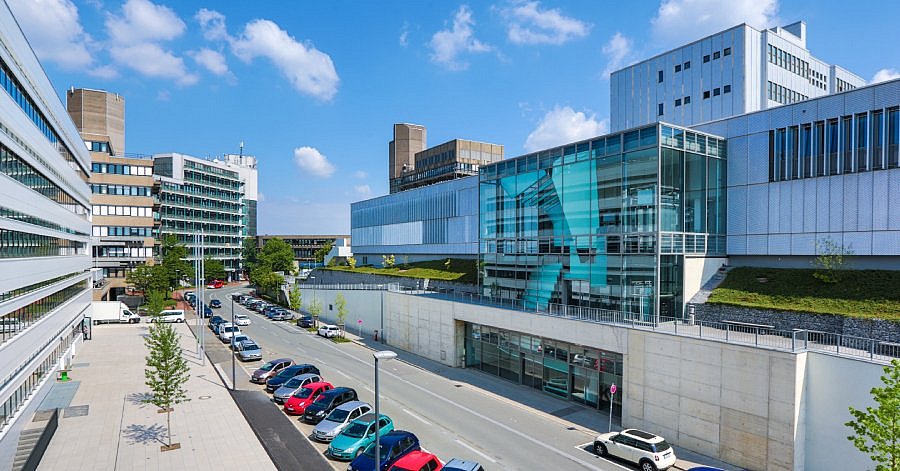
The university sites are Campus Grifflenberg (the main campus, with seven of the faculties and schools, the rectorate, central administration, the central university library, the Student Service Centre and the International Center), Campus Haspel (Architecture and Civil Engineering) and Campus Freudenberg (Electrical, Information and Media Engineering, the university archive and a guest house). Branch libraries and branch canteens of the Studierendenwerk operate at Haspel and Freudenberg.
Research is bundled in interdisciplinary centres and institutes, for example the Wuppertal Centre for Smart Materials and Systems (CM@S), the Interdisciplinary Center Mobility and Energy (IZME), the Interdisciplinary Center for Machine Learning and Data Analytics (IZMD) and the Port-Hamiltonian Institute. The PLEIADES computing centre provides high-performance computing for researchers.
Student life is supported by the Central Student Advisory Service (ZSB), the Student Service Centre at the main entrance, the student union AStA and the Studierendenwerk Wuppertal, which runs the canteen and cafeterias and the student halls of residence. The Language Teaching Institute offers German courses, and the In Touch programme, a buddy programme and the International Students Team support newcomers. About 14 per cent of students are international. The university offers English-taught programmes such as the Bachelor in Sustainable Chemistry and the Master programmes Computer Simulation in Science, Applied Economics and International Economic Policy, and Smart Materials and Systems. Internationalisation has been a central element of the university's development plan since 2009.
The Semesterbeitrag (semester contribution, not tuition) for winter semester 2026/27 is 358.05 euros: 109.00 euros social contribution, 22.25 euros student body contribution and 226.80 euros mobility contribution. The semester ticket is part of the mobility contribution. Payment is by bank transfer after enrolment, and direct debit is not offered.
The Deutschlandstipendium pays 300 euros per month regardless of income and is not offset against BAföG or housing benefit. It is normally awarded for at least two semesters and up to the end of the standard period of study. Bachelor and Master students within the standard period of study and school leavers can apply; good grades are wanted but are not the only criterion, and social engagement and obstacles in the educational biography are considered. About 250 scholarships are awarded each year. Details: Deutschlandstipendium.
The Studienstiftung awards scholarships to committed and high-achieving students, study grants for projects, excursions and learning materials, family scholarships for students caring for children or relatives, and completion grants for students with a registered thesis and a financial need. Details: Studienstiftung der BUW.
The International Office administers scholarships and further support for refugees and points to the DAAD scholarship database and the MyStipendium database. Contact: International Center, International Office. Overview: Funding opportunities.
Deutschlandstipendium at the University of Wuppertal →
Studienstiftung of the University of Wuppertal (BUW) →
DAAD STIBET Graduation Scholarship (Studienabschlussstipendium) at the University of Wuppertal →
Browse the scholarships listed for University of Wuppertal and check each award’s eligibility.
View scholarships for University of Wuppertal →Applicants with a German university entrance qualification apply online through the university's application portal. For restricted-admission (NC) two-subject programmes the portal is open from mid-May to 15 July for the winter semester. All restricted-admission single-subject programmes in the first subject semester take part in the dialogue-oriented service procedure (DoSV) of hochschulstart. Some programmes require an aptitude test. Applicants with vocational qualifications can enter without the Abitur through a separate route. The grade stated must be that of the final certificate, not of a provisional certificate.
Applicants whose entrance qualification was gained abroad apply through uni-assist, uploading officially certified copies and certified translations for documents not in German or English. Standard deadlines are 15 May to 15 July for the winter semester and 15 November to 15 January for the summer semester; some Master programmes have special deadlines (for example, Anglistik/Amerikanistik, Smart Materials and Systems, Computer Simulation in Science and International Management and Intercultural Communication). Those who must first attend a Studienkolleg and pass the Feststellungsprüfung may instead gain a subject-related entrance qualification through the TestAS, with a Core Test score of at least 95 (paper-based) or 75 (digital) and a subject-specific test score of at least 100. Applicants with a German Abitur but a foreign Bachelor's degree also apply to a Master through uni-assist. International applicants with a German Bachelor's degree apply to the relevant Master examination board and then to the international student admissions office, by 15 April for the summer semester and 15 October for the winter semester.
German-taught programmes require the DSH at level DSH-2 or higher, for which at least C1 is a prerequisite. Exempt are holders of TestDaF with TDN 4 in all parts, Goethe-Zertifikat C2 (GDS), DSD II, ZOP, KDS or GDS, or telc Deutsch C1 Hochschule. Applicants with a C1 certificate can sit the DSH at the university (fee 150 euros) with conditional admission, and preparatory full-time German courses are available. The Master in Psychology specialisation Clinical Psychology and Psychotherapy requires German at C2.
Bachelor in Sustainable Chemistry and Master programmes Computer Simulation in Science, Applied Economics and International Economic Policy, and Smart Materials and Systems are taught in English. Free parallel German courses are offered to students on these programmes.
Master applicants apply through the application portal and additionally ask the responsible Master examination board to check the admission requirements set out in the programme's examination regulations. Some programmes require an aptitude test (for example the Master in Architecture); the Master in Psychology uses a further application through the Joint Examination Board for Psychology.
The Centre for Graduate Studies (ZGS) advises doctoral candidates and those interested in doctoral studies from all faculties. Doctoral enrolment deadlines are 30 November for the winter semester and 31 May for the summer semester.
Admitted international students enrol with the signed enrolment application, a copy of passport or ID, a copy of the study visa or residence permit (non-EU), a health insurance certificate for study purposes and the admission letter; studies enrolment deadlines are 31 October (winter) and 30 April (summer).
Buildings are open Monday to Friday 7.00 to 20.00; Grifflenberg buildings are open Monday to Friday 7.00 to 22.00 and Saturday 8.00 to 16.00.
Experiences shared by students of University of Wuppertal.
Studied here? Share your experience to help other applicants.

Book a free consultation with our expert counsellors and take the first step towards your dream university.
Copyrights © 2026 StudyMapped. All rights reserved.

Enter your credentials to continue.
Join us and start your study abroad journey.


