


Engineering
Architectural Engineering
University of Waterloo, Canada
- Degree
- Bachelor's
- Next intake
- First-year students are admitted for the September (fall) term only. Terms: fall (September to Decem

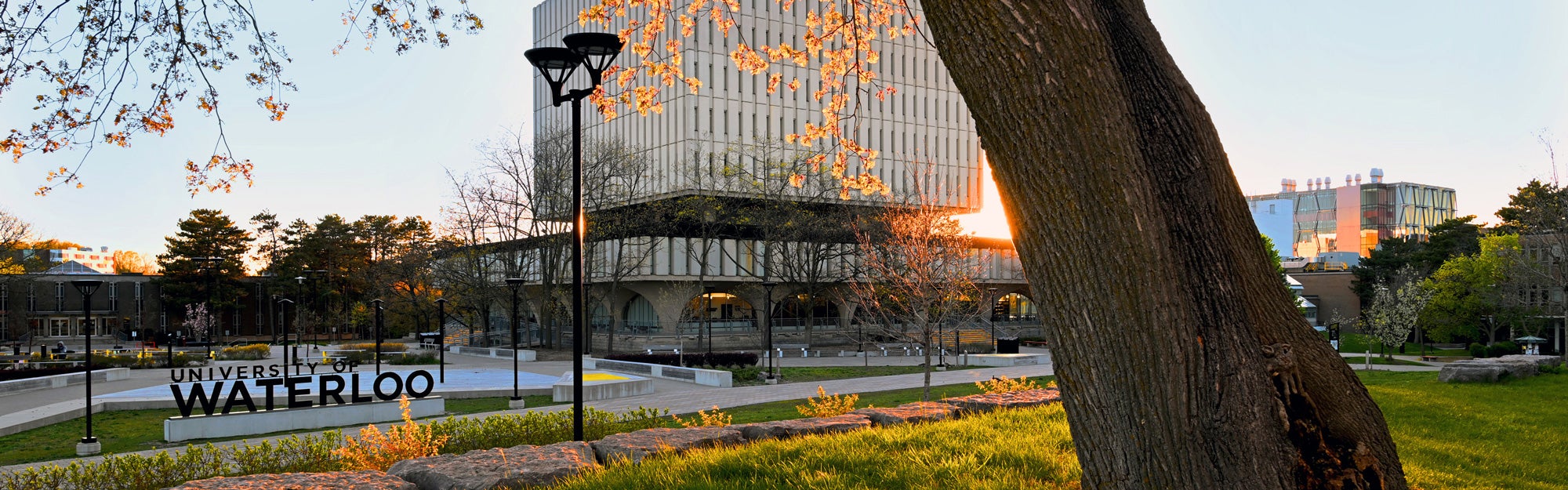

Engineering
University of Waterloo, Canada
Conduct research to generate new knowledge and advance your career with the PhD in Systems Design Engineering program. You’ll take an innovative and interdisciplinary approach to exploring solutions to engineering problems at the cutting edge of technology and design. This program will prepare you to pursue or advance your career in fundamental or applied research in academic, government or corporate environments.
Faculty: Faculty of Engineering | Department: Systems Design Engineering | Duration: 48 months (full-time) | Study mode: full-time | Intake: Fall (September - December), Winter (January - April), Spring (May - August); application deadlines: February 1(for admission in September); June 1(for admission in January of the following year); October 1(for admission in May of the following year) | Location: Waterloo, Ontario, Canada
Research fields: Biomedical Engineering, Human Factors and Ergonomics, Machine Learning and Intelligence, Mechatronic and Physical Systems, Modelling, Simulation and Systems Theory, Optimization and Decision Making, Societal and Environmental Systems, Vision, Image and Signal Processing, Research project opportunities for this program, Modeling and analyzing human-environment interplays, I am seeking fully funded Ph.D. students to join my new research group in the Dept. of Systems Design Engineering at the University of Waterloo, starting September 2026., Computational Simulations for Disaster Risk Management, As climate change increases the frequency and severity of disasters, proactive planning for post-disaster housing recovery is essential to mitigate long-term social and economic disruption. Computational models can support this planning by simulating potential recovery trajectories, yet many existing approaches are limited by overwhelming data requirements or narrow applicability to past events. Our work focuses on developing novel computational tools to improve how we manage disaster risk. These can include computational simulations using agent-based models or computer vision-based algorithms to study post-disaster recovery in communities., Micro, Nano, and Quantum Sensors, Join a team researching micro, nano, and quantum resonators created by the interaction of light, (lower frequency) electromagnetic fields, and micro/nano-scale mechanical structures with a view to; discover new phenomena, learn how to integrate then to best advantage and create novel sensors., Real-time 3D monocular camera map reconstruction and physics simulation, 3D maps are essential for autonomous navigation by vehicles and drones as well as augmented reality applications. We have developed a robust real-time 3D SLAM mapping system that is also to render (using 3D Gaussian splatting) an environment to produce a realistic 3D environment that can be used in simulation in a physics engine for training vehicle control using Reinforcement learning. SLAM and other 3D reconstruction methods assume a relatively static environment while most environments are not. We are exploring methods to deal with dynamic environments for building these maps. Other applications of interest include biomedical applications such as cacheters with camera-on-tip endoscopes, space, mining and any drone application., PhotoMedicine, Biphotonics and Biomedical Optics, Our work explores how photons interact with living matter, and how those interactions can be transformed into meaningful biomedical insight. We are interested in seeing what is usually hidden: subtle changes in tissue, chemistry, and structure that precede disease, progression, or healing. The goal is not just sharper images, but deeper understanding., Energy Systems Research, Interested in creating sustainable energy systems for vibrant economies and happy communities? Professor Jessie Ma is looking for MASc/MES students and /or PhD students at the University of Waterloo to join us in exploring deep electrification through distributed energy resources.. Study option(s): Thesis.
Conduct research to generate new knowledge and advance your career with the PhD in Systems Design Engineering program.
A master’s degree in engineering with a minimum average of 80% or a Master of Applied Science that includes the following two courses or their equivalent: Calculus II (SYDE 112) Matrices and Linear Systems SYDE 114) And one of the following two courses or their equivalent: Probability and Statistics (SYDE 212) Calculus 3 (SYDE 211) Demonstrated ability to formulate research problems and to execute the research required to solve problems (such as a Master of Applied Science (MASc) research thesis or published scientific/technical papers). Transfer to the PhD program without completion of the MASc program: a student enrolled in a MASc program at the University of Waterloo may apply for transfer to the PhD program without completing a master's degree. Transfer from a MASc program to a PhD program will normally be considered if an applicant: Has an excellent undergraduate record. Has obtained a grade average of at least 80% in courses that have been taken for graduate credit. Has developed a clearly defined research program that seems likely to satisfy the research proposal component of the PhD comprehensive examination and has demonstrated an aptitude for research. Presents objective evidence of adequate English language skills which should enable the candidate to write a thesis and to communicate orally. Is not beyond the fourth academic term of a MASc program.
Tuition is charged per credit, so the total depends on the courses you register for each year. Current fees are listed in the official fee schedule.
Graduate applications are made online through the Graduate Studies Application and the non-refundable application fee is $150 CAD per program. Deadlines are set by each programme.
Apply through the official page: https://grad.apply.uwaterloo.ca/apply/
Engineering
University of Waterloo, Canada
Engineering
University of Waterloo, Canada
Engineering
University of Waterloo, Canada
Engineering
University of Waterloo, Canada
Engineering
University of Waterloo, Canada
Engineering
University of Waterloo, Canada
Engineering
University of Waterloo, Canada
Engineering
University of Waterloo, Canada

Book a free consultation with our expert counsellors and take the first step towards your dream university.
Copyrights © 2026 StudyMapped. All rights reserved.

Enter your credentials to continue.
Join us and start your study abroad journey.