


Engineering
Architectural Engineering
University of Waterloo, Canada
- Degree
- Bachelor's
- Next intake
- First-year students are admitted for the September (fall) term only. Terms: fall (September to Decem

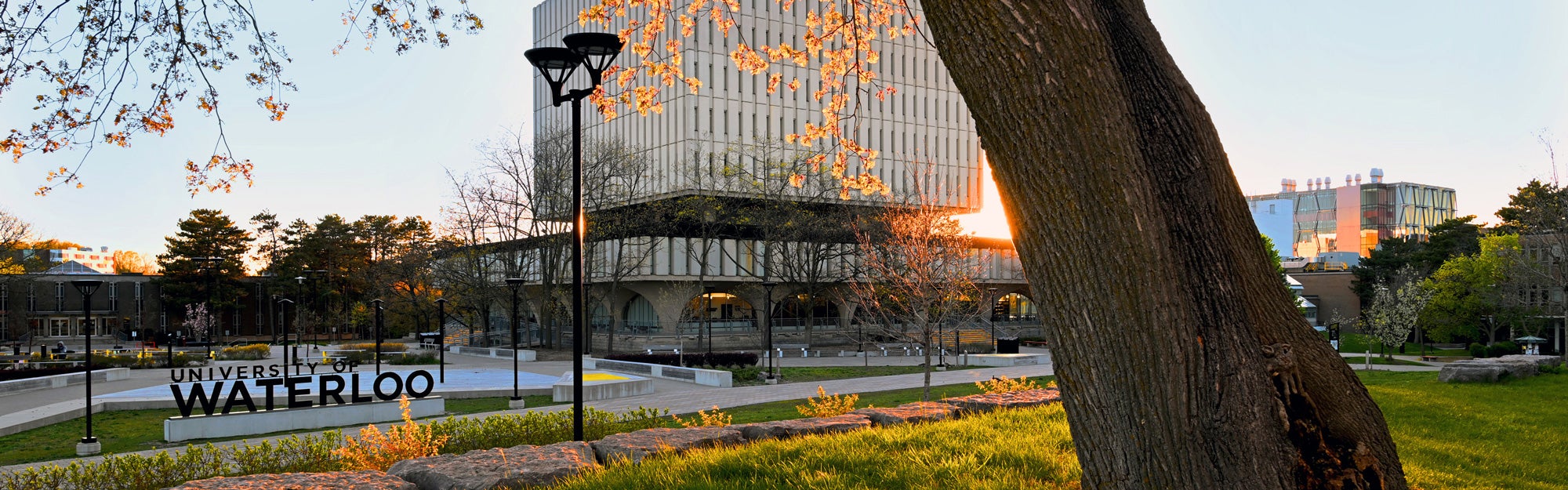

Engineering
University of Waterloo, Canada
Pursue an in-demand career in computer science with the Master of Mathematics in Computer Science program. Advance your knowledge in areas like machine learning and cloud computing or pursue your preferred area of research with a supervisor. You’ll be prepared to conduct further research at the PhD level or pursue a career in industry.
Faculty: Faculty of Mathematics | Department: David R. Cheriton School of Computer Science | Duration: 24 months (full-time) | Study mode: full-time | Intake: Fall (September - December), Winter (January - April), Spring (May - August); application deadlines: December 1 (for admission in September of the following year); June 1 (for admission in January of the following year); October 1 (for admission in May of the following year) | Location: Waterloo, Ontario, Canada
Research fields: Algorithms and Complexity, Artificial Intelligence, Bioinformatics, Computer Algebra and Symbolic Computation, Computer Graphics, Cryptography, Security and Privacy, Databases, Formal Methods, Health Informatics, Human-Computer Interaction, Information Retrieval, Machine Learning, Programming Languages, Quantum Computing, Scientific Computing, Software Engineering, Systems and Networking, Research project opportunities for this program, Exploring Artificial Intelligence (AI)/Machine Learning (ML) for Computational Models in Fintech, Financial technology, or Fintech, is a new trend that revolutionized the financial industry. Automated trading programs have become the new standard. Many of the financial activities that have been traditionally done based on human skills and experience have recently been replaced or will be replaced by computer systems. In fact, banks and investment companies are hiring more staff with strong computing skills than ever. Fintech is a broad subject and this research project is going to focus on quantitative analytics, and in particular on developing efficient and effective models for applications in finance., Physical Simulation for Visual Computing, Our lab's research explores the intersection of computer graphics, computational physics, and geometry processing. We develop mathematical and algorithmic foundations for simulating complex physical phenomena, such as liquids, gases, and rigid or deformable materials, with efficiency, high fidelity, and robustness. By advancing computational methods for partial differential equations and dynamic surface evolution, we aim to make physically based animation both accurate and visually compelling., We investigate a broad range of topics including multi-physics fluid-solid interactions, free-surface and multiphase flows, non-Newtonian and viscoelastic materials, and aspects of geometric representations, such as reconstruction of implicit surfaces (e.g., signed distance fields) and mesh-based topology tracking for dynamic surfaces. Our work bridges theory and practical application, often influencing research and production tools used in visual effects, animation, and interactive media. We strive to build well-grounded simulation methods that integrate physics, mathematics, and computation to push the boundaries of realism and control in the virtual worlds of the future.. Study option(s): Thesis*, Master's Research Paper.
Pursue an in-demand career in computer science with the Master of Mathematics in Computer Science program.
An honours bachelor degree in computer science or engineering (or equivalent degree) with at least a 78% standing.
Tuition is charged per credit, so the total depends on the courses you register for each year. Current fees are listed in the official fee schedule.
Terms run fall (September to December), winter (January to April) and spring (May to August). Programmes are currently accepting applications for fall 2027; intake terms vary by programme.
Graduate applications are made online through the Graduate Studies Application and the non-refundable application fee is $150 CAD per program, paid in the applicant portal. Deadlines are set by each programme (for example MDSAI part-time: fall January 15, winter July 1). Apply two to four weeks ahead of the programme deadline.
Apply through the official page: https://grad.apply.uwaterloo.ca/apply/
Engineering
University of Waterloo, Canada
Engineering
University of Waterloo, Canada
Engineering
University of Waterloo, Canada
Engineering
University of Waterloo, Canada
Engineering
University of Waterloo, Canada
Engineering
University of Waterloo, Canada
Engineering
University of Waterloo, Canada
Engineering
University of Waterloo, Canada

Book a free consultation with our expert counsellors and take the first step towards your dream university.
Copyrights © 2026 StudyMapped. All rights reserved.

Enter your credentials to continue.
Join us and start your study abroad journey.