

University in United Kingdom
Coventry, England, United Kingdom
University profile
The University of Warwick is a research-intensive public university on a campus at the southern edge of Coventry, on the border with Warwickshire. Founded in 1965 under a Royal Charter, it is the youngest member of the Russell Group, the association of 24 research-intensive UK universities. Its 41 academic departments are organised into three faculties, and by the end of 2023 it had more than 28,000 students, over 9,000 of them postgraduates.
The main campus sits on land granted by Coventry City Council and Warwickshire County Council, three miles (5km) from Coventry city centre, and spans Central Campus, Gibbet Hill, Westwood, Cryfield Village and Lakeside Village. The University also runs the Innovation Campus at Wellesbourne near Stratford-upon-Avon, the Warwick Venice Centre in the Palazzo Giustinian Lolin on the Grand Canal, and Warwick Business School's London base on the 13th and 17th floors of The Shard.
Teaching and research run through three faculties:
WMG is both an academic department and one of the UK's High Value Manufacturing Catapult centres, and the campus also hosts the National Automotive Innovation Centre, the Institute of Advanced Study and Warwick Arts Centre.
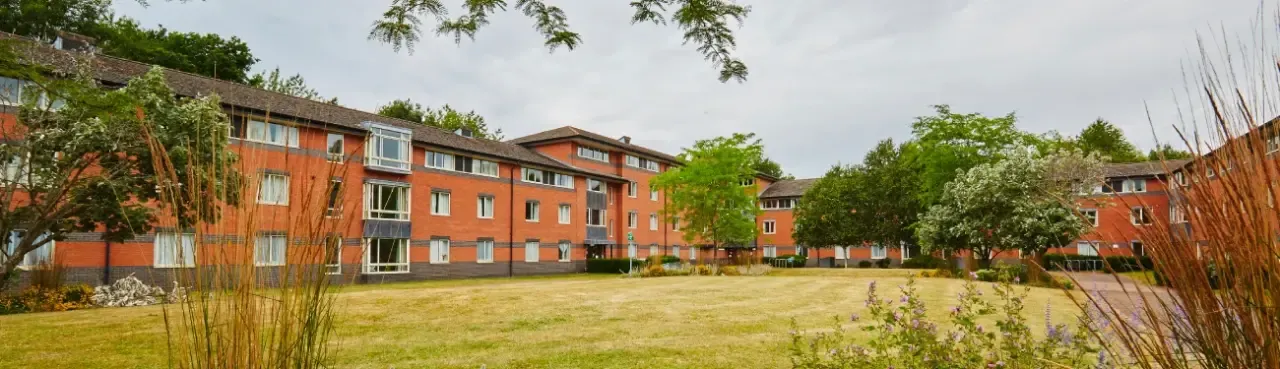
Student life centres on campus, where the University owns and manages more than 7,000 self-catered bedrooms in residences such as Rootes, Tocil, Arthur Vick, Bluebell, Jack Martin, Claycroft, Heronbank, Sherbourne, Cryfield and Westwood. Eligible first-year undergraduates who meet the allocation conditions are guaranteed university-allocated accommodation, with no application fee or deposit. The Students' Union, a 24-hour Library, the Sports and Wellness Hub and a Health Centre are on site.
Around a third of students come from outside the UK. International applicants are supported by the Office for Global Engagement and the Student Immigration and Compliance Service, and the Warwick International Foundation Programme offers a one-year on-campus route for students whose school qualifications do not allow direct entry to a UK degree.
Home undergraduates: £9,790 for 2026-27 (up from £9,535 in 2025-26) and £10,050 for 2027-28, following the UK government's fee cap. Overseas undergraduates (2026-27): Band 1 £27,870 a year (classroom-based courses, including humanities and most social sciences); Band 2 £35,530 a year (laboratory-based courses plus Mathematics, Statistics, Theatre and Performance Studies, Economics and most Warwick Business School courses). Overseas fees for 2027-28 had not yet been set. Fees for continuing students may rise in line with inflation. Eligible Home students can take a government Tuition Fee Loan and a means-tested Maintenance Loan.
A non-repayable annual award for full-time Home undergraduates living in England, Scotland or Northern Ireland with household income of £42,875 or below, as assessed by SFE, SFNI or SAAS: £2,500 for income up to £25,000, £1,250 for £25,000.01-£35,000 and £500 for £35,000.01-£42,875. No separate application is needed; eligibility is checked from student finance data, and payments are made in three instalments. Warwick Bursary
For self-funded applicants paying overseas fees who apply for a full-time undergraduate course, including Foundation courses but not the MBChB, by the UCAS deadline. For 2026 entry, scholarship applications closed at 12:00 GMT on 27 February 2026, and applicants needed an offer by 13 May 2026. Awards last for the whole course; in 2025 the University made 6 full-fee awards, 148 half-fee awards, 103 awards of 25% of fees and 6 awards of £2,000. The scheme is being reviewed for 2027 entry. Through a partnership with Ashinaga, students selected by the Ashinaga Africa Initiative have their full tuition covered by the scholarship, with travel, visa and living costs paid by Ashinaga UK. Global Excellence Scholarship
Chancellor's Scholarships fund the most outstanding Home and International PhD applicants. For 2027/28 the application deadline is 10 December 2026 at 16:59 GMT, with results by email by 5 March 2027. The Chancellor's International Scholarship normally covers academic fees at the Overseas rate and a maintenance grant at the UKRI rate for up to 3.5 years of full-time doctoral study, plus a £5,000 Researcher Training Support Grant. Warwick is also a partner in the UK Government's Chevening Scholarships. Departmental awards, postgraduate loans for Home students and fee awards appear in the University's scholarship search. Scholarship search
Warwick Undergraduate Global Excellence Scholarship →
Warwick Undergraduate Sanctuary Scholarship →
Warwick Postgraduate Taught Sanctuary Scholarship →
Browse the scholarships listed for University of Warwick and check each award’s eligibility.
View scholarships for University of Warwick →Undergraduate applications go through UCAS, institution code W20. For 2026 entry, applications were due by the UCAS deadline of 14 January 2026; a small number of courses may consider later applications, but equal consideration does not apply after that date. Applications are judged by academic and professional Admissions Tutors on achieved and predicted grades and their context, the personal statement and the academic reference. Some courses hold interviews.
Typical offers in A levels, the International Baccalaureate, Scottish Highers and BTECs are set course by course. All applicants need at least grade C/4 in GCSE English Language and Mathematics or an equivalent. Applicants normally take three full A levels; a fourth A level or an Extended Project Qualification earns no extra credit or reduced offer. T Levels are considered individually, and QAA-recognised Access to HE Diplomas are accepted for many courses where essential subjects are met. Applicants taking the Advanced Skills Baccalaureate Wales may receive an alternative offer one grade lower, with grade C or above in the Baccalaureate.
Home-fee applicants at UK state schools who meet a contextual flag (individual Free School Meals eligibility in the past eight years, a neighbourhood in the most deprived 20% by IMD, or a school with below-average performance and above-average Free School Meals eligibility) may receive an offer up to two grades lower than the standard offer and/or have an additional requirement such as an admissions test removed. Care leavers, estranged students, refugees and asylum seekers, and those who complete Realising Opportunities or the Pathways to Law, Banking and Finance or Engineering programmes are also considered. Contextual offers do not apply to foundation year or graduate-entry programmes, including Medicine.
Warwick accepts a wide range of overseas qualifications, with country-by-country guidance on UK equivalents. The Warwick International Foundation Programme is a one-year intensive access course taught on campus, with all students living in campus accommodation. Foundation programmes at other institutions are also considered.
Courses are placed in Bands A, B or C:
IELTS and PTE results must be dated within two years and one month of the course start. Applicants who need a Student visa may have to provide a secure English language test such as IELTS for UKVI (Academic). A Pre-sessional English course is available for applicants who do not fully meet the requirement.
As a guide, taught courses require at least a Lower Second Class UK Honours degree or equivalent; some courses ask for an Upper Second or First. Applications are made online with transcripts and grading criteria, and a non-refundable application assessment fee of £75 (2027 entry) is payable before submission. Applicants may apply for several courses but can accept only one full-time place. The on-time deadline for taught courses starting in September/October 2027 is 2 August 2027; late applications are accepted but may not be processed in time. Some science and engineering courses require ATAS clearance. The Warwick MBA, MBChB Graduate Entry Medicine and PGCE courses have their own application processes.
Research degrees generally require at least an Upper Second Class UK Honours degree or equivalent. Applicants should identify and contact a potential supervisor before applying and prepare a research proposal where the department asks for one. For research courses starting in September and October 2026, the deadline for applicants who need a Student visa was 2 August 2026.
Campus residences provide over 7,000 self-catered bedrooms across 13 residences, with bills, Wi-Fi and contents insurance included in the rent. Residential Community Teams living in the halls offer 24-hour pastoral support.
Study programmes offered at University of Warwick.
Experiences shared by students of University of Warwick.
Studied here? Share your experience to help other applicants.

Book a free consultation with our expert counsellors and take the first step towards your dream university.
Copyrights © 2026 StudyMapped. All rights reserved.

Enter your credentials to continue.
Join us and start your study abroad journey.


