

University in Canada
Victoria, British Columbia, Canada
University profile
The University of Victoria (UVic) is a public research university on the coast of British Columbia, Canada, serving more than 22,000 undergraduate and graduate students, including international students from over 100 countries. It offers more than 280 undergraduate and graduate programs, from degrees to diplomas and certificates, and operates under the University Act, governed by a Board of Governors and Senate.
Academic units are the faculties and schools of Business (Gustavson School of Business), Education, Engineering and Computer Science, Fine Arts, Health, Humanities, Law, Science and Social Sciences, together with Graduate Studies and Continuing Studies. Gustavson offers undergraduate business programs with mandatory co-operative education, and the university runs a wider co-operative education program.
UVic has more than 900 faculty members and more than 6,000 employees. Its research is organised around five impact areas: climate, environmental change and sustainability; health and wellness; Indigenous-led scholarship; social justice and equity; and technology and the human experience. The university holds 68 research chairs and over 50 research centres, entities and facilities, among them Ocean Networks Canada, the Pacific Institute for Climate Solutions and the Centre for Indigenous Research and Community-Led Engagement.
Student life includes the Vikes varsity teams, the CARSA athletics and recreation centre, residence communities including the Indigenous Living Learning Community, and arts and culture programming from Fine Arts. First-year students may apply for on-campus housing through Residence Services, and the International Centre for Students supports international undergraduates and graduates with immigration documents, health insurance, housing and settling in. UVic's English Language Centre offers English programs and a university pathway program for international applicants.
The university has partnership agreements with over 200 post-secondary institutions worldwide and has about 162,500 alumni (2024). Graduates of bachelor's degree programs may be eligible for a post-graduation work permit under Immigration, Refugees and Citizenship Canada rules.
Undergraduate students new to UVic are eligible for automatic entrance scholarships based on admission average, with no application required, and for scholarships based on admission average and other criteria, for which an application is needed. Figures for the 2027-2028 academic year:
Recipients must normally register in at least 12.0 units (10.5 graded on the nine-point scale) in their first winter session (September to April); lower loads apply for students with a disability. Scholarship funds are applied to tuition and fees, and any surplus is paid to the student. Contact: [email protected]. Details: UVic entrance scholarships.
The General Bursary program covers part of the financial need not met by Canadian government student loans and grants. It is open to Canadian citizens and permanent residents who receive the maximum full-time government loans and grants, register in at least 4.5 units in the term (3.0 for students with a permanent disability) and for at least 12 consecutive weeks; continuing students need a GPA of at least 2.0 in the previous session. Bursaries are offered in the Summer Session (May to August) and the Winter Session (September to April), with one application per session. See bursary programs.
Canadian students with financial need who hold an eight-month (September to April) residence contract may apply for a bursary of up to $1,500 through Student Awards and Financial Aid.
Financial assistance for former youth in care in BC and support for students whose Nations offer funding is also available. Student Awards and Financial Aid awards more than $12.5 million in scholarships and over $4.4 million in bursaries each year; contact [email protected] or 250-721-8423. See scholarships and financial aid.
UVic Entrance Scholarships Based on Admission Average (Canadian Citizens and Permanent Residents) →
Browse the scholarships listed for University of Victoria and check each award’s eligibility.
View scholarships for University of Victoria →Most undergraduates follow the standard admission process: high school students in their graduating year, high school graduates who have not studied full-time at college or university, college and university transfer students, and graduates applying for a second bachelor's degree. Each program sets its own admission requirements and deadlines.
Applications are submitted through EducationPlannerBC. The application fee is $89.50 if all transcripts come from institutions within Canada and $184.00 if any transcript comes from outside Canada. A confirmation email follows within 3-5 business days, after which the applicant creates a UVic NetLink ID using the UVic student number, views an application checklist and submits grades, transcripts and test scores. BC-curriculum students order transcripts through the StudentTranscripts Service; IB students upload predicted scores; students of other international curriculums upload in-progress transcripts. An admission offer is accepted by paying an acceptance deposit, which is credited toward tuition.
September entry: most degree programs January 31; high school students who submit grades by early December can be considered for early admission. Teacher Education post-degree programs (Elementary Curriculum and Secondary Curriculum) January 2; Indigenous Education ongoing; Public Administration diploma and certificate programs May 31; Discovery Studies and visiting with a letter of permission April 30. January entry: Computer Science, Art History and Visual Studies, Music (BA) and all programs in Humanities, Science and Social Sciences September 30; Health Information Science October 31. Summer entry: Computer Science, Art History and Visual Studies, Music (BA) and programs in Humanities, Science and Social Sciences March 31; Engineering December 31 (high school graduates only). Some programs continue accepting applications after these dates while space remains.
Applicants who studied full-time for at least four years in Canada at high school or post-secondary level, with all instruction in English, have met the requirement. Other routes include four years of full-time study with English as the language of instruction in a recognized English-speaking country or at a recognized international curriculum school, Grade 12 English in Canada with 86% or higher, AP English Language and Composition or English Language and Literature with 4 or higher, IB Higher Level English A with 4 or higher, O-Level English with grade B (6) or A-Level English with grade C.
Minimum test scores: IELTS Academic 6.5 (no component below 6.0); TOEFL iBT 88 (no section below 20); Duolingo English Test 120 (no subscore below 110); PTE Academic 65 (no skill below 60); CAEL 70 (no section below 60); MET 64 (four-skill only); Cambridge C1 Advanced or C2 Proficiency 180 (no skill below 170). Tests taken more than two years before application are not accepted and scores must be sent directly by the testing organization. UVic's TOEFL institution code is 0989.
Conditional admission is available to applicants to Business, Engineering and Computer Science, Fine Arts (Art History and Visual Studies, Music BA), Humanities, Science and Social Sciences, who must then meet the full requirement by the date in their offer. Minimum scores: IELTS 6.0 (no component below 5.5); TOEFL iBT 79 (no section below 17); Duolingo 110 (no subscore below 100); PTE Academic 54 (no skill below 50); CAEL 60 (no section below 50); MET 58 (no skill below 53). English Language Centre preliminary admission gives up to 24 months to satisfy the requirement for applicants to Business, Engineering and Computer Science, Humanities, Science or Social Sciences, and the University Pathway Program is available for international students.
Advanced Placement exams with grade 4 or 5 may earn transfer credit, and a grade of 3 may give advanced standing (UVic's CEEB code is 0989). A full IB diploma with minimum subject scores can earn up to one year of transfer credit, and Higher Level IB courses are assessed course by course. BC college credit follows the BC Transfer Guide, with 30 units guaranteed when an associate degree has been granted. College of applied arts and technology diplomas may earn up to 7.5 units (two-year) or up to 15 units (three-year).
International students may apply for degree programs directly from high school or as transfer students. The International Centre for Students helps admitted students with immigration documents, health insurance, housing and working in Canada. Full-time international graduates of bachelor's programs may be eligible for a post-graduation work permit of up to three years under IRCC rules; programs delivered more than 50% by distance learning are not eligible.
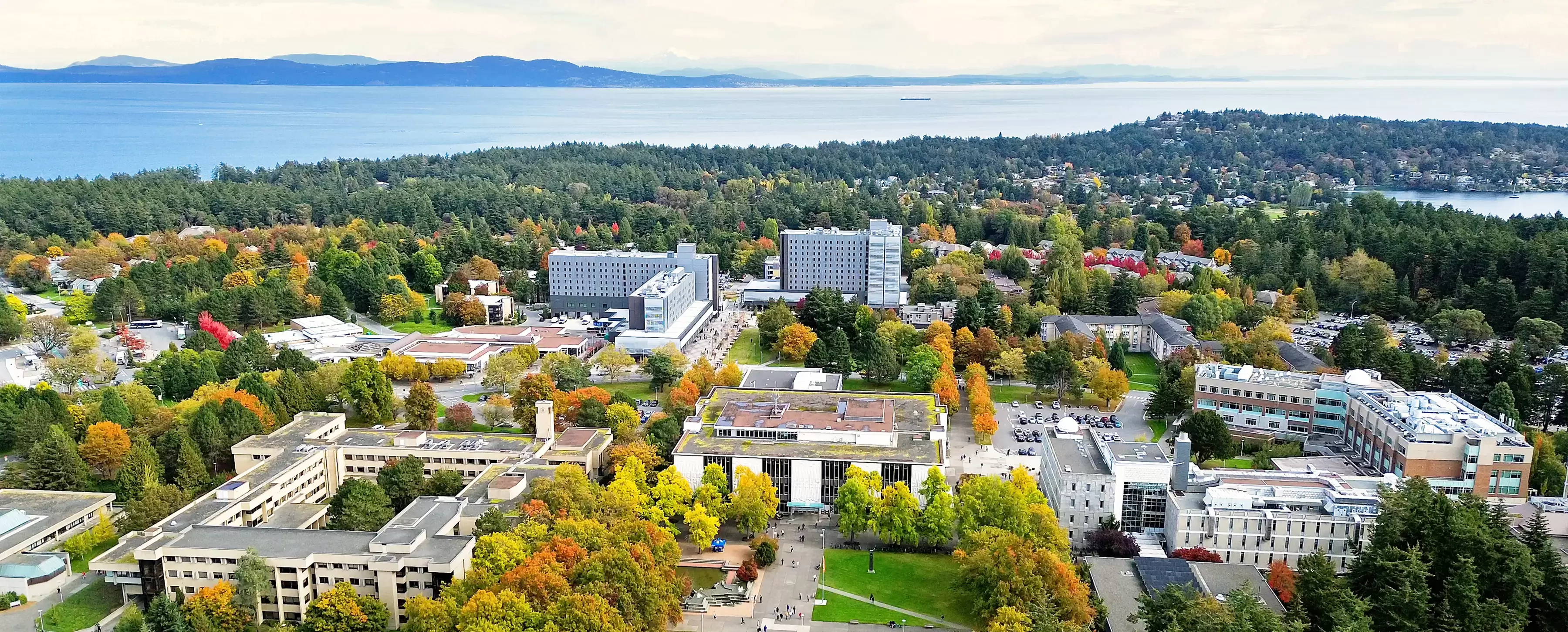
UVic is based on a single main campus in Victoria, British Columbia, on the territory of the Lək̓ʷəŋən (Songhees and Xʷsepsəm/Esquimalt) Peoples and the Lək̓ʷəŋən and W̱SÁNEĆ Peoples.
Study programmes offered at University of Victoria.
Experiences shared by students of University of Victoria.
Studied here? Share your experience to help other applicants.

Book a free consultation with our expert counsellors and take the first step towards your dream university.
Copyrights © 2026 StudyMapped. All rights reserved.

Enter your credentials to continue.
Join us and start your study abroad journey.


