
University in United States
Burlington, VT, United States
University profile
The University of Vermont (UVM) is a research university in Burlington, Vermont, chartered in 1791 as the fifth college in New England after Harvard, Yale, Dartmouth and Brown. Its legal title is The University of Vermont and State Agricultural College. The name derives from the Latin Universitas Viridis Montis, University of the Green Mountains, and its colors are green and gold with the catamount as mascot. UVM describes itself as the land-grant university of the State of Vermont and is classified R1 (Carnegie classification), a status it achieved in February 2025.
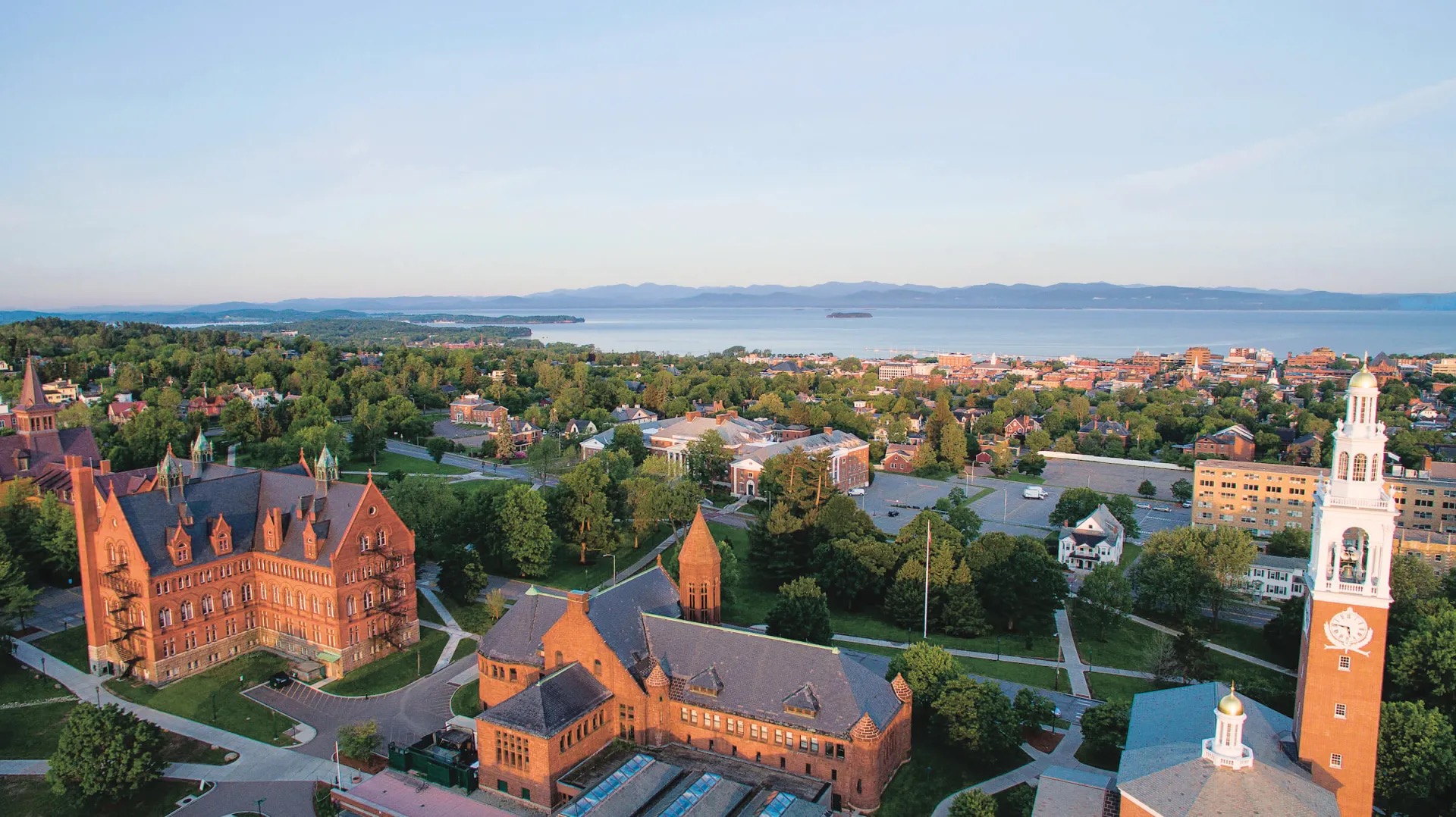
The main campus covers 459 acres in Burlington, the state's largest city, with views of Lake Champlain and the Adirondack Mountains to the west and the Green Mountains to the east. UVM has 13,861 degree students, an undergraduate student-to-faculty ratio of 17:1 and an average class size of 35. In fall 2025 it enrolled approximately 11,600 undergraduates, 1,780 graduate students and 490 medical students, and it employs over 4,700 faculty and staff.
Academic units are the College of Agriculture and Life Sciences (with UVM Extension), College of Arts and Sciences, College of Education and Social Services, College of Engineering and Mathematical Sciences, Larner College of Medicine, College of Nursing and Health Sciences, Rubenstein School of Environment and Natural Resources, Grossman School of Business and the Patrick Leahy Honors College, together with the Graduate College, Professional and Continuing Education and the UVM Libraries. UVM offers more than 100 bachelor's degrees and more than 120 graduate degrees and certificates, including the MD. The Larner College of Medicine is the nation's seventh oldest medical school.
Student life centres on residential learning communities, among them Arts and Creativity, Global Connections, Innovation and Entrepreneurship, Leadership and Social Change, Outdoor Experience, Sustainability, Wellness Environment and the Honors College. Rooms are single, double and triple occupancy in corridor, suite and private style, and UVM Dining includes the campus Dairy Bar. One in four undergraduates studies abroad.
International students are admitted as first-year and transfer students and graduate students come from more than fifty countries. International undergraduates are automatically considered for merit scholarships of up to $30,000 per year. UVM is accredited by the New England Commission of Higher Education (NECHE); the most recent comprehensive evaluation took place in March 2019.
International undergraduates are automatically considered for merit scholarships of up to $30,000 per year, including the Presidential Scholarship ($20,000-$30,000 per year) and Trustees Scholarship ($10,000-$15,000 per year) for out-of-state and international first-year students, renewable for four years with a 3.0 GPA. No separate application is needed. International graduate students may hold graduate teaching, research and general assistantships with a minimum 9-month stipend of $25,781 and tuition support.
UVM awards need-based grants, scholarships, loans and work-study based on the FAFSA (school code 003696); the CSS Profile is not required. Priority FAFSA deadlines for fall 2027 entry are November 15, 2026 (Early Action/Early Decision I) and February 1, 2027 (Early Decision II/Regular Decision). 92% of undergraduates receive scholarships or financial aid and $180M in UVM support is awarded to undergraduates. A Net Price Calculator is available. See UVM scholarships and types of aid.
UVM Presidential Scholarship →
UVM International Merit Scholarships →
UVM Green and Gold Scholars Award →
UVM Dean's Merit Scholarship (Transfer) →
Browse the scholarships listed for University of Vermont and check each award’s eligibility.
View scholarships for University of Vermont →Applicants apply through the Common Application or the Coalition Application with Scoir; there is no advantage to either. Admission is a holistic review of academic rigor, grades, trends, essays and recommendations. At least one letter of recommendation, preferably from a teacher, is required, along with an official high school transcript sent directly by the school and first-quarter or mid-year grades. There is no application fee.
Minimum entrance requirements: four years of English; three years of mathematics (Algebra I, Algebra II and Geometry or equivalents); two years of the same foreign language (American Sign Language qualifies); three years of natural or physical science including a laboratory science; and three years of social science. Colleges and schools may have additional requirements.
UVM is test-optional: ACT and SAT scores may be self-reported and official scores are required only if the student is admitted and enrols. The admitted first-year profile reports an average GPA of 3.8 (4.0 scale); middle 50% scores are SAT EBRW 670-740, SAT Math 650-740 and ACT 31-34, for the 45% of applicants who submitted them.
Credit is granted for AP scores of 4 or 5 in most subjects (3 in some areas). IB credit may be awarded for scores of 5 or higher on HL or SL exams, up to one year of introductory-level credit in a discipline. College coursework taken in high school at a regionally accredited institution may transfer.
Transfer applicants use the same applications with deadlines of June 1 for fall and November 1 for spring. A cumulative GPA of at least 3.0 in college-level coursework is required, plus the same subject expectations as first-year applicants. Transcripts from the final high school and all colleges attended are required; course syllabi may be requested for credit evaluation. A letter of recommendation from a current professor is optional. The Grossman School of Business requires college-level micro or macroeconomics and/or calculus; Engineering and Mathematical Sciences requires coursework up to pre-calculus and physics; Nursing and Health Sciences requires all first-year non-nursing requirements.
International first-year applicants submit an official secondary school transcript with an official English translation. Test scores are optional for international applicants. Applicants whose first language is not English submit official English proficiency results sent directly by the testing agency. Minimums: Duolingo English Test 110; TOEFL 80 of 120 (or 4.5 of 6 on the new scale); IELTS 6.5; ACT English 22; SAT EBRW 550; Cambridge English 180; MyBest TOEFL is not accepted. Students scoring 80-89 on TOEFL are placed in an ESOL course in their first semester. TOEFL and SAT code is 3920. Proof of funding for one year (usually a bank statement dated within six months) is required: for 2026-27 the I-20 estimated cost of attendance is $79,012 (tuition and fees $50,713, living expenses $17,724, other expenses $10,575). After paying the acceptance fee, admitted students apply for the I-20 and visa through the Office of International Education.
Applicants must hold a US baccalaureate degree from an accredited institution or an equivalent degree from a recognised foreign institution before enrolment. Requirements are a statement of purpose, resume, at least two letters of recommendation (some programs up to three) and transcripts from every post-secondary institution attended (international applicants may use a NACES or AICE credential evaluation). Application fees: $65 for Master's and doctoral programs, $25 for Graduate College fee for CAS applicants in select programs and $20 for a Certificate of Graduate Study. Program-specific requirements and deadlines apply.
International graduate English minimums: TOEFL iBT 90 (or 4.5 on the new scale), IELTS 6.5, Duolingo 110; to qualify for a Graduate Teaching Assistantship: TOEFL 100 (5), IELTS 7.0, Duolingo 120. Recommended international deadlines (or program deadline if earlier): fall June 24, spring November 8, summer March 8. Evidence of financial support is submitted to the Office of International Education after admission.
UVM's main campus is in Burlington, Vermont (459 acres) and holds the primary academic core, athletic and residential functions. The original 50 acres on the hilltop were given by Ira Allen in 1791. University Row includes the Old Mill, Ira Allen Chapel, Billings Hall, Williams Hall, Royall Tyler Theatre and Morrill Hall.
Experiences shared by students of University of Vermont.
Studied here? Share your experience to help other applicants.

Book a free consultation with our expert counsellors and take the first step towards your dream university.
Copyrights © 2026 StudyMapped. All rights reserved.

Enter your credentials to continue.
Join us and start your study abroad journey.


