
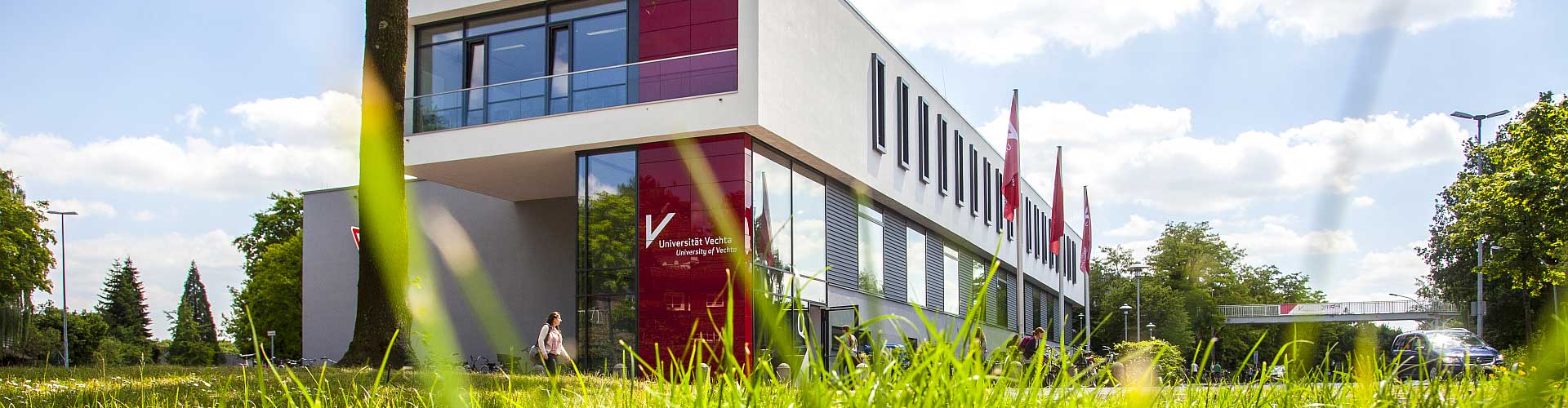

University in Germany
Vechta, Niedersachsen, Germany
University profile
The University of Vechta (Universität Vechta) is a state university in the town of Vechta in the Oldenburg Münsterland region of Lower Saxony, between Bremen, Oldenburg and Osnabrück. Its mission statement is "Responsibility is Key", and it takes the 17 UN Sustainable Development Goals and the Responsible Research and Innovation framework as reference points for research and teaching. Its teaching centres on teacher training for primary and lower secondary schools (Grundschule, Hauptschule and Realschule), social and human services, gerontology, transformation processes in rural areas and cultural studies, with a two-subject Bachelor (Bachelor Combined Studies) as the route into the teaching profession.
Teaching and research are organised in two faculties. Faculty I covers Education Studies, Gerontology, Social Service Management, Social Work, Educational Psychology, Sociology and Business and Ethics. Faculty II covers English Studies, Biology, Design Pedagogy, Geography, German Studies, History, Catholic Theology, Cultural Studies, Mathematics, Music Education, Philosophy, Political Science, Natural, Social and Technical Sciences in Primary Education, and Physical Education/Sports Science. The School of Education (founded 2012) coordinates teacher training and the Graduate Centre (founded 2019) supports doctoral candidates.
Research is organised around three profile areas: teaching-learning research, profession and inclusivity research, and transformation research. The interdisciplinary institutes are BERGVINK (Vechta Institute for Inclusion) and VISTRA (Vechta Institute of Sustainability Transformation in Rural Areas); the Institute of Gerontology sits in Faculty I and the Cultural Anthropological Institute Oldenburger Münsterland, in Cloppenburg, is an affiliated institute. The university holds the right to award doctorates in 20 subjects and disciplines, mainly in the humanities, education and social sciences.
The compact campus on Driverstraße has the university library, a dining hall, the Edith-Stein-Kapelle, a campus café and a two-field sports hall opened in 2025. Student life includes the Students' Union (AStA), the campus newspaper, an environmental group and other initiatives, and a university sports centre. Student accommodation is offered in halls and apartment complexes in Vechta run by the Studentenwerk Osnabrück, church foundations and private providers, and the semester ticket covers buses and trains in Lower Saxony.
In winter semester 2025/26 the university had 3,464 students, of whom 245 were international students, plus 189 doctoral candidates. The International Office runs German intensive courses, a Studienkolleg alternative, exchanges and mentoring, and the Language Centre teaches 12 foreign languages. It has been an independent state institution with university status since 1995 and Universität Vechta since 2010.
The University of Vechta charges no tuition fees for Bachelor and Master study; as a Lower Saxony state university it states that only the semester contribution is payable. Tuition fees may apply only to long-term students who have used up their study credit. The semester contribution (Semesterbeitrag, not tuition) for winter semester 2026/27 is EUR 456.36: EUR 246.36 for the Students' Union (AStA, EUR 18.06) and the semester ticket (EUR 228.30), EUR 135.00 for the Studentenwerk Osnabrück (dining hall and advisory services) and EUR 75.00 administrative fees. Exchange and preparatory students are exempt from the administrative fees and pay EUR 381.36. For summer semester 2026 the contribution was EUR 396.36.
The Deutschlandstipendium gives EUR 300 per month, half from the federal government and half from private sponsors, for at least two semesters, independent of income and in addition to BAföG. It rewards good grades and study results together with social and voluntary engagement, or overcoming obstacles in one's own educational path. Since 2011 the university has awarded 510 scholarships (as of academic year 2026/27). Deutschlandstipendium at Vechta.
The OM-Stipendium is funded by the City of Vechta and the districts of Vechta and Cloppenburg and pays EUR 300 per month for at least two semesters on top of BAföG. Preference goes to students with good grades who are active as volunteers in the Oldenburger Münsterland, receive BAföG, or study Social Work (Bachelor or Master) and are willing to complete the Berufsanerkennungsjahr in a district administration. The application period for 2026 ran from 3 to 30 July. OM-Stipendium.
The Landesstipendium Niedersachsen supports students at Vechta on the basis of grades, social criteria and social engagement (in 2020, 53 awards of EUR 500 each). Doctoral scholarships are awarded under the Graduate Scholarship Regulations (GradFO) on the basis of previous study results, the doctoral project description and the supervisor's assessment. Doctoral positions are paid under the TV-L collective agreement, mostly in pay group E 13, usually on part-time contracts of about three years. Further information: Graduate Centre scholarships.
BAföG and student loans are handled by the Studentenwerk Osnabrück. The International Office advises on accommodation, health insurance, part-time work and the Deutschlandstipendium, and offers free preparatory German courses for eligible third-country nationals, including a B2/C1 course with telc C1 Hochschule exam preparation starting 28 January 2027 (application deadline 15 November 2026, minimum level B1). The housing-for-help scheme provides rooms without cold rent in return for household help (one hour per month per square metre).
Deutschlandstipendium at the University of Vechta →
OM-Stipendium (Oldenburger Münsterland Scholarship) at the University of Vechta →
Landesstipendium Niedersachsen at the University of Vechta →
STIBET Scholarships for Engaged International Students at the University of Vechta →
Browse the scholarships listed for University of Vechta and check each award’s eligibility.
View scholarships for University of Vechta →All Bachelor programmes (Social Work, Management of Social Services, Gerontology: Shaping ageing sustainably, and the two-subject Bachelor Combined Studies) are admission-free without a Numerus clausus; enrolment follows when the entry requirement is met. The Bachelor Combined Studies subjects Design Pedagogy, Music Education and Sport Science require an aptitude test. A valid Hochschulzugangsberechtigung is needed, in many cases the Abitur; the university checks foreign qualifications and recommends that applicants abroad contact the International Office first so that recognition of their certificates can be clarified. Applicants may send their desired programme and school certificates in German or English by email for a pre-check.
Applicants who would need a one-year Studienkolleg can instead enrol as preparatory students (or guest students) and study two modules of their chosen Bachelor programme, plus courses on academic work. Those completing the modules with a good or very good result are admitted directly; with an adequate or sufficient result they are enrolled conditionally and must earn at least 30 credit points by the end of the second semester. The alternative is open for all admission-free Bachelor programmes, and the university states that all Bachelor programmes are currently admission-free except the partial subjects German Studies and Sachunterricht in the Bachelor Combined Studies.
Applications go directly to the University of Vechta through its online application portal. For winter semester 2026/27 the portal was open from 20 May to 30 September 2026. The deadline for the first Bachelor semester is 30 September (exclusion deadline), and applying before 31 August is recommended. Higher semesters can be applied for in winter semester (3rd and 5th) and summer semester (2nd, 4th and 6th, deadline 31 March). Documents include proof of the entrance qualification, a chronological overview of activities since gaining it, health insurance details and a photograph for the UniCard; documents not in German or English need translations, and the first-year semester contribution is due immediately.
Applicants with a foreign entrance qualification need DSH level 2, TestDaF level 4 in all four parts, Goethe-Zertifikat C2 (Grosses Deutsches Sprachdiplom), Austrian Sprachdiplom C1 Oberstufe Deutsch, Deutsches Sprachdiplom level 2 (DSD II) or telc Deutsch C1 Hochschule. Applicants with C1 knowledge can be admitted on condition that they submit the certificate in the first semester. The Bachelor and Master programmes are taught in German.
Master programmes (Social Work, Ageing Sciences/Gerontology, Management of Social Services, Cultural Studies, Transformation Management in Rural Areas, Master of Education and the double degree in Gerontology and Management of Social Services) are admission-free after a preliminary check of the applicant's documents. Each programme sets its own first-degree and credit-point prerequisites. Applications are online via the portal; deadlines are recommended by 15 July and at the latest 30 September for winter semester, and 15 January and at the latest 31 March for summer semester. Documents include transcripts and degree certificates with official German translations where needed, a CV listing all study periods, and proof of German (DSH 2, TestDaF 4, Goethe C2, C1 OD, DSD II or telc C1 Hochschule) for applicants without a German degree or entrance qualification. Enrolment with a condition to supply the language proof within the first Master semester is possible, as is conditional enrolment while a Bachelor degree is outstanding. Acceptance by online matriculation is expected within 14 days of the offer.
Doctorates follow the individual model (Individualpromotion) with a Betreuer chosen by the candidate. Admission is individual and is required when supervision begins: a supervision agreement is signed and the topic is agreed from a submitted exposé. Applicants usually need an above-average Master, Magister, Diplom, first state examination for Gymnasium teaching or a comparable foreign degree with at least the grade "good"; holders of other degrees may apply for a doctoral admission examination under § 5 of the Promotionsordnung. Doctoral candidates are enrolled and pay the semester contribution. The Graduate Centre advises on the process.
Applicants needing a visa should book an embassy appointment early; in general admission from the university and proof of sufficient funds, for example a blocked account or scholarship, are required. Health insurance proof is mandatory for enrolment.
The university is a single-site campus university with its main address at Driverstraße 22, 49377 Vechta, Lower Saxony. Buildings, lecture halls, library, dining hall and seminar rooms are within walking or cycling distance of each other, and the town centre is close by.
Study programmes offered at University of Vechta.
Experiences shared by students of University of Vechta.
Studied here? Share your experience to help other applicants.

Book a free consultation with our expert counsellors and take the first step towards your dream university.
Copyrights © 2026 StudyMapped. All rights reserved.

Enter your credentials to continue.
Join us and start your study abroad journey.


