
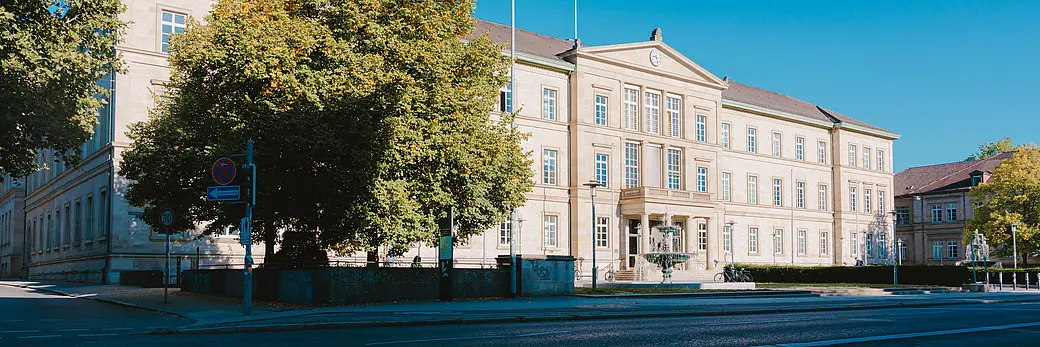

University in Germany
Tübingen, Baden-Württemberg, Germany
University profile
The University of Tübingen (Eberhard Karls Universität Tübingen) is a research university in Tübingen, Baden-Württemberg, founded in 1477 by Count Eberhard the Bearded. It is among Germany's oldest universities and is one of the institutions designated a University of Excellence under the German government's Excellence Strategy, most recently selected again in 2026. Its motto, Attempto (Latin for "I dare"), comes from the founder. Research-based learning from the first semester is a stated principle of its teaching.
Teaching and research are organised in seven faculties: Protestant Theology, Catholic Theology, Law, Medicine, Humanities, Economics and Social Sciences, and Science. The Center for Islamic Theology, opened in 2011 as the first of its kind in Germany, also offers degrees. In winter semester 2025-26 the university had 28,046 students, 543 professors and over 200 degree programmes, of which 106 are undergraduate and 138 graduate. Innovative programmes include Machine Learning, Medical Technology, Molecular Medicine, Geoecology, Nanoscience, Media Informatics, Sports Management and Islamic Theology.
There is no single campus: Tübingen is a town that is also a campus, with university buildings in the historic centre, on the outskirts and in between. The University Library works from sites including the Morgenstelle campus and Schloss Nord, and the university also runs the Botanical Garden, the University Sports Center with more than 350 courses per semester, the Museum in Schloss Hohentübingen and language courses through the Foreign Language Center and the department of German as a Foreign Language. Tübingen has about 85,000 inhabitants, around 35,000 of whom work in research or teaching or study, and the city has the lowest average age in Germany.
Research strengths include six Clusters of Excellence (infection research CMFI, plant research GreenRobust, human evolution HUMAN ORIGINS, cancer research iFIT, Machine Learning, and the geo- and life sciences cluster TERRA), eight collaborative research centres, nine DFG research training groups and 51 ERC grants (2025 figures). Neuroscience, medical imaging and AI form part of the profile, and the Cyber Valley artificial intelligence cooperation has involved the university since 2016.
International students numbered 4,495 in winter semester 2025-26. The university lists 549 international partner universities, takes part in the CIVIS European Civic University alliance (10 partner institutions) and The Guild of European Research-Intensive Universities, and has two branch offices in East Asia. An Admissions Office for International Students, a Welcome Center and a Student Counseling Service support applicants and new arrivals, and degree programmes taught fully in English are open without German. A welcome and orientation programme runs in the two weeks around each semester start.
Students from non-EU/EEA countries pay tuition of 1,500 euros per semester for a Bachelor, a consecutive Master, Staatsexamen and full Theology programmes; students taking a second degree pay 650 euros per semester. Students from EU/EEA countries pay only the semester contribution (Semesterbeitrag). This is not tuition: it is 194.80 euros for winter semester 2026/27 (107.80 euros Studierendenwerk Tübingen-Hohenheim including the naldo semester ticket solidarity charge, 80.00 euros administration fee, 7.00 euros student union fee) and 197.80 euros for summer semester 2026. It is paid by bank transfer after enrolment and within the re-enrolment period; a 10 euro surcharge applies for late payment.
The university awards Deutschlandstipendium scholarships of 300 euros per month for one year at a time, regardless of income and combinable with BAföG. Applicants in the first semester need a school-leaving average of at least 1.40 (German scale); students in higher semesters and Master students need an average of 1.40 or better (Law: at least 9 points). Doctoral students, part-time students and guest students are excluded. Foreign certificates are converted to a German average, and a German average is required. German proficiency is not required. Applications for the summer semester 2027 and winter semester 2027/28 round run from 1 to 30 November 2026 through the online portal. Deutschlandstipendium page
DAAD STIBET grants are administered through the university: the Study Completion Grant (about 550 euros per month for up to 3 months) for students close to graduation in unexpected financial difficulty, the Student Engagement Grant (about 550 euros per month for up to 3 months) for outstanding international engagement, and the Equal Opportunity Grant (about 300 euros per month for up to 5 months) for students in special circumstances such as chronic illness or disability.
Universities in Germany usually do not offer full scholarships covering living costs and tuition; students apply to external organisations. DAAD scholarships for Master students must be applied for before study begins, with deadlines up to a year ahead (for winter semester 2027/28, 15 November 2026). Only about 14% of international degree students receive a scholarship, and German at B2 or C1 is often required. Study funding for international degree-seeking students
Browse the scholarships listed for University of Tübingen and check each award’s eligibility.
View scholarships for University of Tübingen →Applicants need a higher education entrance qualification: the general (allgemeine Hochschulreife) or subject-related (fachgebundene Hochschulreife) entrance qualification, or recognition of a foreign school-leaving certificate. International applicants' certificates are checked and grades converted to the German system by the Admissions Office for International Students; the anabin database and the DAAD admissions database can be used to check entitlement beforehand. Whether a Studienkolleg and the Feststellungsprüfung are required depends on the certificate; applicants who need it are assigned to the Studienkolleg Heidelberg, which sets a written placement test, usually in October for winter semester and April for summer semester. Applicants who still have to attend Studienkolleg cannot apply for Medicine, Dentistry or Pharmacy.
Applications are made online through the ALMA portal; no application via uni-assist is needed. Up to three admission-restricted applications can be submitted. Subjects such as Biology, Psychology, Medical Technology and the Jurisprudence Staatsexamen are allocated through the nationwide DoSV procedure on hochschulstart.de for EU applicants; non-EU applicants apply only through ALMA, and there is a special quota of 5% to 10% of places for non-EU applicants. Non-EU applicants can improve their average grade for restricted programmes through above-average German skills, above-average TestAS results (0.1 to 1.0) and at least one year of vocational training or related work (up to 0.2 each); TestAS itself is not compulsory.
Deadlines: for programmes with restricted admission, 15 July for winter semester (October start) and 15 January for summer semester (April start); for programmes without restricted admission, 30 September and 31 March. Admission notices are usually issued from early August for winter semester and early February for summer semester. Applicants with university entrance qualifications from China (excluding Hong Kong, Taiwan and Macao), India or Vietnam must submit an APS certificate with the application. Documents not in German or English need a certified translation, uploaded together with the original.
Programmes taught in German require proof of German proficiency by the application deadline: DSH with an overall grade of at least DSH 2, TestDaF with at least 4 in all parts, the German part of the Studienkolleg assessment test, or the telc Deutsch C1 Hochschule exam. Holders of DSD II or C1 and the Goethe-Zertifikat C2 (GDS) are exempt. Programmes taught entirely in English do not require German; English requirements differ by programme and are set in each programme's regulations. Provisional admission without German proficiency is not possible.
Applicants upload a Bachelor certificate with transcript of records (or the latest transcript, with the certificate to follow by the end of the first semester), proof of the required German and/or English proficiency, and where the programme asks for them a letter of motivation and CV. Deadlines for restricted programmes are 15 January for summer semester and 15 July for winter semester; for unrestricted programmes 15 March and 15 September. There is no international quota at Master level. Applications are made through ALMA and up to three programmes can be applied for. Further requirements are set in each programme's selection regulations.
Doctoral candidates must first be accepted as doctoral students by a faculty, through the Dean's Office of the relevant faculty, and present written confirmation when enrolling through Student Administration. Candidates employed at the university for at least half the regular hours may be exempted from enrolment. International doctoral candidates are supported by the Welcome Center.
Wait times for visa appointments can reach 12 months in some countries, so applicants are advised to request an appointment as soon as they receive admission; it can be cancelled if enrolment does not follow.
Tübingen has no single enclosed campus; university buildings are spread through the historic old town, the Morgenstelle campus on the hill and other districts.
Accommodation: the university manages 42 one- to three-room apartments and 23 rooms in two guest houses (Dozentenwohnheim at Heuberger-Tor-Weg and guest houses at Lessingweg) for visiting researchers and guests. Student dormitories, including Heuberger-Tor-Weg 15, are run by the Studierendenwerk Tübingen-Hohenheim, and enrolled doctoral candidates may apply for a room there. Health and wellbeing programmes, a Psychosocial Counseling Service and the Student Counseling Service serve students.
Study programmes offered at University of Tübingen.
Experiences shared by students of University of Tübingen.
Studied here? Share your experience to help other applicants.

Book a free consultation with our expert counsellors and take the first step towards your dream university.
Copyrights © 2026 StudyMapped. All rights reserved.

Enter your credentials to continue.
Join us and start your study abroad journey.


