
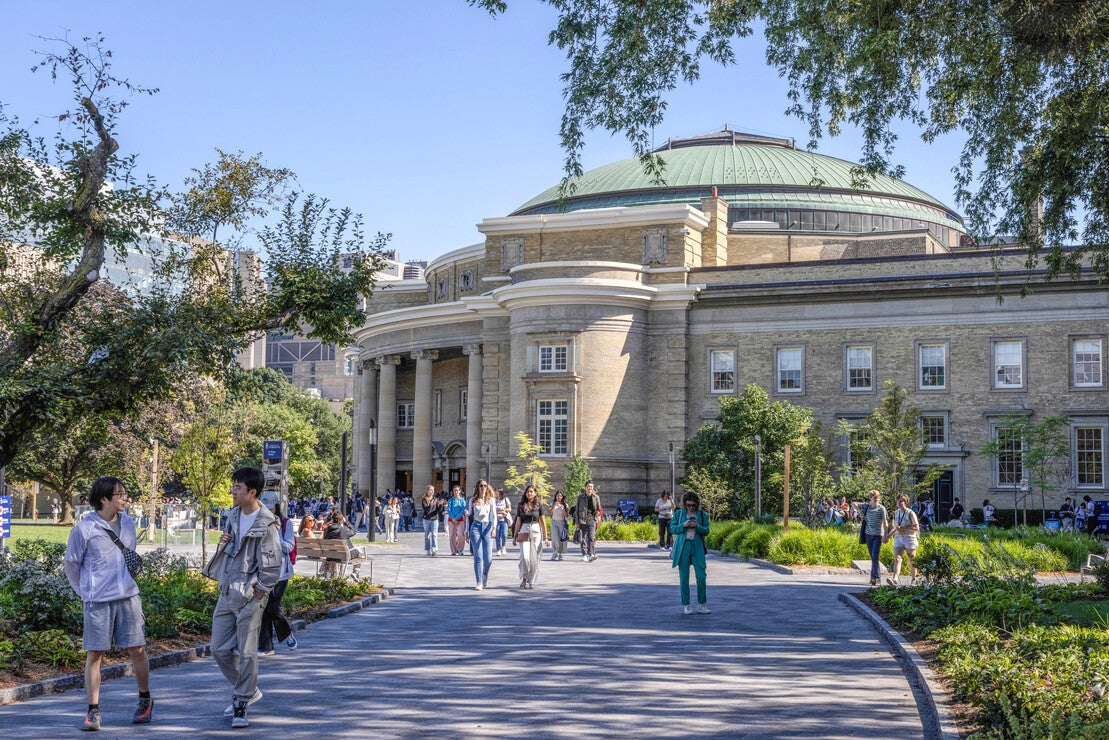

University in Canada · Featured · Top university
Toronto, Ontario, Canada
University profile
The University of Toronto, founded in 1827, is a public research university with three campuses in the Greater Toronto Area: St. George in downtown Toronto, Mississauga to the west and Scarborough in eastern Toronto. In Fall 2025-26 it enrolled 103,140 students, of whom 81,412 were undergraduates and 21,728 graduate students, taught by 16,378 faculty with 9,546 staff and 168 librarians.
First-entry undergraduate programs are delivered through Applied Science & Engineering, Architecture, Landscape, and Design, Arts & Science (at St. George, Mississauga and Scarborough), Kinesiology & Physical Education, Music, Information (iSchool) and the Transitional Year Programme. Second-entry professional programs include Education, Nursing, Dentistry, Pharmacy, Law and Medicine, and graduate study is overseen by the School of Graduate Studies. More than 700 undergraduate programs are offered across the humanities and social sciences, life sciences, physical and mathematical sciences, commerce and management, computer science, engineering, kinesiology, music, and architecture, landscape and design.
Arts & Science students at St. George belong to one of seven colleges: Innis, New College, St. Michael's, Trinity, University College, Victoria and Woodsworth. The Mississauga campus offers 180 programs in 13 admission categories, while Scarborough offers over 250 program options and runs the university's first co-op program, with more than 50 years of internships and hands-on learning. Residence applications are made through the U of T Residence Portal, and Student Life also supports off-campus housing searches.
The university has 44 libraries, including Robarts Library at St. George. International students come from 176 countries and territories; in 2025-26 the largest groups were from China (14,050), India (1,841), the United States (1,388), South Korea (1,070) and Hong Kong (774). The university has more than 720,000 alumni in 200 countries and territories, and 323 tenured-stream faculty hold Canada Research Chairs. Its governing body is the Governing Council, established by the University of Toronto Act, 1971.
All students entering first-year undergraduate study from high school, including international applicants, are automatically considered for entrance scholarships based on academic performance at admission; most need no separate application. The university reports $55 million in admission awards to 7,100 undergraduates, 5,700 awards administered by colleges, faculties and divisions, and $18.1 million in in-course awards to 7,900 undergraduates. Winners are usually told with the offer of admission, and some awards are renewable.
Awards based on financial need, Indigenous identity, first-generation status, leadership or community involvement require the Awards Profile (deadline February 1), open to eligible domestic students. External programs the university partners with include the National Scholarship Program (Canadian high school students), the Lester B. Pearson International Scholarships (academics, creativity and leadership, for international students), the Loran Scholar program and the Beland Honderich Awards.
The university cannot offer direct financial aid to international students, who are advised to seek funding in their home country; international students on a study permit are not eligible for Canadian government assistance and must show proof of financial support for the study permit. Canadian citizens, permanent residents and protected persons can use OSAP, UTAPS (the university's largest need-based grant program, applied for through Need Navigator, typically opening mid-March) and the Awards Profile.
Links: Admission awards; Student awards and scholarships; International student financial aid; Ontario financial aid; Graduate awards and funding.
National Scholarship Program →
Lester B. Pearson International Student Scholarship →
University of Toronto Scholars Program →
President's Scholars of Excellence Program →
Browse the scholarships listed for University of Toronto and check each award’s eligibility.
View scholarships for University of Toronto →Undergraduate applications are made in two steps. First, applicants submit an application through the Ontario Universities' Application Centre (OUAC), choosing up to three program areas (one application per program area). About a week later an email gives access to the Join U of T applicant portal (or the Engineering Applicant Portal), where documents are uploaded, supplemental applications or profiles are completed and the application status is tracked; residence and financial aid applications are also made there. Many programs are applied to by admission category (for example Life Sciences or Humanities) rather than by specific program.
Grade 12 English (ENG4U/EAE4U or equivalent) is required for all programs, plus program-specific prerequisites. Ontario: Ontario Secondary School Diploma with six 4U/M subjects including English; common prerequisites are Calculus & Vectors (MCV4U), Advanced Functions (MHF4U), Biology (SBI4U), Chemistry (SCH4U) and Physics (SPH4U). Alberta: five Grade 12 academic subjects numbered 30/31 including English (ELA 30-1). British Columbia: six Grade 12 academic subjects including English. Conditional offers are made from Grade 11 and 12 marks, and all courses and graduation requirements must be completed by the end of June of the application year.
A senior/Grade 12 English course is required and other prerequisites must be at senior/Grade 12 level; conditional offers rest on the previous year's grades and mid-term results. British-patterned education (including GCSE/IGCSE/O Level and A Level): five IGCSE/GCSE/Ordinary Level academic subjects and three A Level subjects (four AS subjects may be considered for most programs), with English required and Mathematics at AS or A Level for programs with the Calculus prerequisite. Caribbean CAPE: six CAPE units with English at CSEC or CAPE level. International Baccalaureate: the full Diploma with English HL or SL, assessed on predicted or final results excluding bonus points; the IB Career-related Programme is not accepted. U.S.-patterned: an accredited high school diploma with rigorous academic coursework, prerequisites at Senior Year level or AP/IB, and AP Calculus or one semester of college calculus for most math, science, computer science and commerce programs. French Baccalaureate: Baccalauréat including Anglais in première and terminale. Country-by-country minimum qualifications are set for each national system. AP and IB courses may earn transfer credit, assessed after admission.
All undergraduate applicants must present a senior-level English course (equivalent to ENG4U/EAE4U), counted in the admission average. Applicants whose first language is not English must also show proficiency unless exempt (four or more years of full-time study in a recognized Canadian school in Canada, or in an English-language school in a country where English is dominant; countries listed for possible exemption include Ghana, Nigeria, Kenya, Uganda, Zambia and South Africa). Accepted minimums: IELTS Academic overall 6.5 with no band below 6.0; TOEFL iBT overall 4.5 with Writing 4.5 and Speaking 4.0 on the new scale (for tests before January 21, 2026: total 89 with 22 in Speaking and Writing); PTE Academic overall 65 with no part below 60; Duolingo English Test overall 120 with Production 120 (tests on or after July 1, 2024); CAEL overall 70 with no part below 60; Cambridge C1 Advanced/C2 Proficiency 180 overall with 170 per component; GCSE/IGCSE/O Level English grade B (6), or GCE A Level/AS/AICE English grade C; IB English A at 4 or higher; CSEC English grade A (I) or B (II); ELDA/COPE total 86 (32 Writing, 22 Reading and Listening); U of T School of Continuing Studies Academic English level 60 with grade B. Scores must be achieved on a single date and sent electronically; TOEFL institution code 0982-00. English transition programs of six weeks to eight months run on all three campuses.
Applicants from a college or university outside Canada, and mature, non-degree and visiting students, apply through separate routes with country-specific requirements. One year of full-time university study in an English-dominant country (at least four transferable full-year courses with C in each) also satisfies the English requirement.
Master's programs require an appropriate bachelor's degree with a final-year average of at least mid-B; doctoral programs require an appropriate master's degree with at least B+, or demonstrated comparable research competence (some units admit directly from a bachelor's degree with a minimum A- average). Individual graduate units may set higher minimums and some require the GRE. Applicants from non-Canadian universities where English was not the language of instruction need a test taken within the last 24 months: IELTS Academic 7.0 with at least 6.5 in each component; TOEFL iBT 93 overall with 22 in Writing and Speaking (4.5 overall, 4.5 Writing, 4.0 Speaking on the new scale). Applications are made online through GradApp; the application fee is CDN $135 (non-refundable).
First-entry undergraduate tuition for 2025-26 ranges from approximately $6,100 to $16,090 for domestic students and $48,090 to $70,060 for international students, depending on program, before incidental fees. International students on a study permit should also budget for the University Health Insurance Plan (UHIP). Offers may require a non-refundable admission deposit paid through ACORN; it is refunded only in exceptional circumstances such as a denied study permit.
Residence and off-campus housing support is run through U of T Student Life Housing, with applications through the U of T Residence Portal.
Reasons students choose University of Toronto for their study abroad journey.
Study programmes offered at University of Toronto.
Experiences shared by students of University of Toronto.
Studied here? Share your experience to help other applicants.
A glimpse of campus life and the academic environment.




Book a free consultation with our expert counsellors and take the first step towards your dream university.
Copyrights © 2026 StudyMapped. All rights reserved.

Enter your credentials to continue.
Join us and start your study abroad journey.


