

University in South Africa
Johannesburg, Gauteng, South Africa
University profile
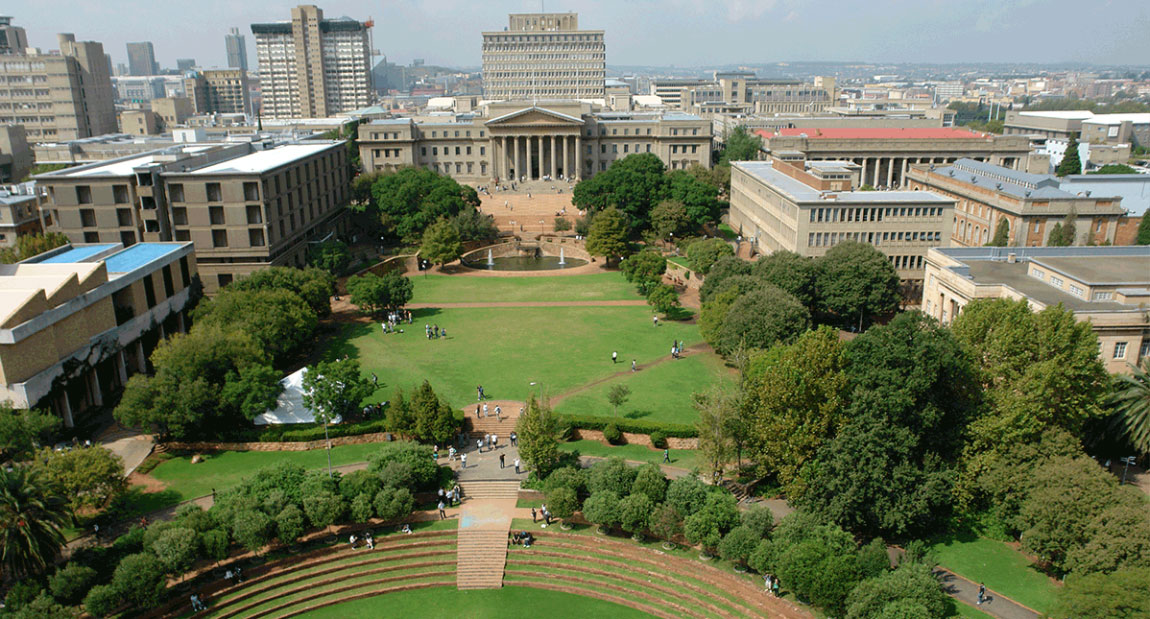
The University of the Witwatersrand, Johannesburg (Wits) is a public research university in Braamfontein, Johannesburg, whose own website describes it as linked to the development of the city for over 100 years. It reports 41,702 students in 2025, about 40% of them postgraduates, and teaches through five faculties containing 33 schools.
The five faculties are Commerce, Law and Management (Accountancy, Business Sciences, Economics and Finance, Law, Wits Business School, Wits School of Governance); Engineering and the Built Environment (Architecture and Planning, Civil and Environmental, Chemical and Metallurgical, Construction Economics and Management, Electrical and Information, Mechanical, Industrial and Aeronautical, and Mining Engineering); Health Sciences (Biomedical Sciences, Clinical Medicine, Oral Health Sciences, Pathology, Public Health, Therapeutic Sciences); Humanities (Wits School of Arts, Education, Human and Community Development, Literature, Language and Media, Social Sciences); and Science (Animal, Plant and Environmental Sciences, Chemistry, Computer Science and Applied Mathematics, Geography, Archaeology and Environmental Studies, Geosciences, Mathematics, Molecular and Cell Biology, Physics, Statistics and Actuarial Science).
Wits describes seven campuses in Parktown and Braamfontein, a digital innovation precinct, a sports complex, the Rural Campus in Mpumalanga, the Sterkfontein Caves and Pullen Farm. It also owns the Wits Donald Gordon Medical Centre, described as the only private hospital owned by a university, and runs museums, the Wits Anglo American Digital Dome and the Wits Theatre Complex.
Student life includes Wits Sport with more than 28 active clubs, Campus Health, and the Counselling and Careers Development Unit, which offers personal and career counselling, psychometric assessments and graduate recruitment. Wits lists 18 residences and 12 libraries on its facts page. Residences are catered, self-catering or Wits Junction apartments, with 24/7 security, Wi-Fi, study rooms, a free bus service, gyms and disability-friendly access.
International students need a study visa and comprehensive medical aid cover and are supported by the International Students Office (ISO) and the International Students Sub-Council (ISSC). Undergraduate applicants with non-South African school qualifications must have them evaluated by the Matriculation Board, and foreign degrees at postgraduate level by SAQA.
The 2026 maximum university funding per undergraduate is R205,000, bursaries are forfeited on deregistration, and NSFAS recipients do not receive Council funding. Council funds are allocated by the end of March.
The Wits Registration Assistance Fund (not a bursary) helps South African students with household income below R600,000 and a prior-year average of at least 50% with registration. A Donation Discretionary Fund and Wits Transitional Accommodation are available by application through student self-service. Sponsor bursaries (for example Sasol, Eskom, Vodacom and government bursaries) are applied for directly with the sponsor and administered by the Financial Aid and Scholarships Administration (FASO). Postgraduate funding opportunities are listed on the Wits Funding Portal.
Official scholarships and bursaries page | Financial aid (FASO)
Wits Vice-Chancellor's Scholarship →
CoE-HUMAN Postgraduate Bursaries (Wits) →
Wits-TUB-UNILAG Master of Urban Studies Scholarship →
Browse the scholarships listed for University of the Witwatersrand and check each award’s eligibility.
View scholarships for University of the Witwatersrand →Wits requires a National Senior Certificate (DBE, IEB or SACAI) with the achievement levels for a Bachelor's degree pass plus any faculty or school requirements. Meeting the minimum does not guarantee a place, because places are limited. Only one matric upgrade or rewrite attempt is considered. The NCV, the Senior Certificate (as amended), and matriculants from before 2008 have separate pages.
The APS uses the best seven subjects including Life Orientation, with faculty-specific subjects included; English must be taken at Home Language or First Additional Language. Wits does not distinguish between designated and non-designated subjects. Points per subject: 90-100% = 8; 80-89% = 7; 70-79% = 6; 60-69% = 5; 50-59% = 4; 40-49% = 3; below 40% = 0. English and Mathematics carry a bonus of 2 points at 60% and above (10, 9, 8, 7). Life Orientation scores 4, 3, 2, 1 for the 90-100, 80-89, 70-79 and 60-69% bands and 0 below 60%. Programme APS values are in the course entries.
Mathematics is compulsory for Commerce, Law and Management, Engineering and the Built Environment, Science and most Health Sciences programmes. Mathematical Literacy is accepted for the LLB, Education and Humanities, except Speech-Language Pathology and Audiology.
Where required, the NBTs are the Academic and Quantitative Literacy (AQL) test and the Mathematics (MAT) test; only the first attempt in the most recent year counts and results are valid for three years. Health Sciences applicants (except those listed as exempt, such as degree holders, final-year undergraduates and GEMP/GEPP applicants) must write the NBTs in person, paper and pencil, by 15 August for early feedback. Audiology and Speech-Language Pathology applicants write by 15 August. Science applicants write before the end of October. Some programmes also require a portfolio, essay or audition.
Faculty rules distinguish mature-age conditional exemption applicants aged 23 to 44 and 45 or older; an exemption does not reduce credits and does not guarantee admission. Recognition of Prior Learning is limited to particular programmes and is not open to applicants under 26. Contact the Student Enrolment Centre for transfer enquiries.
Non-South African school qualifications are evaluated by the Matriculation Board (2026 exemption fee R1,070, non-refundable); foreign degrees for postgraduate study need SAQA evaluation. English proficiency must be met. All students need a study visa and comprehensive medical aid, and the ISO issues a Letter of Undertaking. International students pay 75% of annual tuition before registration and the rest by 30 June.
Requirements and closing dates are set per programme in the online course finder; examples published include a 65% minimum average for the MSc in Artificial Intelligence (closing 30 November) and the MSc(Med) Translational Research (closing 30 September). Research and PhD applicants should first contact the school about topic and supervisor. Apply online at wits.ac.za/applications; the fee is R200 (not charged to current Wits students applying online). Certified documents must be dated within the last 3 months.
For the 2027 intake, Health Sciences, Architectural Studies, Audiology, Speech-Language Pathology and BA Film and TV closed 30 June 2026; all other programmes closed 30 September 2026. Residence applications ran 1 April to 30 September 2026. The application fee is R100, applications are online with up to three programme choices, and Wits does not deal with third-party agents. Firm offers follow final matric results; current Grade 12 learners may get provisional offers on Grade 11 results.
The 2026 first fee payment is R9,340, non-refundable, with exemptions for NSFAS-funded students, Wits scholarship holders and externally bursaried students. Residence fees for 2026: catered single from R67,554 and double from R63,384 (excluding meals); self-catering single from R55,000 and sharing from R52,500; Wits Junction apartments from R87,912; initial payment R5,000.
Entry requirements | How to apply | Postgraduate applications
Facilities include libraries (the Historical Papers Research Archive holds over 3,400 collections), seven museums, the Wits Anglo American Digital Dome, the Wits Theatre Complex, Campus Health, the Emthonjeni Centre, the Counselling and Careers Development Unit, and Wits Sport, with the Wits Brian and Dorothy Zylstra Sports Complex under development since a May 2023 ground-breaking.
Study programmes offered at University of the Witwatersrand.
Experiences shared by students of University of the Witwatersrand.
Studied here? Share your experience to help other applicants.

Book a free consultation with our expert counsellors and take the first step towards your dream university.
Copyrights © 2026 StudyMapped. All rights reserved.

Enter your credentials to continue.
Join us and start your study abroad journey.


