
University in United Kingdom
Brighton, England, United Kingdom
University profile
The University of Sussex is a public research university at Falmer, on the edge of Brighton in the south of England. Sussex was the first of the new wave of UK universities founded in the 1960s, receiving its Royal Charter on 16 August 1961, and from its foundation has had an international outlook and an emphasis on interdisciplinary study. It had 19,261 students in 2024-25 (headcount), of whom around 29% were postgraduates, and staff and students come from more than 170 countries.
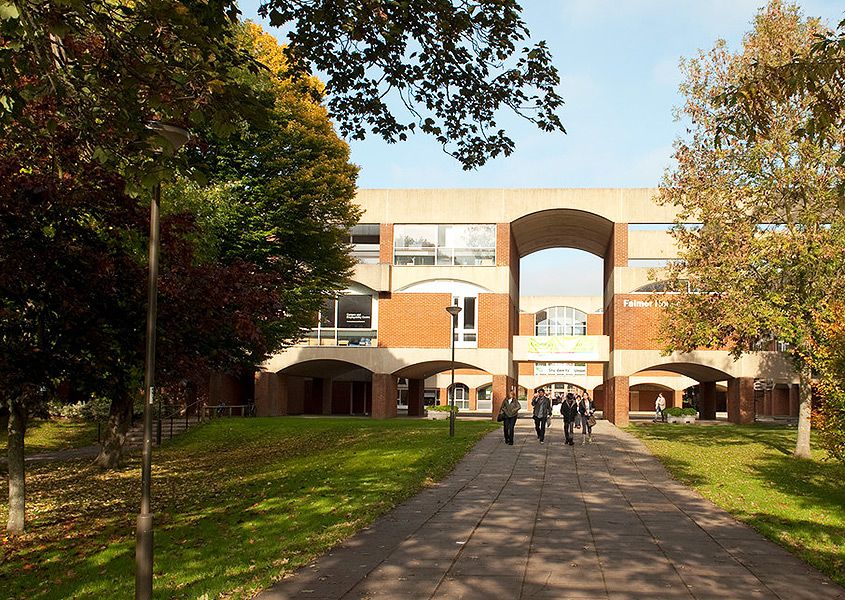
Teaching and research take place on a single campus set in parkland surrounded by the South Downs National Park, a few minutes from Brighton & Hove and within reach of London and the airports at Gatwick and Heathrow. The core buildings were designed by Sir Basil Spence and became listed buildings in 1993; Falmer House is one of only two educational buildings in the UK listed at Grade I.
Academic work is organised in four faculties: the Faculty of Media, Arts and Humanities; the Faculty of Science, Engineering and Medicine, with the Schools of Engineering and Informatics, Life Sciences, Mathematical and Physical Sciences and Psychology, and Brighton and Sussex Medical School (an equal partnership with the University of Brighton and NHS organisations in the South East); the Faculty of Social Sciences, with the Schools of Education and Social Work, Global Studies, and Law, Politics and Sociology; and the University of Sussex Business School, which includes Accounting and Finance, Strategy and Marketing, Economics, Management and SPRU (Science Policy Research Unit). The Sussex School for Progressive Futures is an interdisciplinary hub. There are more than 200 undergraduate courses across 56 subject areas and more than 200 Masters, PG Diploma and PGCE courses.
Sussex is known for development studies, delivered with its partner the Institute of Development Studies (IDS), climate change and sustainability, quantum technologies, neuroscience and consciousness science, and the study of corruption; Sussex was the first university to open a Centre for the Study of Corruption, in 2012. Six Nobel Prize winners have been members of staff.
Campus life includes more than 180 clubs, societies and sports teams run with the Students' Union, two sports centres, the Attenborough Centre for the Creative Arts, the Meeting House chaplaincy and a health centre. Accommodation is guaranteed for new undergraduate, Masters and PhD students starting in 2026-27 and 2027-28 who apply by the deadline; the new West Slope residence adds 376 ensuite rooms from autumn 2026.
International students make up 33% of the student population. The University of Sussex International Study Centre runs an International Foundation Year, International Year One and Pre-Masters programmes, and the Sussex Centre for Language Studies offers pre-sessional English. Sussex was awarded Silver in the 2023 Teaching Excellence Framework (TEF).
Home and Islands undergraduate fees follow the UK government maximum: £9,790 for 2026/27 entry, and likely £10,050 for 2027/28. Undergraduate and Masters fees for international students are set per course. For PhD study starting in 2027, the full-time fee is £5,238 per year for Home, Channel Islands and Isle of Man students, and £23,500 (non-lab) or £27,300 (lab) per year for international students; international fees rise by 3% each year. See tuition fees.
Home undergraduates with an assessed household income below £35,000 receive £1,000 in the first year (Year 1 or Foundation Year) and £500 in each later year of study, paid automatically through Student Finance on or around 13 November. Students who qualify and join in autumn 2026 also get free lunches in their first term. Sussex Bursary.
Search all awards in the undergraduate scholarships database.
See Masters scholarships. Eligible students can also apply for a government Postgraduate Masters Loan, and U.S. citizens can use Federal Direct Loans.
Funded doctoral places are available through doctoral training partnerships including CHASE, SeNSS, SoCoBio, South East Doctoral ARC, EPSRC, STFC and Leverhulme Doctoral Scholarships. See PhD funding.
Students facing financial difficulty can apply to the University's hardship fund through the Funding Team ([email protected]). Scholarship enquiries go to [email protected].
Chancellor's International Scholarships (Undergraduate) →
Sussex Pakistan Scholarship (Undergraduate) →
Sussex Türkiye Scholarship (Undergraduate) →
Sanctuary Scholarship (Undergraduate) →
Browse the scholarships listed for University of Sussex and check each award’s eligibility.
View scholarships for University of Sussex →Full-time undergraduate applications are made through UCAS (institution code S90, code name SUSX). The application deadline for most courses is 6pm on Wednesday 13 January 2027; for Medicine at Brighton and Sussex Medical School it is Thursday 15 October 2026. UCAS accepts late applications until 30 June, though some courses close earlier when full. Medicine, Primary and Early Years Education and Social Work have their own specific application routes, and some courses interview applicants.
The general entry requirement is two A-levels or equivalent, though most successful applicants have at least three A-levels or equivalent, together with a good range of GCSEs (A*-C or 4-9) including English and Mathematics. Standard offers are given per course, often as a range of three A-level grades; Life Sciences offers normally require a pass in the practical element of science A-levels. The Extended Project Qualification is taken into account but not normally included in offer conditions. Sussex also accepts the Access to HE Diploma, BTEC and OCR qualifications, the European Baccalaureate, the International Baccalaureate Diploma, Scottish Highers and Advanced Highers, T-Levels and the Welsh Baccalaureate Advanced Diploma. Mature applicants may be assessed on wider experience, and integrated foundation years are available for those without the grades for direct entry.
Applicants from postcodes in IMD deciles 1-2 or POLAR4 quintile 1, or who received free school meals, among other criteria, automatically receive a contextual offer. The typical contextual offer for first-year entry is BCC at A-level, DMM in the BTEC Level 3 Extended Diploma, or a T-Level pass with Merit and grade B in the Core Component; for foundation years it is usually CDD or DDD at A-level, MMP in BTEC, or a T-Level pass with grade C in the Core Component.
International students also apply through UCAS, and country-specific entry requirements are set out in information-by-country guides. Applicants who do not meet direct-entry requirements can take the International Foundation Year or International Year One at the University of Sussex International Study Centre. Some science and engineering courses require ATAS clearance after an offer, and students who need a visa receive a Confirmation of Acceptance for Studies (CAS) once their place is confirmed. All results must be submitted by 31 August.
Courses use three levels of English: Standard (IELTS Academic 6.0 overall with at least 5.5 in each component), High (IELTS 6.5 overall with at least 6.0 in each component) and Advanced (IELTS 7.0 overall with at least 6.5 in each component). Medicine (BMBS) requires IELTS 7.5 overall with at least 7.0 in each section. Equivalent scores are accepted in PTE Academic (Standard 59 overall with 59 in all skills; Advanced 67 with 62), Duolingo (Standard 110 with 105; Advanced 130 with 120), Cambridge CAE/CPE (Standard 169 with 162; Advanced 185 with 176), LanguageCert, Oxford ELLT and TOEFL iBT (for tests from 21 January 2026: Standard 4 overall, High 4.5, Advanced 5). Tests should normally have been taken within two years of the course start. Applicants may instead complete the Sussex pre-sessional English course.
Masters applications are made through the University's online postgraduate application portal; applications are considered from late November for September entry, and some courses also start in January. The general requirement is an upper second-class (2:1) or lower second-class (2:2) honours degree or equivalent, depending on the course. The latest recommended application dates are one month before the course start for UK applicants and two months before for international applicants, though high-demand courses close earlier. PGCE applicants apply through GOV.UK teacher training, Social Work MA/PGDip through UCAS, and postgraduate medicine through the University of Brighton. Self-funded international Masters students pay a tuition fee deposit, and the CAS is issued through the application system. Pre-Masters programmes are available at the International Study Centre.
PhD and MPhil applicants apply directly through the postgraduate application system (up to three applications), normally with a 2:1 honours degree or international equivalent and sometimes a Masters degree. Applications require a research proposal or statement, degree certificates and transcripts, English language evidence where applicable, a CV and two academic references, and applicants may be interviewed. Entry is in September with some courses also starting in January or May; the recommended deadlines are three months before the start date for international applicants and one month before for Home applicants.
All teaching takes place on the single Falmer campus, on the outskirts of Brighton (Sussex House, Brighton BN1 9RH), set in parkland within the South Downs National Park. Brighton and Sussex Medical School is run as an equal partnership with the University of Brighton and NHS organisations in the South East.
Study programmes offered at University of Sussex.
Experiences shared by students of University of Sussex.
Studied here? Share your experience to help other applicants.

Book a free consultation with our expert counsellors and take the first step towards your dream university.
Copyrights © 2026 StudyMapped. All rights reserved.

Enter your credentials to continue.
Join us and start your study abroad journey.


