
University in Germany
Stuttgart, Baden-Württemberg, Germany
University profile
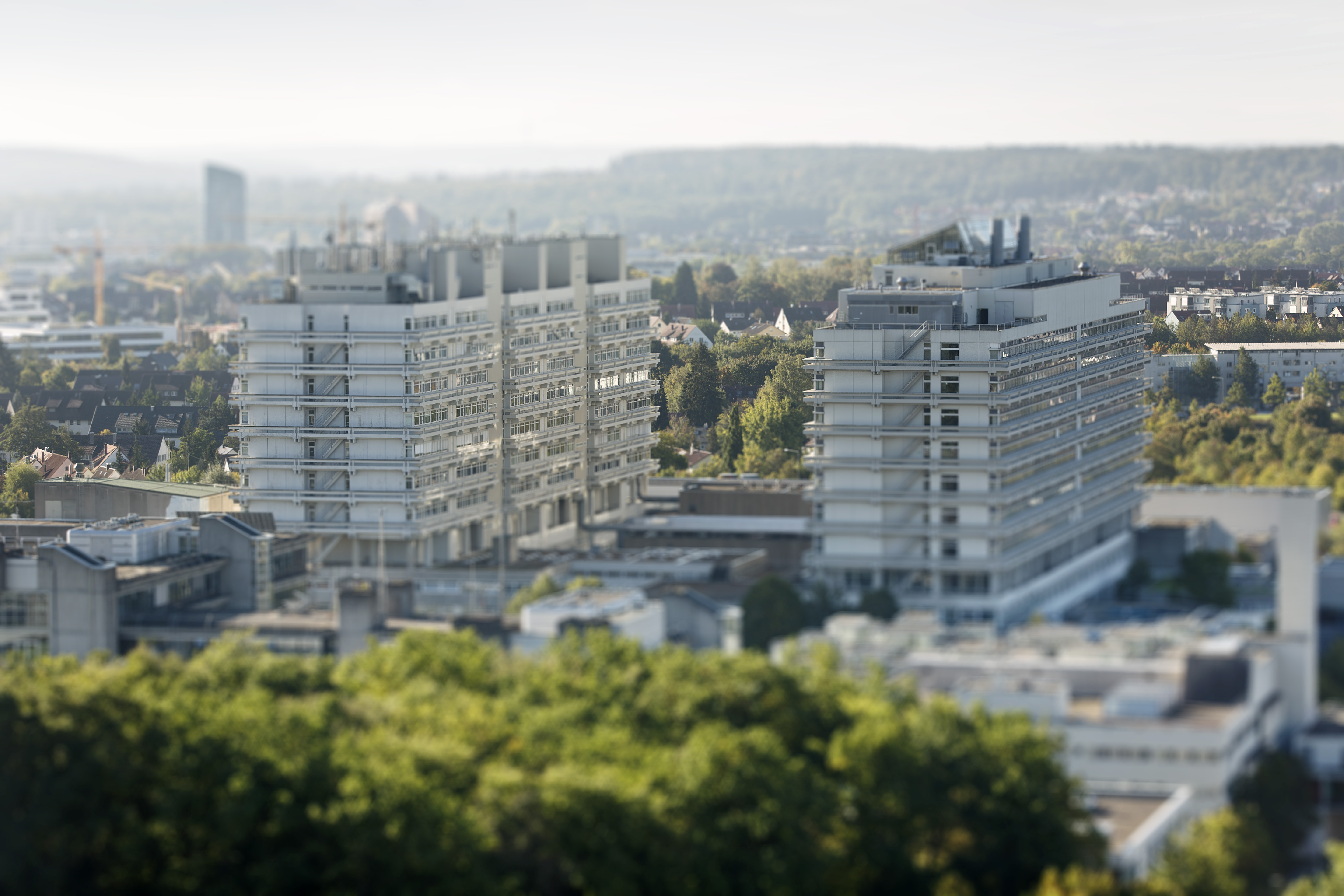
The University of Stuttgart is a technologically oriented research university in the capital of Baden-Württemberg. Its guiding idea, the Stuttgart Way, integrates engineering and the natural sciences with the humanities, management, economics and the social sciences. It is a member of the TU9 alliance of leading German universities of technology and has taken part in the federal and state Excellence Initiative and Excellence Strategy since 2007.
The university has two main sites, the Vaihingen campus in the south-west of the city and the City Centre campus (Stadtmitte). It is organised into ten faculties and around 150 institutes, with nearly 26,000 students and more than 5,600 employees.
The faculties are:
Strategic research areas include Aerospace Technologies, Architecture and Adaptive Buildings, Biomedical Systems and Robotics for Health, Digital Humanities and Societies, Production Technologies, Quantum Technologies and Simulation Science. Central facilities include the University Library, the Graduate Academy GRADUS and the High Performance Computing Center Stuttgart (HLRS), whose Hawk supercomputer is among the fastest in the world.
Campus life centres on student organisations, campus sports, the Startup Café, Café Faust and Campus Beach, with dining halls and cafeterias on both campuses. Student housing is provided mainly by the Studierendenwerk Stuttgart, which maintains more than 5,800 places in 31 dormitories in Stuttgart, Ludwigsburg, Esslingen and Göppingen, and by the Vereinigung Stuttgarter Studentenwohnheime e.V. with 2,578 places on the Vaihingen and Stadtmitte campuses.
About 20 per cent of students are international. The university maintains relationships with nearly 400 universities abroad, offers more than 500 exchange places with partners and is expanding its English-language Master's programmes; the teaching language of the Bachelor's programmes and most Master's programmes is German. Applications for all programmes are made online through the C@MPUS portal. The University of Stuttgart is a public university of the state of Baden-Württemberg.
Most students pay no tuition. Non-EU/EEA degree students pay tuition of EUR 1,500.00 per semester, as at all state universities in Baden-Württemberg, and students beginning a second Bachelor's or a second consecutive Master's programme pay EUR 650.00 per semester. Exemptions are rare and mostly apply to students with a refugee background, a disability or a sudden financial emergency. Separately, every student pays the semester fee (Semesterbeitrag), which is not tuition: EUR 184.00 for students and EUR 177.50 for doctoral students, made up of an administrative fee of EUR 80.00, a Student Services fee of EUR 96.50 and a student body fee. The university also states living costs in Stuttgart of at least EUR 992 per month.
The Germany Scholarship pays EUR 300 per month, half from the Federal Ministry of Education and Research and half from private sponsors. It is a merit award requiring above-average marks plus at least one further criterion such as social commitment or background. Applications are usually accepted for ten days each January for awards starting in April, and awards run for one year with the option to re-apply. German and international degree students enrolled in the summer semester may apply, and the award does not reduce BAföG.
The university does not offer its own scholarships for degree studies; international degree students are directed mainly to the DAAD scholarship database. International degree students in an unexpected financial emergency may apply for temporary support such as DAAD STIBET I, Beihilfe or the Bürkert emergency fund after consultation with the International Office. The Studierendenwerk Stuttgart advises on BAföG and student loans. The university also lists foundations such as the German Academic Scholarship Foundation, political and religious foundations and scholarships for women. More: Financial aid and scholarships, Deutschlandstipendium, Financing for international students.
Deutschlandstipendium at the University of Stuttgart →
DAAD STIBET I Final Stage Scholarship (University of Stuttgart) →
Browse the scholarships listed for University of Stuttgart and check each award’s eligibility.
View scholarships for University of Stuttgart →Applicants need a higher education entrance qualification: the Abitur for all programmes, a vocational entrance qualification for the programmes named in the certificate, or successfully completed undergraduate studies. Holders of a Fachhochschulreife or subject-specific Hochschulreife who wish to study a different field must pass a Delta Examination. Bachelor's programmes start only in the winter semester. Programmes with selective admission or entrance exams accept applications from 15 May to 15 July; programmes without selection accept applications from 15 May to 15 September. Where a combined degree includes a restricted major, the deadline is 15 July. All applicants, whatever their nationality, apply online through the C@MPUS portal; there is no application fee.
Applicants with a foreign qualification must have it recognised as equivalent. Non-EU applicants upload their entrance qualification with transcript, any university entrance exam results, previous higher education records, proof of German proficiency and any other requested documents, with documents translated into German or English by a sworn translator and uploaded in both original and translation. Applicants with credentials from India, China and Vietnam must add an APS certificate from the German Embassy Academic Evaluation Centre; applicants from Pakistan need the Higher Education Commission stamp on degree certificates. Applicants whose school certificate does not qualify them for direct entry may be referred to a Studienkolleg: the University of Stuttgart has none of its own and assigns applicants to the Studienkolleg at the Karlsruhe Institute of Technology (T course) or at Heidelberg University (G/S/W course). It requires at least 500 to 800 hours of German, and applications run from 15 May to 15 July for the winter semester and 15 November to 15 January for the summer semester.
The teaching language of the Bachelor's programmes and most Master's programmes is German, and proof of German must be supplied at the time of application. Accepted proofs include TestDaF with level 4 in all four parts, Goethe-Zertifikat C1 or C2, the Deutsches Sprachdiplom of the Kultusministerkonferenz (DSD II), telc Deutsch C1 Hochschule, DSH-2 or higher, ÖSD C2, the German section of the Studienkolleg assessment test, or a previous degree taught in German. The university offers preparatory German courses lasting from 3 weeks (TestDaF training) to two semesters. English-taught Master's programmes require sufficient English; the level is set in each programme's admission regulation.
Applicants need a completed Bachelor's degree of at least six semesters, or an equivalent qualification, in the same or a closely related subject. Many programmes add subject-specific criteria set out in their admission regulations, such as a supplementary application, interviews or numerus clausus ranking. Documents include a transcript with grades and ECTS credits, the Bachelor's certificate if already issued, and a description of the modules taken. Admission subject to requirements allows missing modules to be made up before the Master's thesis. Master's programmes taught in German usually accept applications from 15 May to 15 July for the winter semester, and some from 1 December to 15 January for the summer semester. English-taught programmes have their own periods, for example Chemical Sciences from 1 February to 15 July, Computer Science from 15 November to 15 January (winter) and 15 May to 15 July (summer), and Computational Linguistics from 15 May to 15 July (winter) and 1 December to 15 January (summer).
Doctoral candidates register in C@MPUS, apply for acceptance as a doctoral researcher through the Graduate Academy GRADUS, and then enrol. The application includes a signed doctoral agreement with work plan and timetable, a curriculum vitae and the Master's or equivalent certificate and transcript; applicants with foreign degrees submit certified copies of Master's and Bachelor's certificates and the form on formal equivalence of foreign degrees.
Facilities include the University Library, laboratories and research centres, the Startup Café, Café Faust, dining halls and cafeterias, learning spaces and a family-friendly campus programme with accessibility information for buildings. Student residences are run by the Studierendenwerk Stuttgart (more than 5,800 places in 31 dormitories across Stuttgart, Ludwigsburg, Esslingen and Göppingen) and the Vereinigung Stuttgarter Studentenwohnheime e.V. (2,578 places).
Study programmes offered at University of Stuttgart.
Experiences shared by students of University of Stuttgart.
Studied here? Share your experience to help other applicants.

Book a free consultation with our expert counsellors and take the first step towards your dream university.
Copyrights © 2026 StudyMapped. All rights reserved.

Enter your credentials to continue.
Join us and start your study abroad journey.


