

University in United Kingdom
Glasgow, Scotland, United Kingdom
University profile
The University of Strathclyde is a technological university in the centre of Glasgow, founded in 1796 as Anderson's Institution under the will of the Glasgow scientist John Anderson to be ‘a place of useful learning’. It received its Royal Charter in 1964, and that founding purpose still shapes a practical, industry-linked approach to teaching and research. Almost 30,000 students from over 140 countries study at Strathclyde.
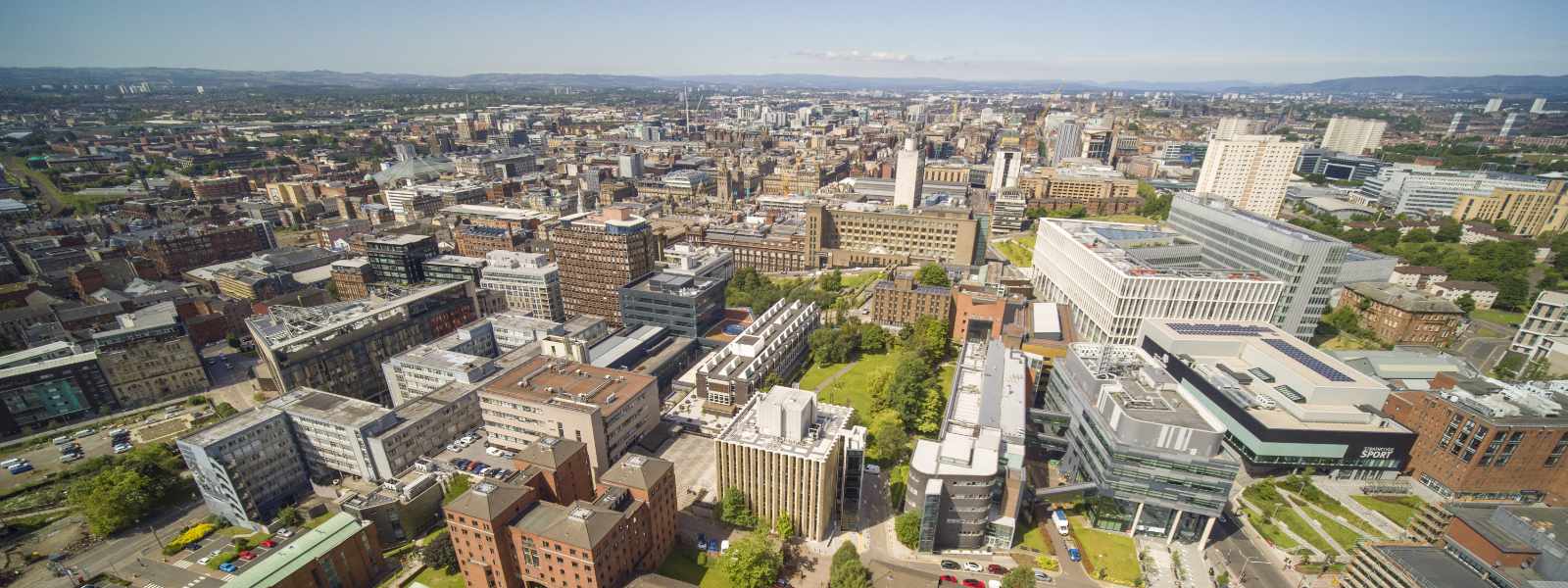
The main campus sits in Glasgow city centre beside the Merchant City, five minutes from George Square and a short walk from two mainline railway stations, the bus station and the subway. Teaching, research, the Andersonian Library, Strathclyde Sport and the campus village of student residences are all on one compact city-centre site. The University also runs a campus in the Harbour Heights building in the Bahrain Harbour district of Manama, offering degrees in business, engineering and computing.
Study is organised in four faculties: the Faculty of Engineering, with eight departments from Architecture to Naval Architecture, Ocean & Marine Engineering; the Faculty of Humanities & Social Sciences, including Education, Law and the Centre for Lifelong Learning; the Faculty of Science, including the Strathclyde Institute of Pharmacy & Biomedical Sciences; and Strathclyde Business School, home to the Hunter Centre for Entrepreneurship, Strategy & Innovation and the MBA. There are almost 250 undergraduate courses, alongside taught masters, research degrees, degree apprenticeships and online learning.
Research and industry partnership are concentrated in the Technology & Innovation Centre on George Street and in flagship centres such as the National Manufacturing Institute Scotland, the Advanced Forming Research Centre, the Continuous Manufacturing & Crystallisation centre (CMAC), the Institute of Photonics, the Fraser of Allander Institute and the Centre for Energy Policy. The University has received the Queen’s Anniversary Prize in 1996, 2019, 2021 and 2023.
Around 1,300 students live each year in University-managed accommodation on campus. Strath Union, the students’ union, is based in the Dame Jocelyn Bell Burnell Wing of the Learning and Teaching Building and runs societies, sports clubs and wellbeing support. International students are supported by the Recruitment & International Office and an International Student Support Team, and those who do not meet direct entry requirements can take pathway programmes at the University of Strathclyde International Study Centre.
The University is a charitable body registered in Scotland (number SC015263). Its awards include Daily Mail UK University of the Year (2026), Scottish University of the Year in The Times & Sunday Times Good University Guide 2026 and Research University of the Year in the Daily Mail University Guide 2027.
Students from Scotland usually make no personal contribution to tuition fees; students who normally live outside Scotland usually pay fees. Fees for students from the rest of the UK were £9,790 a year for full-time undergraduate programmes in 2026/27 (subject to Parliamentary approval); Scottish and rest-of-UK rates for 2027/28 were still to be confirmed.
International undergraduate fees, 2027/28 entry:
Postgraduate taught fees, 2027/28 entry: Scotland and rest-of-UK students pay £10,700 (Humanities & Social Sciences), £13,300 (Science), £13,800 (Pure & Applied Chemistry) and £12,550 (Engineering). International students pay £24,950 (Humanities & Social Sciences), £32,800 (Engineering; Architecture £28,500), £28,500 to £34,800 across Science departments, and programme-specific rates at the Business School. Fees for later years can rise by up to 10% a year. Fees
EU Engagement Scholarships at the Business School are worth £5,000 to £8,000. For students from England, Wales and Northern Ireland, the Strathclyde Excellence Scholarship is worth up to £1,000 and the Humanities & Social Sciences RUK Deans Excellence Scholarship up to £2,000. Undergraduate scholarships
Students may hold only one University scholarship per academic year, and fully government- or embassy-sponsored students are not eligible for the faculty international scholarships. Scholarship search | Engineering international scholarships
The Student Money Support Team ([email protected], +44 (0)141 548 2753) advises on funding and financial support, and hardship support includes a Mature Students Hardship Fund. Electronic & Electrical Engineering students can also apply for industry-sponsored scholarships, including IET Power Academy awards with annual bursaries of up to £5,000. Funding your studies
Faculty of Engineering International Scholarship for Undergraduate Study (September 2026) →
Faculty of Science Undergraduate Scholarships for International Students (2026/27) →
BBA International Scholarship (September 2026) →
Browse the scholarships listed for University of Strathclyde and check each award’s eligibility.
View scholarships for University of Strathclyde →UK applicants apply through UCAS; the University’s UCAS institution code is S78. For 2027 entry the UCAS application fee is £34.50 for up to five choices. The UCAS deadline for equal consideration for September 2026 entry was 14 January 2026; several courses use a ‘gathered field’, considering most applications after the January deadline, so decisions may come in March. Applications must include achieved and pending qualifications, a personal statement and an academic reference.
Entry requirements are set for each course in SQA Highers and Advanced Highers, A Levels, the International Baccalaureate and HNC/HND, and the Irish Leaving Certificate and BTEC are also welcomed. Each course lists Standard Entry Requirements and lower Minimum Entry Requirements. For example, the BA Economics & Business Law asks for Highers AAAA/AAABB at first sitting (minimum ABBB), A Levels ABB-BBB and IB 32-30. Advanced entry to Year 2 (or Year 3) is possible on some courses with Advanced Highers, A Levels, IB or a relevant HND. Most offers are made on the UCAS application alone, but some courses require an interview or a portfolio. Relevant qualifications must normally have been completed within the last 5 years for Engineering, Science and Business School programmes and within 3 years for Humanities & Social Sciences.
Applicants in any of five contextual categories, such as a Scottish SIMD Quintile 1 or 2 postcode, attending a target school or having care experience, are considered against the Minimum Entry Requirements. Applicants from the rest of the UK with a Quintile 1 postcode receive a one-grade concession in a non-essential subject from the minimum published A Level range. Care-experienced applicants who meet or are working towards the Minimum Entry Requirements are guaranteed an offer for most courses. Some Engineering and Science applicants may receive an offer conditional on the four-week STEM Summer School.
International applicants can apply through UCAS or by Direct Application, which may not be available for every course. Country-by-country entry requirements apply; many national school-leaving qualifications lead to entry through a foundation programme, while IB, A Levels and the American High School Diploma may allow direct entry. The University of Strathclyde International Study Centre offers an Undergraduate Foundation Programme (progression to Year 2 of business, social sciences, engineering or science degrees) and International Year Two (progression to the second or third year of business degrees). Ineligible international applicants are automatically considered for a relevant International Foundation Programme.
Some courses set different levels, and other recognised English tests are accepted. English Language Teaching courses allow offer holders to meet language conditions without retaking a test.
Applications are made online through the Pegasus applicant portal from the course page; PGDE teacher-training applications go through UCAS. Applicants upload their degree certificate and transcript, translations where needed, English test results, a passport (for overseas applicants’ CAS), sponsor letters and any CV, personal statement or portfolio required. Decisions usually take around 10 working days. Equivalence is assessed by country, for example a UK 2:1 or 2:2 benchmark. For September 2026 programmes, international applicants faced fixed deadlines of Friday 31 July 2026 for applicants from Bangladesh, Ghana, Nepal and the Indian states of Punjab, Gujarat and Haryana, and Friday 14 August 2026 for all other countries; PGDE and MSc Secondary Education closed on 30 June 2026. A Pre-Masters Programme at the International Study Centre is available to those who do not meet direct entry requirements.
Applicants either apply for an advertised PhD project or submit their own research proposal at any time. Routes include the PhD, PhD@Work, professional doctorates, Centres for Doctoral Training and MRes/MPhil degrees.
Recruitment & International Office, Level 4, Graham Hills Building, 50 George Street, Glasgow G1 1XP; +44 (0)141 548 2913; [email protected], [email protected], [email protected].
The John Anderson campus lies in the heart of Glasgow beside the Merchant City, around George Street, Cathedral Street, Richmond Street and Rottenrow. All four faculties teach here. Main buildings include the Royal College Building, James Weir Building, John Anderson Building, Graham Hills Building, Livingstone Tower, McCance Building, Learning and Teaching Building, Lord Hope Building (humanities), Strathclyde Business School and Sir William Duncan Building, the Strathclyde Institute of Pharmacy & Biomedical Sciences building and the Technology & Innovation Centre at 99 George Street.
The National Manufacturing Institute Scotland and Advanced Forming Research Centre (85 Inchinnan Drive, PA4 9LJ), next to Glasgow International Airport, carry out manufacturing research and development with industry.
Located in Harbour Heights in the Bahrain Harbour district of Manama. Programmes include the BBA Business Administration (with a Marketing specialisation option), BEng Mechanical, Electronic & Electrical, Civil and Chemical Engineering, BSc Hons Computer Science and Software Engineering, and the MSc Economics & Finance and MSc Finance. Applicants must also meet the requirements of Bahrain’s Higher Education Council.
Study programmes offered at University of Strathclyde.
Experiences shared by students of University of Strathclyde.
Studied here? Share your experience to help other applicants.

Book a free consultation with our expert counsellors and take the first step towards your dream university.
Copyrights © 2026 StudyMapped. All rights reserved.

Enter your credentials to continue.
Join us and start your study abroad journey.


