
University in United Kingdom
Stirling, Scotland, United Kingdom
University profile
The University of Stirling is a public university in central Scotland, founded in 1967 by Royal Charter as part of the expansion of UK higher education that followed the 1963 Robbins Report. Lord Robbins was its first Chancellor. It has more than 17,500 students from over 140 nationalities, including more than 11,000 undergraduates and more than 6,000 postgraduates, and around 1,500 staff; more than 30% of students are international.
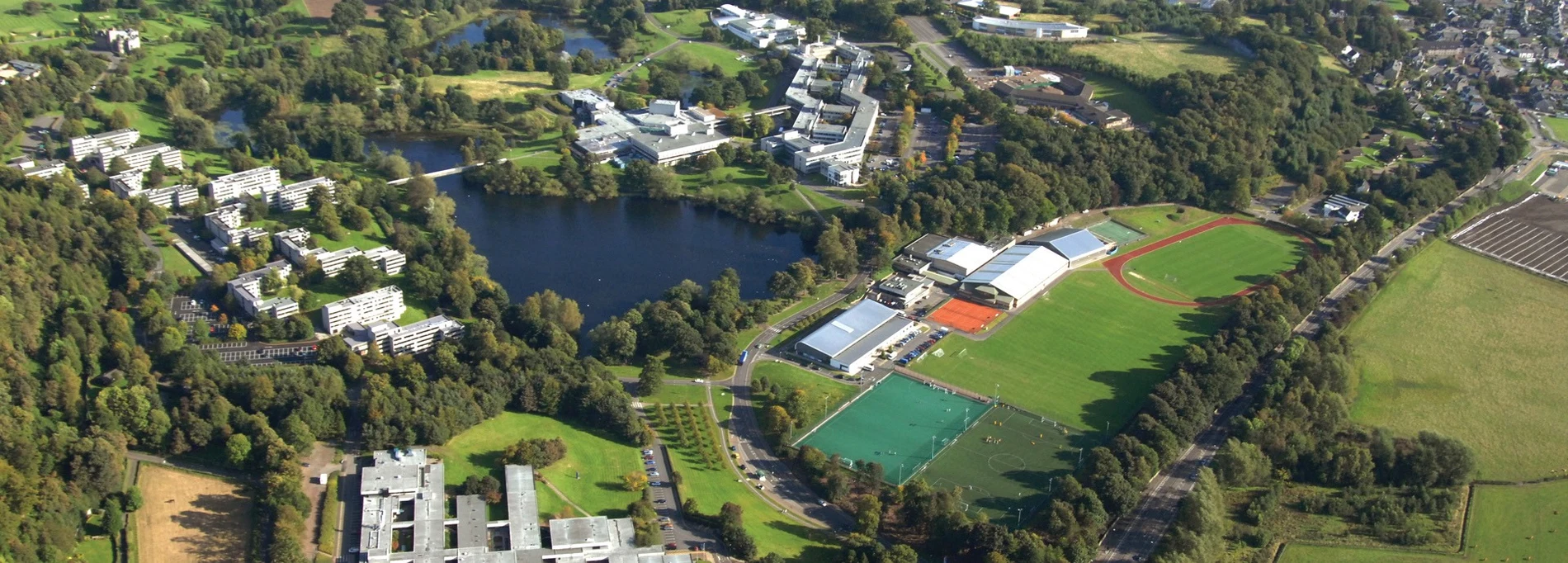
The main campus is a 330-acre estate two miles from Stirling city centre, with a castle and loch and views of the foothills of the Highlands, and with fast transport links to Glasgow and Edinburgh. Degrees are also taught overseas, including at an international campus in Ras Al Khaimah (UAE) and through partners in China, Japan, Singapore, Vietnam, Spain and Hungary.
Teaching and research run through three faculties and a business school: the Faculty of Arts, Humanities and Social Sciences (Schools of Humanities; Law, Politics and Social Science; and Communication), the Faculty of Health, Sport and Society (Schools of Education and Social Work; Health Sciences; Public Health and Society; and Sport), the Faculty of Natural Sciences (Schools of Life and Environmental Sciences; Computing, Data and Mathematical Sciences; and Psychology) and the University of Stirling Business School, which holds AACSB accreditation. The Institute for Advanced Studies supports postgraduate researchers.
Notable strengths include the Institute of Aquaculture, the largest centre of its kind in the world and a Queen's Anniversary Prize winner (2019), along with sport: Stirling is Scotland's University for Sporting Excellence, a Scottish Government designation, and runs a high-performance sport programme that has supported more than 700 student-athletes since 1981. Other centres include the Institute of Social Marketing and Health and the Salvation Army Centre for Addiction Services and Research.
Campus life centres on Campus Central, with shops, cafés and the Student Services Hub. There is also a Sports Centre with a 50m pool, the Macrobert Arts Centre, a three-floor library and an on-campus NHS medical and dental practice. The University manages over 2,800 rooms on and off campus, and the Students' Union supports more than 120 societies. International students can prepare through pathway programmes at the University of Stirling International Study Centre, run with INTO, and the University holds an institutional Athena Swan Silver award.
Scottish undergraduates do not pay tuition fees; the Scottish Government pays them through SAAS, and students must reapply each year. Students from England, Wales, Northern Ireland, the Republic of Ireland, the Channel Islands and the Isle of Man pay Rest of UK fees, and international (including EU) students pay an annual international fee. Both rates are set by course. Postgraduate research fees for 2026/27:
Overseas PhD fees are fixed at the point of entry. Scottish nursing students receive a SAAS bursary of £10,000 a year in Years 1 to 3 and £7,500 in Year 4.
UK and Irish students can apply to their national funding body for tuition fee and maintenance loans. The University is approved to administer US Federal Education Loans. The Money Support team gives financial advice and manages discretionary and childcare funds.
Undergraduate Africa Scholarship →
Europe Undergraduate Scholarship →
Undergraduate USA Scholarship →
University of Stirling International Study Centre Progression Scholarships →
Browse the scholarships listed for University of Stirling and check each award’s eligibility.
View scholarships for University of Stirling →Full-time undergraduate degrees starting in September are applied for through UCAS, wherever the applicant lives (UCAS name STIRL, institution code S75). Applicants may choose up to five courses and submit a personal statement. Within a few days of applying, they receive access to the Applicant Portal. Deferred entry is also handled through UCAS. January entry is offered on some courses to international students and to students from England, Wales, Northern Ireland and the Republic of Ireland, with applications made directly to the University. Part-time study also uses direct application and is not open to students who need a visa.
Paramedic Science, Sports Studies, and Physical Education and Professional Education include an interview. Successful Social Work applicants submit an additional piece of written work.
Course-specific grades and essential subjects are set on each course page. Widening access applicants may be eligible for adjusted (contextual) offers, for example those from priority postcode areas, care-experienced or estranged students, carers, refugees and asylum seekers, and students on SWAP or Stirling's own Access to Degree Studies course. Recognition of prior learning can shorten a degree.
Accepted qualifications and grades are set country by country. Examples include the IB Diploma with points set by course and HL5 in essential subjects, A-levels at a minimum of BBB, and Australian certificates with a minimum ATAR of 70. Students from some systems need a recognised foundation programme first. The University of Stirling International Study Centre, run with INTO on the Stirling campus, offers an International Foundation (leading to Year 2), International Year 2 (leading to Year 3) and Pre-Masters pathways, including iCAS routes that combine pathway and degree under one visa.
Applicants whose first language is not English must show proof of English at one of three levels, set by course and valid for two years before the course starts:
Applicants from Bangladesh, Iran, Iraq, Nepal, Pakistan and Sri Lanka must take a Secure English Language Test (SELT). Nationals of majority English-speaking countries and of Canada, and holders of an equivalent degree from those countries gained in the past five years, do not need to prove their English.
Most Masters courses require at least a second-class Honours degree or equivalent, and some ask for a higher classification or relevant experience. Applications are made online through the course pages, all year round and up to a year before the start date. International applicants may also apply through representatives. Most courses start in September and some in January. Applicants submit transcripts, certificates, one reference (a professional reference for named professional courses) and a supporting statement. International applicants add translations, proof of English and, if they need a visa, a copy of their passport.
Research degrees (MPhil, PhD and Professional Doctorates) normally require a Masters degree and at least an upper second-class bachelor's degree. Integrated 1+3 routes combine a taught year with three years of PhD research.
Students who need a visa must accept an unconditional offer and pay the tuition fee deposit before a CAS is issued. CAS information is issued only three months before the start of the academic year.
A 330-acre estate two miles from Stirling city centre (Stirling FK9 4LA), with Airthrey Loch and Airthrey Castle. All faculties and the Business School teach here, and all facilities are within a ten-minute walk of each other.
An international campus in the Ras Al Khaimah Economic Zone, teaching Stirling undergraduate degrees in English: Accounting and Finance, Computing Science, Data Science and Artificial Intelligence, Management and Software Engineering.
Study programmes offered at University of Stirling.
Experiences shared by students of University of Stirling.
Studied here? Share your experience to help other applicants.

Book a free consultation with our expert counsellors and take the first step towards your dream university.
Copyrights © 2026 StudyMapped. All rights reserved.

Enter your credentials to continue.
Join us and start your study abroad journey.


