
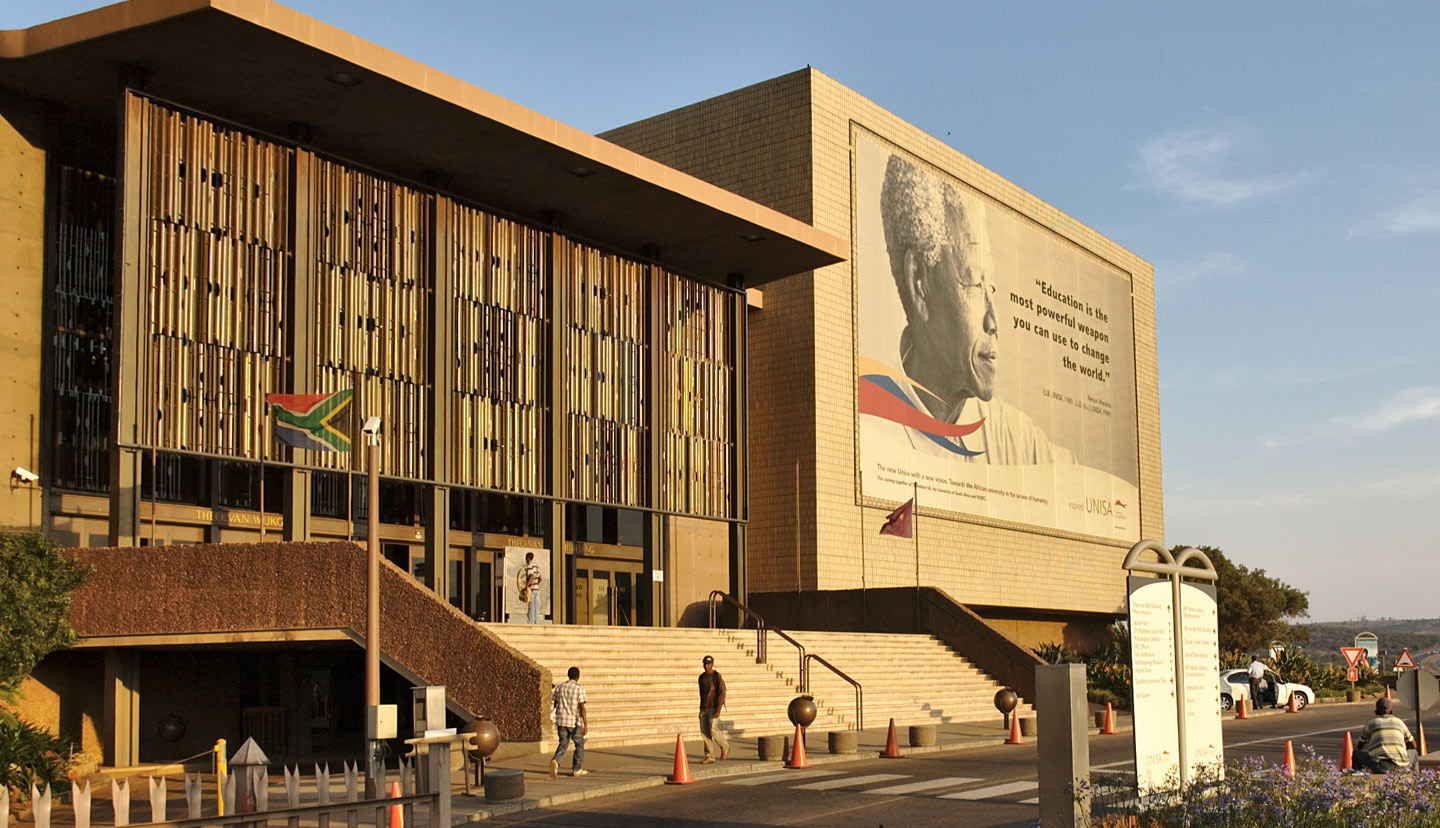

University in South Africa
Pretoria, Gauteng, South Africa
University profile
The University of South Africa (Unisa) is a public comprehensive open, distance and e-learning (CODeL) university, and the only higher education institution that carries the country's name. It is the largest university in South Africa and on the African continent and is counted among the world's mega-universities, with more than 370 000 students from South Africa, Africa and other parts of the world, including students from 109 countries. It accounts for 12.8% of all degrees awarded by South Africa's 26 public universities and universities of technology. Its stated vision is to be the African university shaping futures in the service of humanity.
The head office and main campus are at Muckleneuk Ridge in Pretoria. The Science Campus is in Florida and the Sunnyside Campus is in Pretoria. Seven regional centres (Eastern Cape, Ethiopia, Gauteng, KwaZulu-Natal, Midlands, North Eastern and Western Cape) offer advice, meetings with counsellors, academic literacies services and limited computer access. Because teaching is by distance, most students study from home using myUnisa, myLife email and the online library.
Academic work is organised in eight colleges: Accounting Sciences; Agriculture and Environmental Sciences; Economic and Management Sciences; Education; Human Sciences; Law; Science, Engineering and Technology; and the College of Graduate Studies. The Graduate School of Business Leadership and the Thabo Mbeki African School of Public and International Affairs complete the academic structure. The College of Science, Engineering and Technology includes the Schools of Science, Engineering and Built Environment, and Computing, and five of its engineering diplomas are accredited by the Engineering Council of South Africa.
Qualifications range from advanced certificates, higher certificates, diplomas and advanced diplomas through bachelor degrees, postgraduate certificates and diplomas, honours, master's and doctoral degrees, plus short learning programmes. Recognition of Prior Learning is available for access and for module credit. Teaching, research and engaged scholarship are the three core business areas, and since 2021 the academic agenda has been focused on ten catalytic niche areas, from marine and aviation studies to energy, space and the Square Kilometre Array, and biotechnology.
Student support includes the Advocacy and Resource Centre for Students with Disabilities (alternative-format study material, sign language interpretation, orientation and mobility, examination accommodations and assistive technology support), the Student Retention Project in the College of Human Sciences, and the Library, described as the largest academic library in Africa, with 24/7 online access to databases, e-journals and e-books. Unisa is recognised by the Department of Education, accredited by the Council on Higher Education, and its qualifications are registered with SAQA.
For South African citizens registered for any formal qualification who achieved an average of at least 75% in the previous year of study. Covers tuition fees and prescribed textbooks, subject to available funding. Awards are by invitation from the Division of Student Funding; documents are an ID copy, proof of household income, parents' IDs for dependants and an academic record. Recipients in 2026 do not reapply but must keep a 75% average. Undergraduate bursaries
For South African citizens. New applicants: undergraduate (NQF 7) completers by 31 January 2027 with an average of at least 60% over the whole qualification, or second-year NQF 8 students with at least three postgraduate modules passed at an average of 60%. Returning beneficiaries need a 50% average in previously funded modules. Covers tuition only, for two consecutive years. Applications 21 September to 30 November 2026 through the myUnisa student bursaries app; students must be temporarily registered by 31 January 2027. Appeals 3 to 7 May 2027. Official page
Open to registered master's students within three years of first registration and doctoral students within six, with a passed research proposal (or two passed modules for coursework master's) by 31 January 2027 and the required chapter progress; supervisor support is needed. Covers tuition and research allowances: master's by research R55 000 over 3 years, master's by coursework R25 000 over 3 years, doctoral by research R80 000 over 4 years, doctoral by experimental research R120 000 over 4 years. South African citizens have priority at an 80/20 ratio. Applications 21 September to 30 November 2026. Official page
The Division of Student Funding also administers Hillensberg Trust, SETA, Department of Transport and Department of Sport, Arts and Culture bursaries under donor criteria. NSFAS (bursary for households earning up to R350 000 a year, loan for R350 001 to R600 000) is applied for on the NSFAS website; the 2027 closing date is 31 October 2026. NSFAS covers tuition, a learning material allowance of R660 per module for the first four modules (R5 678 for five or more) and an incidental allowance of R316.70 a month for 10 months. Funding enquiries: [email protected]. NSFAS at Unisa | Student fees and funding
Unisa Hillensberg Trust Bursary →
Unisa Postgraduate Diploma and Honours Bursary →
Unisa Master's and Doctoral Bursary →
Browse the scholarships listed for University of South Africa and check each award’s eligibility.
View scholarships for University of South Africa →Undergraduate and honours/postgraduate diploma applications: 17 August to 9 October 2026. Master's and doctoral applications: 1 September to 20 November 2026 (selection degrees and some other qualifications have different periods). Short learning programme applications open 2 November 2026. All applications are online; applications are not accepted at regional self-help stations for postgraduate study.
Applicants must meet the statutory and college requirements and the minimum Academic Point Score (APS) of the chosen qualification. Applicants may apply for up to three qualifications in order of preference but register for only one; selection depends on available places, not on order of application. Learners completing Grade 12 in 2026 may apply for 2027.
APS uses six recognised 20-credit NSC subjects, excluding Life Orientation, to a maximum of 42: 7 = 80-100%, 6 = 70-79%, 5 = 60-69%, 4 = 50-59%, 3 = 40-49%, 2 = 30-39%, 1 = 0-29%. Minimum APS differs by college and qualification.
A completed higher certificate does not guarantee admission to a diploma or degree, as places are limited. Senior Certificate (pre-2009) holders are assessed against Senior Certificate symbol requirements and equivalence tables.
Upload a school qualification, official tertiary academic records where applicable (internet copies not accepted), ID or passport, marriage or divorce documents if relevant, and sworn translations for documents not in English or Afrikaans. Files: maximum 2 MB each, black and white, PDF, DOC or TIF. The non-refundable application fee is R160, paid by bank deposit or online (no cash), with proof sent to [email protected], and is due by the closing date. Outcomes are issued four to six weeks after closing; offers must be accepted or declined within 10 working days, only one offer can be accepted, and first-time applicants must complete the First-Year Experience MOOC before accepting. Accepted applicants must register for semester 1 of 2027 or reapply. Students pay per module, typically 4 to 6 modules a year at roughly R1 925 to R8 005 per module, plus prescribed books.
RPL provides access without a formal qualification and credit for modules, assessed through portfolios, challenge examinations, interviews and workplace assessments. Programme pages set age and experience conditions, for example at least 27 years, Grade 10 and about five years' relevant experience for the BSc General (30 years for the BBA). Credits and exemptions from other institutions are assessed case by case, up to 50% of prescribed credits.
Admission is not automatic and depends on qualification requirements and space. Master's and doctoral applicants may apply for only one qualification (a second application replaces the first), need a student number first, and normally supply a research outline, CV and academic records (MBA, MBL, DBL and some coursework programmes need no research outline). Final-year undergraduates may apply for postgraduate study.
Apply online at www.unisa.ac.za/apply; the application fee is R160 (payable through Flywire, or SWIFT once a student number is issued). Foreign school qualifications must be on the Matriculation Board's acceptable list, and bachelor applicants may need a Certificate of Conditional Exemption (M30 form, separate fee). Foreign tertiary qualifications for postgraduate entry must be evaluated by SAQA (required NQF level: doctoral 10; master's 9; honours, postgraduate diploma and professional bachelor's 8; advanced diploma 7); the certificate can follow after acceptance but is needed before re-registration, sent to [email protected]. A foreign levy is payable at registration, and students outside Africa pay it. Documents needed: passport copy and sworn translations where required. Contact: [email protected] (undergraduate), [email protected] (master's and doctoral). Recognition of Unisa qualifications in the home country should be confirmed with the relevant authority there.
The Library, with a postgraduate and academic personal-librarian service, can be reached on +27 12 429 3313 (P O Box 392, UNISA, 0003). The Student Communication Centre is open Monday to Friday 08:00 to 19:00 and Saturday 08:00 to 14:00.
Experiences shared by students of University of South Africa.
Studied here? Share your experience to help other applicants.

Book a free consultation with our expert counsellors and take the first step towards your dream university.
Copyrights © 2026 StudyMapped. All rights reserved.

Enter your credentials to continue.
Join us and start your study abroad journey.


