

University in Canada
Saskatoon, Saskatchewan, Canada
University profile
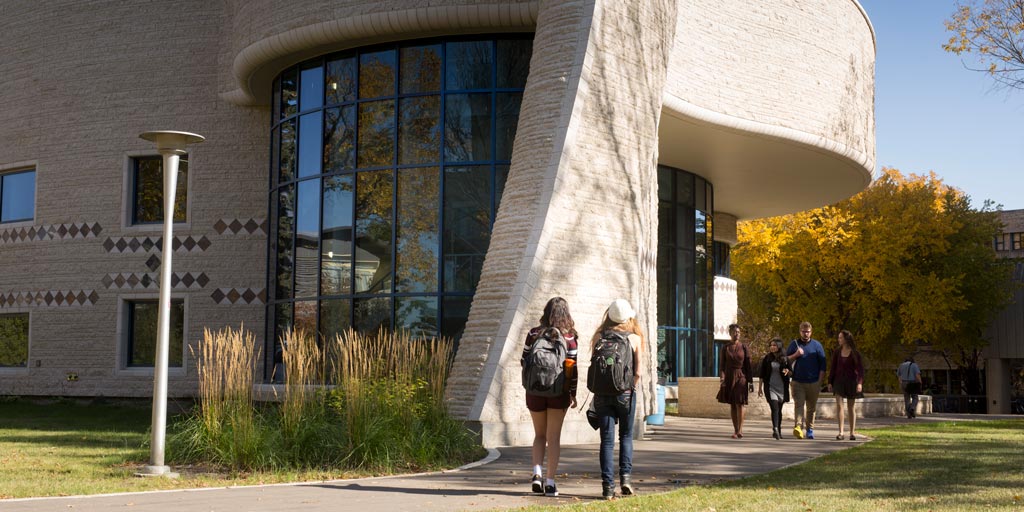
The University of Saskatchewan (USask) is a research-intensive, medical-doctoral university whose main campus is in Saskatoon, Saskatchewan, on Treaty 6 territory and the traditional homeland of the Metis. It was established in 1907 and is a member of Canada's U15 group of research universities. The campus is known for its greystone buildings, green space and tree-lined walkways.
Teaching is organised in 13 interdisciplinary colleges, three graduate schools and six affiliated or federated colleges. Direct-entry colleges for first-year students are Agriculture and Bioresources, Arts and Science, Dentistry (dental hygiene and dental therapy), Education, the Edwards School of Business, Engineering, Kinesiology and St. Thomas More College. Law, Medicine, Nursing, Pharmacy and Nutrition, Veterinary Medicine and Dentistry (DMD) require prior university study. Other units include the School of Environment and Sustainability, the School of Public Health, the School of Rehabilitation Science, the Johnson-Shoyama Graduate School of Public Policy, the College of Graduate and Postdoctoral Studies and the University Library. Federated and affiliated colleges include Briercrest College, St. Thomas More College, Horizon College and Seminary, the Gabriel Dumont Institute, St. Peter's College, the Saskatoon Theological Union, the College of Emmanuel and St. Chad, St. Andrew's College and Lutheran Theological Seminary.
Research strengths include water and food security and infectious diseases. Major facilities are the Canadian Light Source synchrotron, the Vaccine and Infectious Disease Organization (VIDO), the Global Institute for Food Security, the Global Institute for Water Security and the Sylvia Fedoruk Canadian Centre for Nuclear Innovation. One in four students takes part in hands-on research during their degree.
Student life centres on more than 150 clubs and student groups, large intramural programs, and the Huskies, with 15 athletic teams playing in the PAC, Griffiths Stadium and Merlis Belsher Place. The Gordon Oakes Red Bear Student Centre is an intercultural gathering place that integrates Indigenous culture on campus, and the Health Sciences Building brings eight health science fields together. Residences include College Quarter, McEown Park and Graduate House, with Voyageur Place also part of the residence system, and meal plans are part of every residence agreement. A U-Pass bus pass is included in student fees.
USask reports more than 25,900 students, including over 4,300 graduate students, more than 3,100 international students and more than 3,400 self-declared Indigenous students, with students from 130 countries. The International Student and Study Abroad Centre (ISSAC) provides intercultural learning, one-on-one support and settlement help. International students are considered for scholarships on admission and may be eligible to work in Canada during and after study. The university also welcomes exchange students from partner institutions.
600 entering students each year receive $5,000 scholarships, awarded automatically on admission average to students in direct-entry programs (Agriculture and Bioresources, Arts and Science, Dentistry, Education, Engineering, Kinesiology, Edwards School of Business). Eligible applicants are current high school students or graduates with fewer than 18 transferable credit units. The application for admission, fee and all documents must be received by December 1. Offers are emailed from late April, and the award is paid toward tuition and fees by mid-September to students enrolled in at least 18 credit units in the fall and winter terms with a final official high school transcript on file.
The highest-value renewable entrance awards, based on academics, leadership and community contributions: George and Marsha Ivany President's First and Best Scholarships ($40,000, $10,000 a year over four years), Chancellors' Scholarships ($30,000, $7,500 a year), University of Saskatchewan Entrance Scholarships ($30,000, $7,500 a year), Edwards Undergraduate Scholarships ($36,000, $9,000 a year) and College of Agriculture and Bioresources Torvald and Margaret Tollefson Renewable Entrance Scholarships ($24,000, $6,000 a year). Five Circle of Honour awards are designated for Indigenous students. Admission applications are due December 1 and the Best and Brightest application in PAWS by December 15.
Scholarships are based on academic achievement and may consider activities and leadership. Bursaries are based on financial need, assessed with the Financial Need Calculator in PAWS. Apply for admission by February 15, submit documents by March 1 and both award applications in PAWS by March 1. Applicants are asked for a list of activities and reference letters. Offers are emailed between April 1 and July 1 and must be accepted within two weeks.
Awarded on academic achievement, with admission applications due February 15: the University of Saskatchewan International Excellence Award ($10,000, one offered) and the International Baccalaureate Excellence Award ($20,000, one offered, for international students completing the IB Diploma). All international students are considered for scholarships on admission, and most awards are open to international applicants. IB Diploma students are considered automatically for IB awards, with a February 15 admission deadline.
Further transfer awards, off-campus awards and a searchable awards database are listed on the official scholarships page: admissions.usask.ca/money/scholarships.php.
Browse the scholarships listed for University of Saskatchewan and check each award’s eligibility.
View scholarships for University of Saskatchewan →Most programs are applied for through an admissions account at apply.usask.ca. The online application takes about 30 minutes and can be saved and finished later. A Visa or Mastercard is needed to pay the application fee, which is a minimum, non-refundable $120 CAD for most programs (some programs differ). Applicants usually submit one application, naming a first and second choice program for most bachelor programs. Admission requirements and deadlines depend on the program, the intended start term and whether the applicant has attended university before. Applying early gives access to early admission and scholarships, and some scholarship applications are due before the application deadline. Required documents (transcripts, report cards and others) are tracked in the applicant's account.
Applicants can apply from high school to Agriculture and Bioresources, Arts and Science, Education, the Edwards School of Business, Engineering, Kinesiology, Dental Hygiene and Dental Therapy. Dentistry (DMD), Law, Medicine, Nursing, Nutrition, Pharmacy and Veterinary Medicine are non-direct and require prior university study, with requirements set on each program page. Specific Grade 12 subjects are prerequisites for particular areas of study, for example Grade 12 pre-calculus mathematics, chemistry and physics for some programs.
For direct-entry colleges the admission average is calculated from five marks: one English, one mathematics and three other approved subjects (at most two natural sciences, two social sciences or humanities, and one fine or performing art). Marks from international high schools are converted to Canadian grading. For current Grade 12 students, an average calculated from September to February 1 uses Grade 11 marks; from February 2 to June 30 it uses marks to the end of Grade 12 Term 1; after June 30 only Grade 12-level marks are used. Offers based on earlier marks are conditional on a minimum average on final Grade 12 marks. High school graduates are assessed on Grade 12-level subjects only, including those with fewer than 18 transferable credit units of post-secondary study. Applicants with 18 or more transferable credit units are assessed as transfer students.
Requirement pages exist for applicants from Ghana, Nigeria, India, China, Pakistan, Jamaica, Hong Kong, Mexico, Brazil, Colombia, Ecuador, Vietnam, the United States, GCSE/GCE (United Kingdom), the International Baccalaureate and every Canadian province and territory. Most international students must include a provincial attestation letter (PAL) with a study permit application unless exempt. After an offer, applicants should confirm their status in the USask application portal before making payments or applying for a study permit. Education agents may be used but are not required. IB Diploma and AP applicants and mature, home-based, visiting, casual and early-learner applicants have separate pathways. Transfer credit is assessed against a database of recognised institutions that includes institutions in Ghana and Nigeria.
English is the language of instruction. Applicants whose first language is not English may need to show proficiency by one of: completing secondary study in an approved English-medium program (for example at least 3 years including Grades 10 to 12 with Grade 12 English; overseas Canadian-curriculum schools need at least 65% in Grade 12 English); one year of full-time degree study at a recognised English-medium institution; or an accepted test. Minimums: IELTS Academic overall 6.5 with at least 6 in each skill; TOEFL iBT (institution code 0980) overall 4.5 with at least 4 in each skill on the new scale, while scores on the former 0-120 scale taken before January 21, 2026 remain acceptable at 86 overall with 19 per component for up to two years; Cambridge C1 Advanced 176; CAEL 70 with at least 60 in each skill; Duolingo English Test 120 overall with at least 100 in each area (from January 1, 2026); PTE Academic 63 with at least 59 in each skill. Scores come from one sitting and are valid for two years. Other accepted evidence includes AP English 4 or better, IB English A HL or English B HL 5 or better, GCSE/IGCSE/O-Level English grade B or better, and GCE A/AS Level English grade B or better. Approved curricula include IGCSE and CBSE (India), GCSE/GCE O and A Levels, CAPE, SQA, NZQA and Australian curricula.
Applicants not meeting regular requirements may be considered if they are 21 or older by the first day of classes and entering first year with fewer than 18 university credit units. There is no separate form: applicants first apply in the usual way, and if suitable are asked for proof of age, a written request, a current resume and any other credentials, prepared separately for each college.
Master's, Ph.D. and graduate certificate programs require an undergraduate degree in a relevant field and are applied for through the graduate admissions site (grad.usask.ca).
Facilities include the Physical Activity Centre (fitness centre, Jr. Olympic pool, racquetball and squash courts, climbing wall, gymnasiums, dance studio, gymnastics room, indoor track), tennis courts, a curling rink, a hockey rink, playing fields and an outdoor track, Griffiths Stadium at Nutrien Park, Merlis Belsher Place, the Greystone Theatre, Louis Pub and a Culinary Centre dining hall overlooking the Bowl. Residences are College Quarter (suites of two to four bedrooms, with Queer Housing program), McEown Park (Assiniboine, Wollaston, Souris and Seager Wheeler Halls for upper-year students, couples and families), Graduate House and Voyageur Place. Residence staff include Resident Assistants, a Counsellor in Residence and Faculty in Residence, with free tutoring several nights a week. Homestay is available to international students through the Canada Homestay Network.
Study programmes offered at University of Saskatchewan.
Experiences shared by students of University of Saskatchewan.
Studied here? Share your experience to help other applicants.

Book a free consultation with our expert counsellors and take the first step towards your dream university.
Copyrights © 2026 StudyMapped. All rights reserved.

Enter your credentials to continue.
Join us and start your study abroad journey.


