
University in Germany
Rostock, Mecklenburg-Vorpommern, Germany
University profile
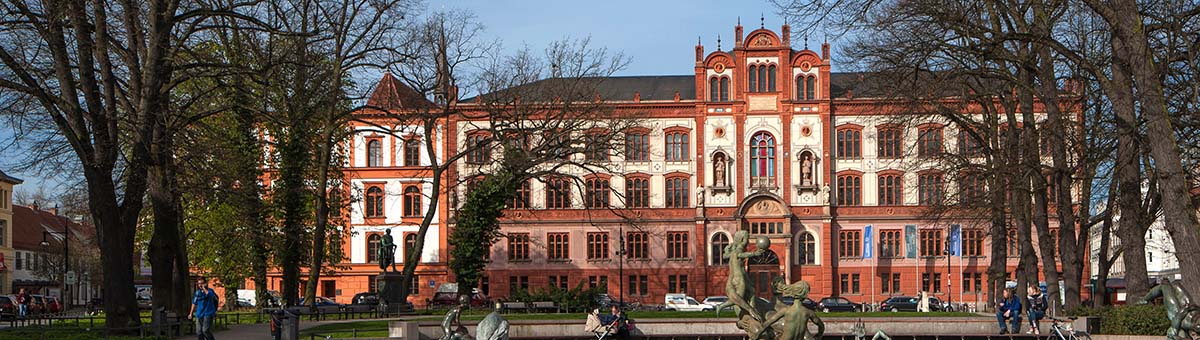
The University of Rostock (Universität Rostock) in Rostock, Mecklenburg-Vorpommern, was founded in 1419 and is the oldest university in the Baltic Sea region. It is a public comprehensive university with the motto Traditio et Innovatio and about 14,000 students. The main building stands on the Universitätsplatz in the old town, and the university has also built a completely new natural sciences campus in the Südstadt district.
Teaching and research are organised in nine faculties: Agricultural and Environmental Sciences; Computer Science and Electrical Engineering; Law; Mechanical Engineering and Marine Technology; Mathematics and Natural Sciences; Arts and Humanities; Theology; Rostock University Medicine; and Economic and Social Sciences. The Interdisciplinary Faculty brings researchers from all disciplines together in four profile lines: Life, Light and Matter; Maritime Systems; Ageing of Individuals and Society; and Knowledge, Culture, Transformation. The technical faculty founded in 1951 was the first ever established at a classical university.
More than 150 degree programmes are offered, among them English-taught Master's programmes in Computational Science and Engineering, Computer Science International, Culture, Ecology and Change, Electrical Engineering, Physics and Sustainable Maritime Engineering, the Erasmus Mundus programme EMship in ship design, and the English-language doctoral programme Molecular Mechanisms of Regenerative Processes. Medical Biotechnology is taught in German and English (German C1 and English B2 required). The university belongs to the EU-CONEXUS European university alliance, a consortium of ten universities focused on the sustainability of coastal regions.
Student life centres on the Hanseatic city. Six refectories run by the Studierendenwerk serve students across the city, about 250 sports courses are open to students and staff, and music, theatre and cultural life include the University Choir, the University Orchestra and the student cabaret ROhrSTOCK, founded in 1970 and described as the oldest active student cabaret in Germany. The Studierendenwerk Rostock-Wismar operates the student halls of residence, and many students rent rooms in shared flats, popularly in the Köpelinger-Tor-Vorstadt district.
International students are supported by the Rostock International House and the International Office, which organise orientation weeks, a tandem programme, partnership programmes with the Senior Academy and a Local Erasmus Initiative. The university is a public body of the State of Mecklenburg-Vorpommern, supervised by the state ministry responsible for science and culture.
There is no tuition at the University of Rostock. Students pay only a semester fee once each semester (Semesterbeitrag), which is not tuition. It funds Studierendenwerk services, student bodies and the Semesterticket, which is the Deutschlandticket and allows travel on local public transport in Germany for the semester; the Warnow ferries are not included.
The university has taken part in the Deutschlandstipendium since the winter semester 2011/2012. It supports talented students with 300 euros per month, paid half by private sponsors and half by the Federal Government. Criteria include achievement at school or university, social commitment and overcoming biographical obstacles. Sponsors may tie awards to subject areas, and one third of all scholarships are not tied to a subject. Official page.
The International Office awards the DAAD-funded Stibet scholarship every six months to international students who intend to complete their Bachelor's, Master's or doctorate in the current semester and face financial difficulties. Official page.
The university advises that financial support for foreign applicants is limited and refers students to the DAAD scholarship database and the Studierendenwerk Rostock-Wismar social counselling. Gender and Diversity offers scholarship programmes for doctoral candidates and postdocs, including scholarships for junior scientists and a fund for the advancement of women in science. Non-EU students must show financing for the visa; the university gives the cost of living in Rostock as roughly 980 euros per month. International students may work up to 140 full or 280 half days per calendar year. Scholarships overview.
Browse the scholarships listed for University of Rostock and check each award’s eligibility.
View scholarships for University of Rostock →Undergraduate study requires a recognised university entrance qualification (Hochschulzugangsberechtigung): the Abitur, a subject-specific entrance qualification, a first professional degree, advanced vocational training leading to a general entrance qualification, or an entrance examination. A university of applied sciences entrance qualification does not entitle the holder to study at the University of Rostock. International applicants can check whether their foreign school-leaving certificate qualifies through the anabin database.
Programmes are either open admission or restricted (Numerus Clausus); restricted programmes require an application, open programmes proceed directly to enrolment. Applicants who gained their entrance qualification abroad and have studied only abroad, from inside or outside the EU/EEA, apply through uni-assist. Applicants for a higher semester apply directly to the University of Rostock. Medicine and Dentistry follow the same routes for international applicants.
Applicants whose school education does not equal a German entrance qualification can attend a Studienkolleg, which ends with the Feststellungsprüfung; passing it removes the need for a separate language certificate. Rostock has no Studienkolleg of its own. The nearest are the Studienkolleg of the University of Hamburg and the Studienkolleg of Hochschule Wismar, which offers the W-course and T-course preparing for economics, social science and technical degrees.
Most programmes require German at level C1 of the Common European Framework, and some require B2; the level for each programme is shown in its programme profile. English-taught programmes may require no German. Accepted proofs include DSH (DSH-1 equals B2, DSH-2 equals C1, DSH-3 equals C2; the DSH is not offered at Rostock), TestDaF (at least TDN 3 in all four parts for B2, at least 16 points in total, 4 x 4, for C1), the Deutsches Sprachdiplom (DSD II), Goethe certificates, telc C1 or B2, ÖSD and UNIcert (level II = B2, III = C1, IV = C2). Language certificates without a stated validity are generally accepted for a maximum of two years.
For English-taught programmes the university uses a reference framework in which IELTS 5.5, 6.0 or 6.5 corresponds to B2 and IELTS 7.0, 7.5 or 8.0 to C1, alongside TOEFL, telc, Cambridge, TOEIC and UNIcert equivalents. The level required is stated in each programme profile.
Applicants with a degree from a German university apply directly to the university. Applicants with a foreign degree apply directly for programmes with local admission restrictions and through uni-assist for programmes without restrictions. Application periods for unrestricted Master's programmes are 1 February to 31 March for the summer semester and 1 June to 30 September for the winter semester. For restricted programmes they are 1 December to 15 January for the summer semester and 1 June to 15 July for the winter semester; applicants with a foreign degree to restricted programmes apply from 1 June to 15 July for the winter semester. Incomplete or late applications are not considered, and unattested copies are not accepted.
The faculties are responsible for doctoral regulations and procedures. International applicants who studied abroad submit their application through uni-assist from 1 February 2026 and receive an evaluation report, which is then uploaded to the university's online portal for admission and enrolment. Documents include the attested copy of the degree entitling the holder to a doctorate with transcript, other degrees, entrance certificates, passport copy, a tabular curriculum vitae from age 16, the evaluation report not older than one year and the registration of doctoral candidates handed to the Graduate Academy. The portal opens for the winter semester from 1 June to 31 March and for the summer semester from 1 February to 30 September. Enrolled students can change to doctoral status within the university.
After admission, international students register in the online portal, print and sign the enrolment application and submit a passport copy, electronic proof of German statutory health insurance (or exemption), attested copies of entrance and university certificates with German or English translation, proof of language skills, a tabular curriculum vitae and exmatriculation certificates from earlier universities. Non-EU students need a visa for study purposes, not a tourist visa. Documents for the embassy include a valid passport, the letter of admission and proof of financing of at least 992 euros per month or 11,904 euros per year, for example a grant award or a blocked account. After arrival, non-EU nationals apply to the Rostock Migration Office for a residence permit; documents include the registration certificate, rental agreement, proof of health insurance, a certificate of expected study duration and biometric photographs. Documents submitted to German authorities generally must be in German.
The University of Rostock is spread across several sites in the Hanseatic city of Rostock.
Facilities include the Rostock University Library, the Language Center (a licensed test centre for TestDaF and UNIcert), roughly 250 university sports courses, music ensembles and six refectories.
Experiences shared by students of University of Rostock.
Studied here? Share your experience to help other applicants.

Book a free consultation with our expert counsellors and take the first step towards your dream university.
Copyrights © 2026 StudyMapped. All rights reserved.

Enter your credentials to continue.
Join us and start your study abroad journey.


