
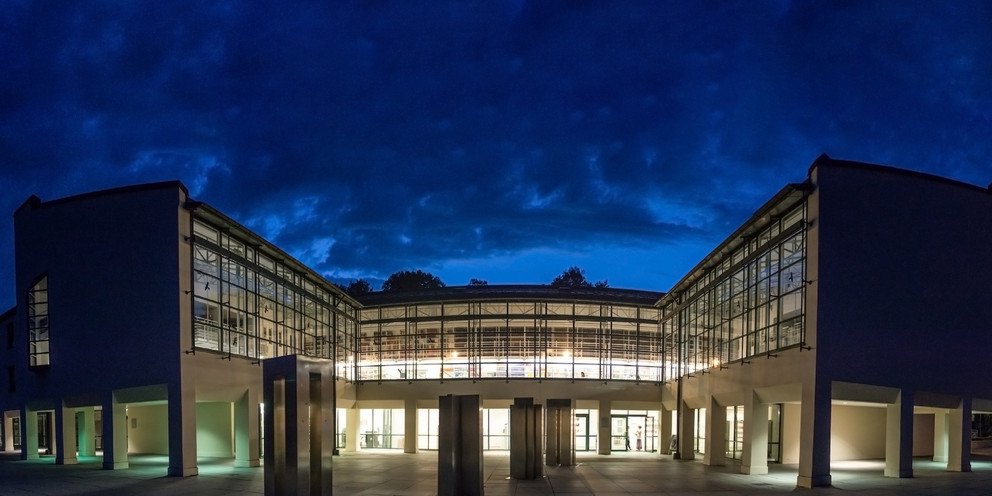

University in Germany
Passau, Bayern, Germany
University profile
The University of Passau (Universität Passau) is a state university in the Lower Bavarian city of Passau, at the confluence of the Danube, Inn and Ilz rivers in the east of Bavaria, between Munich, Prague and Vienna. It opened on 9 October 1978 and today enrols 10,123 students (1 June 2026), of whom 1,899 (18.76%) are international students. Its subject range covers the humanities, law, the social sciences, economics and business, and computer science and mathematics, and it describes itself as a Bavarian university for Europe with a strong international network, with partnerships with more than 327 universities abroad.
Teaching and research are organised in five faculties: the Faculty of Law; the Faculty of Business, Economics and Information Systems; the Faculty of Social and Educational Sciences (founded in 2023, covering political science, sociology, communication science, geography, psychology and educational science); the Faculty of Humanities and Cultural Studies; and the Faculty of Computer Science and Mathematics, the youngest faculty, which is expanding work on artificial intelligence and IT security under the Hightech Agenda Bavaria. The Department of Catholic Theology is also part of the university.
Degrees include the Law state examination programme, Bachelor's programmes such as B.Sc. Computer Science, B.Sc. Artificial Intelligence and B.A. European Studies, teacher education programmes, and Master's programmes including M.Sc. Artificial Intelligence Engineering, M.A. Development Studies and LL.M. German Law for foreign graduates. Several programmes are taught in English, double degree options exist with partner universities, and the Language Centre offers courses in fourteen languages.
Central facilities include the University Library, the Graduate Centre, the Language Centre, the Sports Centre, the Centre for Information Technology and Media Services, the Teacher Education Centre and the Passau International Centre for Advanced Interdisciplinary Studies (PICAIS). The city has around 50,000 inhabitants, which gives student life a personal scale. More than 100 student clubs and societies cover music, politics, languages, film, sport and other interests, and the Student Services Association (Studierendenwerk Niederbayern/Oberpfalz) runs the refectory, cafeterias and halls of residence, with private flatshares and studios as the main alternative.
The university ranks among the leading 30 percent of institutions worldwide in the Times Higher Education World University Ranking (601–650 band of 2,297 institutions in the latest edition), placed 187th of 2,016 institutions in the UI GreenMetric Ranking, and its Law, Business Administration and Information Systems programmes achieved top placements in the CHE Ranking 2026. As a Bavarian state university, admission is governed by the Bavarian Higher Education Law (BayHSchG).
The semester fee (Semesterbeitrag) is paid at the start of every semester and is not tuition. For winter semester 2026/27 it is EUR 126.90, of which EUR 82 goes to the Student Services Association (Studierendenwerk) and EUR 44.90 pays for the semester bus pass on city buses in Passau. It is refundable if a student de-registers before the semester starts. Typical monthly living costs quoted by the university are accommodation EUR 300–550, food EUR 200–300, telephone, internet and broadcasting fee EUR 35–50, health insurance EUR 110–150 (under 30) or about EUR 200 (over 30) and other costs EUR 70–100.
The university awards the Deutschlandstipendium, a monthly stipend of EUR 300, to students at all stages of study with excellent academic results, strong social commitment or who have overcome hurdles in their own life and education. See the Deutschlandstipendium page.
Students from the second semester and doctoral candidates in financial need can receive a one-off grant of up to EUR 500 for books and learning materials (including laptops and tablets) or, for doctoral candidates, thesis printing costs. Students must receive BAföG or have dependants’ income not above twice the BAföG allowance; doctoral candidates must not exceed a monthly income of EUR 1,800. An academic reference from a university teacher is required. See the scholarship page.
International students in acute financial difficulty can apply for a one-off payment under the Promotion of Internationalisation programme, from the 3rd semester (Bachelor’s) or 2nd semester (Master’s) at the earliest, with a complete online application and an academic reference from a Passau professor. See emergency aid for students.
The university supports female Bachelor’s and Master’s students in STEM subjects, offers travel grants for research stays, and the Careers and Competencies unit provides information on funding for internships abroad. Study completion loans are available through the Darlehenskasse der Bayerischen Studentenwerke (up to EUR 700 per month for up to four semesters, maximum EUR 17,000, normally against collateral). DAAD scholarship holders may apply directly to the university, and the M.A. Governance and Public Policy and M.A. Development Studies are linked to the DAAD Helmut-Schmidt-Programme. Further information is at uni-passau.de/en/scholarships and cost of living and funding options.
Deutschlandstipendium at the University of Passau →
Promotion of Internationalisation Travel Scholarship (University of Passau) →
Emergency Scholarship for International Students (University of Passau) →
Browse the scholarships listed for University of Passau and check each award’s eligibility.
View scholarships for University of Passau →Applicants need a German general or subject-specific university entrance qualification (Abitur or equivalent), a vocationally acquired entrance qualification, or a foreign or international entrance qualification recognised in Germany. Whether a foreign certificate gives direct general admission, subject-restricted admission or access only to a Studienkolleg preparatory course and the Feststellungsprüfung depends on the home education system. The International Baccalaureate Diploma is recognised only under certain conditions. Teacher education applicants specialising in sport must pass the Bavarian sports aptitude test, and those specialising in arts and crafts submit a portfolio and take an aptitude test.
Applicants with a German or other EU/EEA entrance qualification, a Zeugnisanerkennungsstelle certificate, a Studienkolleg Feststellungsprüfung or a DAAD scholarship apply directly through the university’s Campus Portal. Applicants with an entrance qualification from outside the EEA who do not fall into one of these groups apply through uni-assist, including German nationals in that situation. Master’s applicants apply directly if their first degree is from Germany or another EU/EEA state, or for the LL.M. German Law for foreign graduates and LL.M. Legal Informatics; M.Sc. Computer Science, M.Sc. Artificial Intelligence Engineering and M.Sc. Mathematics also accept direct applications from graduates of a list of named countries. All other applicants with a degree from outside the EU/EEA apply through uni-assist. Applicants first register in the Campus Portal, then start an application and, once an offer or unrestricted status is shown, complete online enrolment.
In the 2026/27 academic calendar the Campus Portal opens for Master’s applications on 1 November 2026 and the uni-assist round for international qualifications for the summer semester begins on 1 November 2026. The deadline is 15 December 2026 for M.Sc. Artificial Intelligence Engineering, M.Sc. Mathematics and M.Sc. Computer Science; 15 January 2027 for all other Master’s programmes and all undergraduate programmes; and 15 February 2027 for LL.M. Legal Informatics. The registration deadline for the Art Education aptitude test is 31 January 2027. Winter semester runs 1 October to 31 March and summer semester 1 April to 30 September. Certificates must be no more than two years old.
Most Bachelor’s programmes require C1 CEFR (or DSH-2) at enrolment and B2 CEFR at application, for example B.A. European Studies, B.Sc. Computer Science, the Law state examination programme and LL.B. Legal Tech. B.Sc. Business Administration and Economics, B.Sc. Information Systems, B.A. Historical Sciences and the teacher education programmes require B2 CEFR (or DSH-1) at enrolment and B1 at application. B.Sc. Artificial Intelligence and B.Sc. Mathematics have no German requirement. Several English-taught Master’s programmes (M.Sc. Artificial Intelligence Engineering, M.Sc. Business Administration, M.Sc. Information Systems, M.Sc. International Economics and Business, M.Sc. Mathematics, M.A. Development Studies, M.A. Governance and Public Policy) require only A1 during the first year, and M.A. International Education and Global Learning requires no German. B2 is evidenced by DSH-1, TestDaF TDN 3 in all four parts or Goethe-Zertifikat B2; C1 by DSH-2 or DSH-3, TestDaF TDN 4 in all four parts, DSD II, Goethe-Zertifikat C1 or telc Deutsch C1 Hochschule.
English at B2 CEFR is an admission requirement for numerous programmes and must be uploaded with the application. Accepted evidence includes IELTS 6.0–6.5 (B2) or 7 and above (C1), TOEFL iBT 72–94 points (B2) or 95 and above (C1), TOEFL ITP 543 or more (B2) or 627 or more (C1), Pearson PTE Academic 59–75 (B2) or 76–84 (C1), Cambridge FCE or CAE, a first degree taught entirely in English where the transcript says so, or a German Abitur or Austrian Matura certificate stating B2 or higher. Certificates older than two years, Duolingo and DAAD language certificates are not accepted.
A completed undergraduate degree is the basic prerequisite; the specific academic requirements are listed in the ‘Academic Requirements’ section of each programme page.
Admission requires a relevant degree and a supervisor from the university, with the subject-specific doctoral regulations (Promotionsordnung) binding. As a guide, the Faculty of Law expects ‘fully satisfactory’ (10–12 points), Business, Economics and Information Systems 2.3, Social and Educational Sciences and Humanities and Cultural Studies 2.5 (Bachelor’s 1.3), and Computer Science and Mathematics 2.5. The university has no structured doctoral programme of its own for most candidates, so doctorates are generally individual, with a supervision agreement (Betreuungsvereinbarung); doctoral students enrol through the Graduate Centre process and may enrol at any time of the year.
At enrolment applicants submit the entrance qualification, proof of statutory health insurance in Germany, proof of payment of the semester fee, proof of German-language skills for international students, previous transcripts and degree certificates where relevant, and a passport scan. Documents not in English or German need a sworn translation. Applicants who need a visa or residence permit must show access to at least EUR 992 per month (as of June 2026).
The University of Passau is a single-city university in Passau, Bavaria. Its administration, study services and Student Registration Office are in the Administration Building at Innstraße 41; the Sports Centre is at Innstraße 45, and the canteen building and refectory forecourt are on Innstraße.
Study programmes offered at University of Passau.
Experiences shared by students of University of Passau.
Studied here? Share your experience to help other applicants.

Book a free consultation with our expert counsellors and take the first step towards your dream university.
Copyrights © 2026 StudyMapped. All rights reserved.

Enter your credentials to continue.
Join us and start your study abroad journey.


