
University in United Kingdom
Oxford, England, United Kingdom
University profile
The University of Oxford is the oldest university in the English-speaking world, with teaching in some form recorded in 1096 and nine centuries of continuous existence. It is an independent, self-governing institution made up of the central University, its academic divisions, departments and faculties, and the colleges. There are more than 26,000 students, including 12,460 undergraduates and 13,755 postgraduates, and teaching centres on the tutorial system within the colleges.
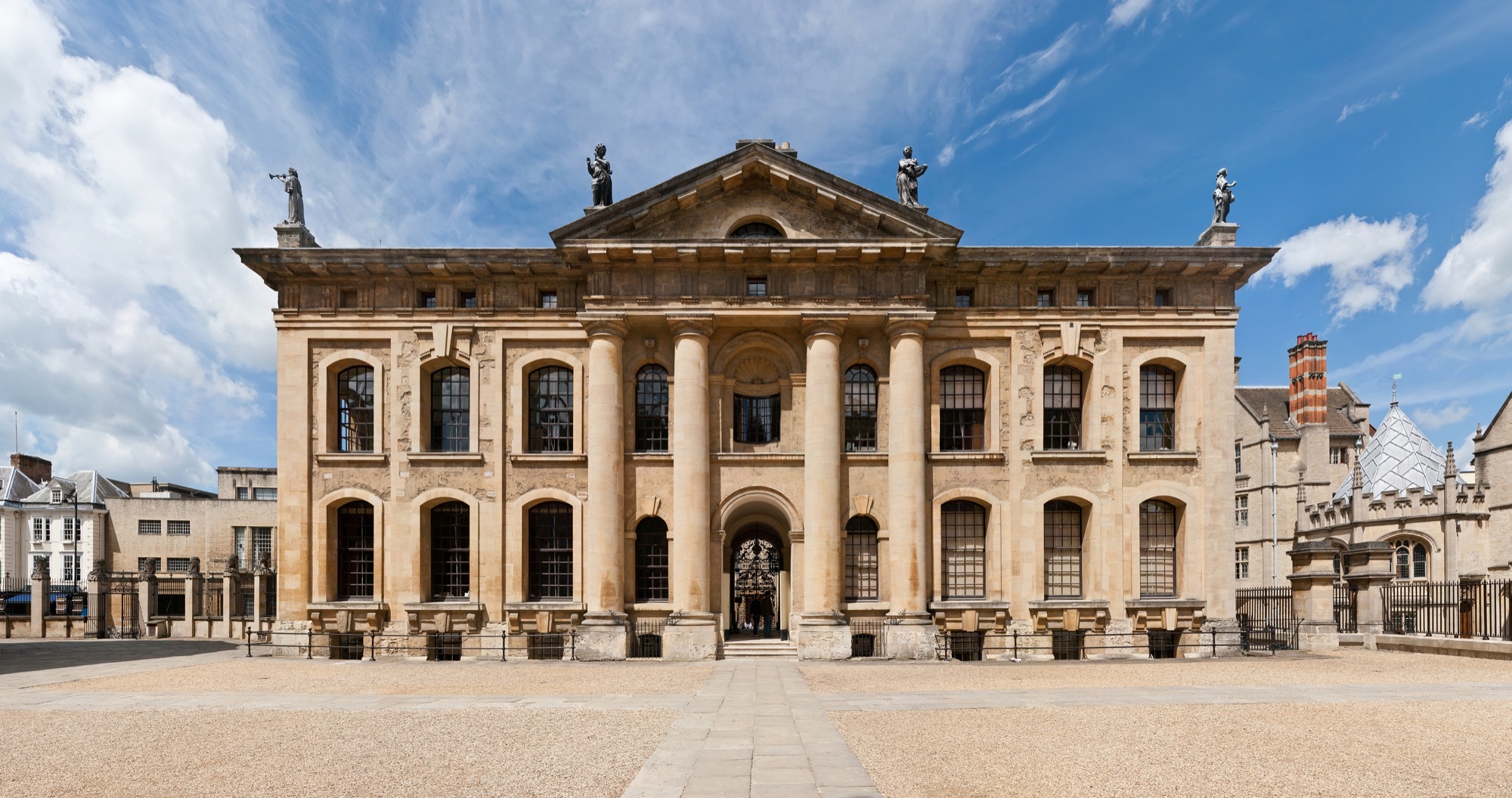
Oxford is not a campus university: colleges, departments and other units are spread across the city of Oxford, with the central University Offices at Wellington Square. The University estate covers around 235 buildings used for teaching, research and administration, 67 of them listed, while the colleges own and manage their own land and buildings.
The 36 colleges and three societies (Kellogg, Reuben and St Cross) are linked to the University through a federal system, alongside four permanent private halls founded by Christian denominations. Undergraduates are admitted to 32 colleges and halls; Harris Manchester College is solely for mature students, and Campion Hall, Green Templeton, Kellogg, Linacre, Nuffield, Reuben, St Antony's, St Cross and Wolfson admit only postgraduates. Academic work is organised in four divisions:
Gardens, Libraries and Museums (GLAM) hold over 21 million objects, specimens and printed items, including the Bodleian Libraries, the Ashmolean Museum, the History of Science Museum, the Museum of Natural History and the Pitt Rivers Museum. Oxford University Press and the Department for Continuing Education, which enrols more than 15,000 students a year, are also departments of the University. Colleges provide accommodation, meals, libraries, common rooms, sports facilities and pastoral care, and there are over 400 clubs and societies and more than 80 sports clubs.
International students make up 43% of the student body, from 175 countries and territories, with 60% of graduate students and 21% of undergraduates coming from outside the UK (as of 1 December 2025). The colleges hold charters approved by the Privy Council, and the University's REF 2021 submission had the highest volume of world-leading research among UK institutions.
Home students on a first undergraduate degree pay £10,050 and can take a UK government tuition fee loan for the full amount. Overseas students pay between £39,620 and £66,580 a year depending on the course, with higher fees for clinical medicine. Home students on a compulsory year abroad pay 15% of the full fee for that year.
UK-resident students on a first undergraduate degree with household income of £32,500 or less receive a Crankstart Scholarship, including a non-repayable bursary of up to £6,500 a year, funded internships, volunteering opportunities and community events.
Home fee status students from lower-income households who do not take up a Crankstart Scholarship receive an annual Oxford Bursary: £4,480 (income £25,000 or less), £3,930 (£25,001 to £32,500), £3,360 (£32,501 to £37,500), £2,230 (£37,501 to £42,875) and £1,120 (£42,876 to £50,000). There is no separate application; eligibility follows the Student Finance household income assessment, which must be completed by 30 May 2028 for 2027 entrants.
Applications for 2027 entry open in January 2027 and close at 12 noon (UK time) on 26 January 2027: the Reach Oxford Scholarship for students from low-income countries (course fee, living costs and one return airfare a year), Simon and June Li Undergraduate Scholarship (Social Sciences), Hill Foundation Scholarship (Russian Federation), Oxford Centre for Islamic Studies Undergraduate Scholarship and Palgrave Brown UK Scholarship (Norfolk and Suffolk). Scholarships for overseas undergraduates are very limited. Details are on the Oxford bursaries and scholarships page.
For 2027-28 the University expects to offer over 1,200 full or partial graduate scholarships for new students, and in 2025-26, 47% of new graduate students received full or partial funding. The Clarendon Fund offers over 200 new fully funded scholarships each year. For most Oxford scholarships, including Clarendon, applicants are considered automatically if they apply by the December or January course deadline, and most awards are made between late February and June. External schemes include Chevening and Commonwealth Scholarships. See graduate scholarships.
Simon and June Li Undergraduate Scholarship →
Hill Foundation Undergraduate Scholarship (second undergraduate degree) →
Browse the scholarships listed for University of Oxford and check each award’s eligibility.
View scholarships for University of Oxford →All applicants, UK and international, apply through UCAS. Applications open in May, can be submitted from early September and must be in by 6pm (UK time) on 15 October; the 2027-entry deadline was Thursday 15 October 2026. Applicants choose a college or make an open application. Some courses require an admissions test (UAT-UK tests such as ESAT, TMUA and TARA taken in October, or UCAT for Medicine and LNAT for Law), and some require written work by 10 November. Shortlisted applicants are invited to online interviews in December, and 2027-entry decisions are released via UCAS on 12 January 2027. Contextual information on socio-economic disadvantage and school performance is used to assess achievements in context.
Requirements range from AAA to A*A*A depending on the course, for example:
Equivalent requirements for Advanced Highers, the International Baccalaureate and accepted international qualifications are set course by course. Applicants self-report qualifications and predicted grades on the UCAS form. Applicants already at another university are considered only in exceptional circumstances.
The process and selection criteria are the same for all applicants, with no international quota except for Medicine. A wide range of international qualifications is accepted, and course-specific subject requirements apply. Certificates or transcripts are needed only if an offer is made.
Offer holders must meet the requirement by 31 July in the year of the offer. Accepted scores include IELTS Academic 7.5 (minimum 7.0 per component), Oxford Test of English Advanced 165 (155 per component), TOEFL iBT 110 (Listening 22, Reading 24, Speaking 25, Writing 24; tests taken up to 20 January 2026 only), C1 Advanced or C2 Proficiency 191 (185 per component) and PTE Academic 76 (66 per skill). Component scores must come from a single sitting. Exemptions may apply to English-taught IB students and those educated full-time in English for the required period.
Most international students on a full-time course longer than six months need a Student visa. The University confirms English proficiency on the CAS when an accepted test or college waiver is held. Offer holders for four-year Physics or Materials courses also need ATAS clearance.
Applications are made through the University's online graduate application form, with up to three courses per cycle (no more than two taught). Entry requirements are set on each course page and are typically expressed as a strong upper second-class or first-class honours degree, or an international equivalent. Almost all courses have a December or January deadline, which is also the deadline for most Oxford scholarships, and applications need all supporting documents and at least two references by the deadline. Decisions usually follow 8 to 10 weeks after the deadline. Courses are set at a Standard or Higher English level, met in a single test sitting (IELTS, TOEFL before 21 January 2026, Cambridge English or Oxford Test of English Advanced), and waivers are available for recent English-taught degrees or qualifying professional experience.
Oxford has no single campus. Its colleges, departments, libraries and museums are spread across the city of Oxford, and the central administration is at the University Offices, Wellington Square, Oxford OX1 2JD.
Study programmes offered at University of Oxford.
Experiences shared by students of University of Oxford.
Studied here? Share your experience to help other applicants.

Book a free consultation with our expert counsellors and take the first step towards your dream university.
Copyrights © 2026 StudyMapped. All rights reserved.

Enter your credentials to continue.
Join us and start your study abroad journey.


