
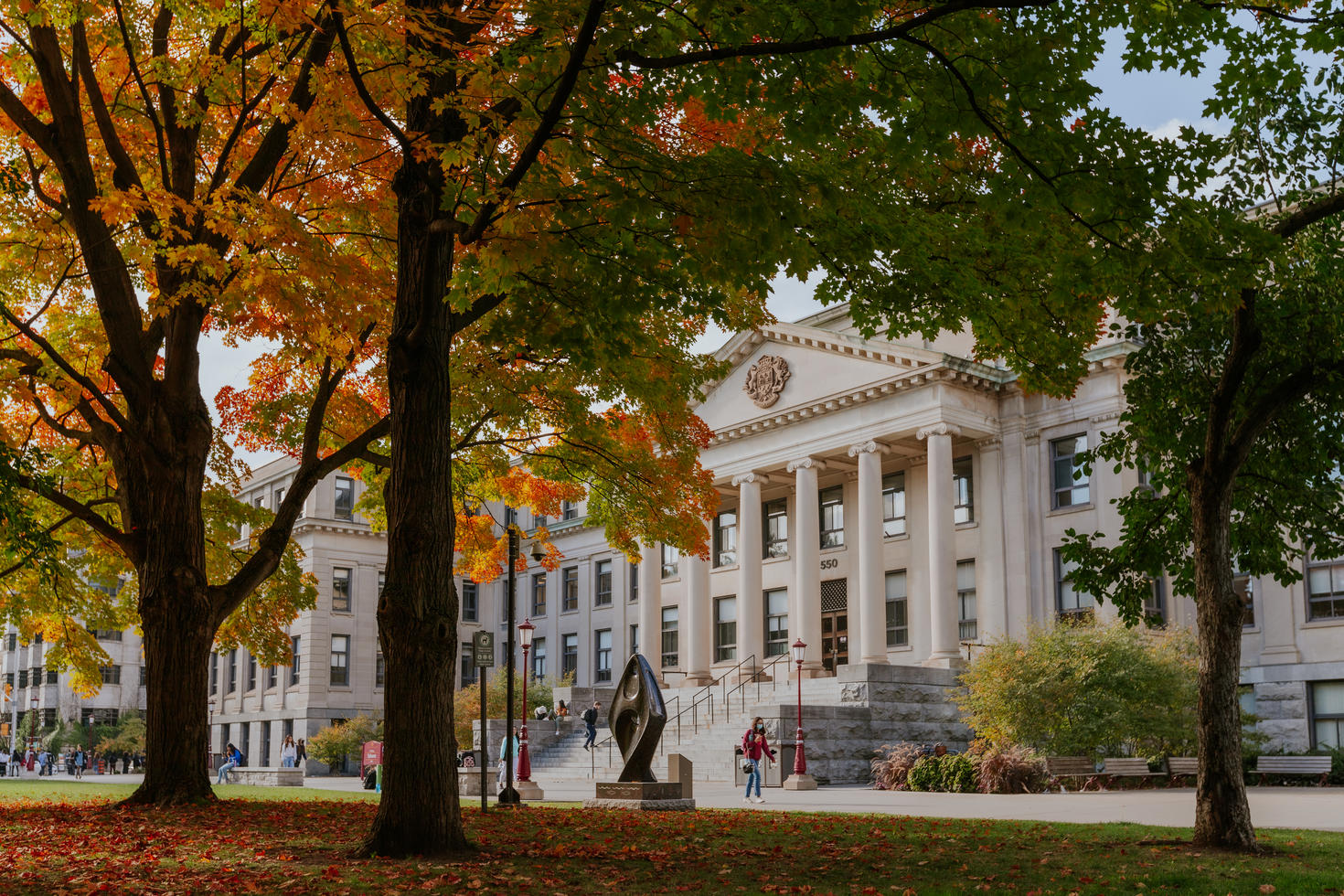

University in Canada
Ottawa, Ontario, Canada
University profile
The University of Ottawa (uOttawa) is a public research university in the centre of Ottawa, Ontario, in Canada's capital. It is the largest English-French bilingual university in the world, with programs and courses offered in English, in French or in both languages, and a French Immersion Stream for students learning French. It describes itself as a leader in French Ontario, French Canada and the French-speaking world, and it is a member of U15 Canada, the group of research-intensive universities. The university sits on the unceded territory of the Algonquin Anishinàbeg and has an Indigenous Action Plan.
About 50,000 students study at uOttawa, supported by some 12,000 professors, researchers and staff, and the alumni community numbers about 300,000. More than 350 undergraduate programs are offered, with options for experiential learning, co-op and the French Immersion Stream. The main campus is in downtown Ottawa; a campus at Kanata North links the university to the country's largest technology park, and partnerships with hospitals and health-care organizations support health research and training.
Teaching is organized in ten faculties and schools:
Medicine, Law and Education have their own application processes, and graduate programs are administered through the academic units that offer them.
On campus, more than 4,100 residence beds serve new and returning students in traditional rooms, traditional plus rooms, suites, studios and apartments, in residences including Annex, Hyman Soloway, 45 Mann, 90 University, Friel, Stanton, Leblanc, Marchand, Thompson, Henderson and Rideau. Student life includes the Gee-Gees varsity teams, intramural leagues, student clubs and organizations, a Student Health and Wellness Centre, a Carrefour francophone, Indigenous community services and a dining hall.
Students from more than 145 countries study at uOttawa. International students are supported by immigration advising, the University Health Insurance Plan (UHIP) and supplemental health and dental insurance, a regional mentoring centre and the Centre for Language Learning. Exchange options cover more than 250 partner institutions in 52 countries.
uOttawa distributes scholarships (academic achievement) and bursaries (financial need) through the Online Scholarships and Bursaries tool, and applicants can apply once they have applied for admission and received their uoAccess login. See Scholarships and awards overview. General eligibility for admission awards: meet the program's admission requirements, enrol full time for the first time in a university undergraduate program, and be a Canadian citizen, permanent resident or protected person unless an award states otherwise.
$7,500 per term ($60,000 over a four-year degree, up to 12 instalments), awarded automatically to international students with a valid study permit who are newly admitted from the winter 2026 term to an English-language undergraduate program in Arts, Engineering, Health Sciences, Science, Social Sciences or the Telfer School of Management, with a minimum admission average of 80%, full-time enrolment and not in the French Immersion Stream. It reduces tuition by $15,000 per year; there is no limit on the number of awards.
$10,000 ($5,000 per term), 100 awards, automatic for international students admitted from winter 2026 to an eligible English-language undergraduate program with an admission average of 90% or higher. It is not renewable but can be combined with the International English Admission Scholarship. Together the two can reach up to $70,000. Details: International English scholarships.
Awarded automatically to international Francophone and Francophile students in a bachelor's or master's program taught in French or in the French Immersion Stream, reducing tuition considerably. See the scholarship page.
University of Ottawa Admission Scholarship ($1,000 for 85-89.9%, $2,000 for 90-94.9%, $3,000 for 95-100%, automatic); French Studies Bursary ($4,000 over four years); Bursaries for Postsecondary Studies in French as a Second Language ($3,000, deadline March 31); Professional Training Scholarship (minimum $1,000); Schulich Leader Scholarship ($100,000 to $120,000, STEM, nomination required, deadline January 27, 2027); Loran Award (up to $150,000, deadline October 15, 2026); Indigenous Leadership Scholarship ($26,000, deadline March 31); Faculty of Science Undergraduate Research Scholarship ($11,500, minimum 92% average, deadline March 15); Fleur de Lys Admission Scholarship ($10,000 for francophone Telfer BCom students from outside Ontario).
International English Admission Scholarship →
Differential Tuition Fee Exemption Scholarship →
Browse the scholarships listed for University of Ottawa and check each award’s eligibility.
View scholarships for University of Ottawa →Most direct-entry undergraduate programs are applied to through the Ontario Universities' Application Centre (OUAC) with a single OUAC application for all Ontario universities. A direct application to uOttawa is required for applicants who previously studied at uOttawa or Saint Paul University, for Spring-Summer term entry, for certificate programs, for current students applying to civil law, for readmission after a required withdrawal, and for partnership programs with institutions outside Canada. The direct application fee is $104 unless a program is fee-free (for example the Honours Bachelor in Public Relations offered with Algonquin College and La Cité). Within a week of applying, applicants receive an email with a student number and access to the uoZone portal, where documents are uploaded through uoDoc and the application is tracked. Medicine, Law and Education have separate admission processes.
Admission depends on the minimum admission average and prerequisite courses set for each program, and meeting the minimum does not guarantee admission. Prerequisites are normally completed in the final year of high school or at postsecondary level. Quebec CEGEP applicants must include their 12-digit CEGEP permanent code in the OUAC application.
Direct entry requires the secondary-school credential equivalent to a Canadian high school diploma for the country of education. For Ghana this is the Senior Secondary School Certificate Examination (SSCE); for the Gambia, the West African Examinations Council Senior Secondary School Certificate; for Liberia, the West African Examination Council (WAEC) Certificate. International applicants pay an admission deposit once admitted: the standard deposit is $2,000 for undergraduate programs ($1,000 for graduate certificates and diplomas), credited toward tuition. International students are not admissible in the Spring-Summer term.
Applicants without three years of full-time study in an institution where English is the only language of instruction, in a country where English is an official language (Ghana is among the exempt locations), must submit a test less than two years old. Direct entry minimums: IELTS Academic 6.5 overall and 6.5 writing (an overall 6.0 allows starting with extra ESL courses); TOEFL iBT 86 overall and 22 writing (tests before 21 January 2026) or 4.5 overall and 4.5 writing (tests after that date); Duolingo English Test 120 overall and 120 literacy; PTE 60 overall and 60 writing; Cambridge B2 First, C1 Advanced or C2 Proficiency 176; CAEL 60 in each of reading, speaking, listening and writing. Applicants scoring below these can be admitted on condition of completing the English Intensive Program (8 to 42 weeks of ESL courses), for example IELTS 4.5 overall with 5 writing (or 5 overall with 4.5 writing), TOEFL iBT 60 overall with 20 writing (or 70 with 16), or Duolingo 85 overall and 85 literacy. IELTS One Skill Retake and TOEFL MyBest scores are accepted.
For French-language programs, applicants without three years of full-time French-medium study must submit DALF C1 or C2, DELF B2 (16/25 in written production), TCF B2 in the three mandatory sections, or TEF B2.
Mature applicants must be Canadian citizens or permanent residents who have not attended secondary school full time in the three years before applying, meet program prerequisites equivalent to recognized Grade 12 courses, and submit a resume and a letter of intent; age is not a factor. Home-schooled applicants, applicants readmitted after withdrawal and non-degree students have their own requirements. Previous college or university study is assessed under transfer credit rules.
For fall 2027 entry, applications open September 17, 2026, with a recommended submission date of January 15, 2027 and all documents and test results due by February 15, 2027 or 30 days after applying. Most programs close in June for Canadian applicants and in May for international applicants, and any program can close earlier once full. For winter 2027, the application deadline is October 17, 2026 with documents by November 1, 2026; Engineering and Health Sciences programs are not open in winter, and Science is open to Canadian students only. Spring-Summer 2027 applications open April 1, 2027 and close April 30, 2027 (Canadian students only).
Residences offer more than 4,100 beds across Annex, Hyman Soloway, 45 Mann, 90 University, Friel, Stanton, Leblanc, Marchand, Thompson, Henderson and Rideau. Housing Services is at 90 University Private, with a 24-hour reception.
Study programmes offered at University of Ottawa.
Experiences shared by students of University of Ottawa.
Studied here? Share your experience to help other applicants.

Book a free consultation with our expert counsellors and take the first step towards your dream university.
Copyrights © 2026 StudyMapped. All rights reserved.

Enter your credentials to continue.
Join us and start your study abroad journey.


