

University in United States
Eugene, OR, United States
University profile
The University of Oregon (UO) is a comprehensive public research university that opened to students in 1876 as a public non-denominational institution. Its stated purpose is exceptional teaching, discovery and service, working at a human scale. It is a member of the Association of American Universities and is regionally accredited by the Northwest Commission on Colleges and Universities, with additional specialised accreditations from national bodies. It is Oregon's flagship public university, with a student body of about 24,000 from 96 countries and all 50 states, a median class size of 23 and a 19:1 student-faculty ratio.
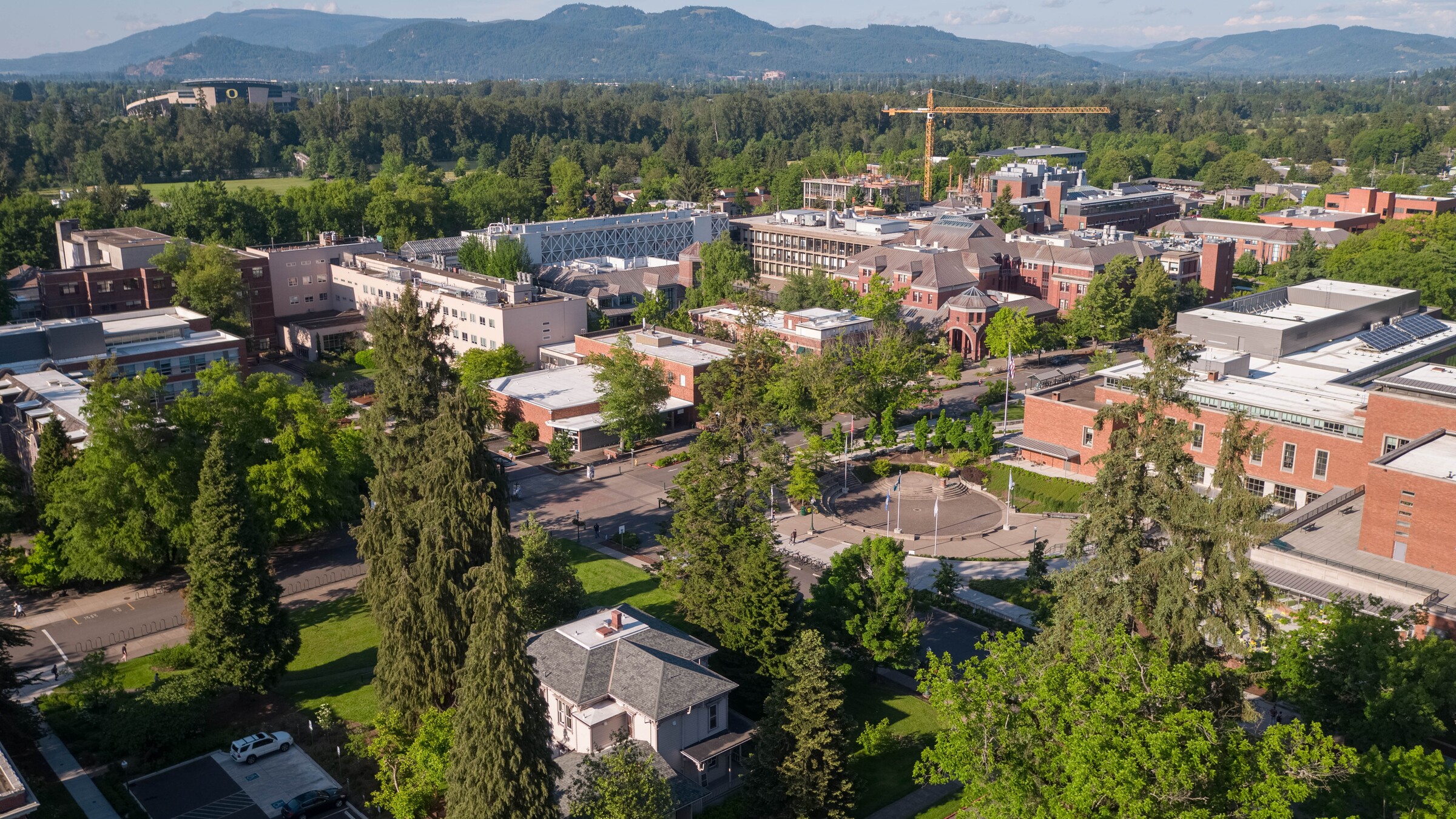
The main Eugene campus covers 295 acres beside the Willamette River, with more than 4,000 trees from over 500 species, about a mile from downtown Eugene; the Oregon coast, Cascade mountains and Portland are within a two-hour drive. The UO has four campuses in all: Eugene, UO Portland in the Concordia neighbourhood, the Oregon Institute of Marine Biology in Charleston on the coast, and the Pine Mountain Observatory in the Deschutes National Forest near Bend.
Academics are delivered through ten schools and colleges: the College of Arts and Sciences, Lundquist College of Business, College of Design, College of Education, Robert D. Clark Honors College, School of Journalism and Communication, School of Music and Dance, School of Law, the Phil and Penny Knight Campus for Accelerating Scientific Impact, and the Ballmer Institute for Children's Behavioral Health. The university offers 302 degrees and programmes, about 200 majors and minors, and some 3,500 graduate students study across more than 75 subject areas, from master's and doctoral degrees to graduate certificates and concurrent degrees.
Student life centres on more than 450 student groups and organisations, the Erb Memorial Union, the Many Nations Longhouse, two museums (the Jordan Schnitzer Museum of Art and the Museum of Natural and Cultural History), over 40 club sports, a student recreation centre and Oregon Ducks athletics. The Eugene campus has 10 residence halls and 14 dining venues; first-year students live in on-campus halls and academic or identity-based residential communities, each hall has a faculty member in residence, and University Apartments serve upper-level, transfer and graduate students. 43 percent of undergraduates study abroad.
International students apply through the Oregon Application or the Common Application, are supported by International Student and Scholar Services, and can enter with conditional admission through the UO Global Welcome intensive English programme if their English test scores fall below the full-admission level. The UO awards more than $5.1 million annually to international students studying on campus.
The UO reports $70M in university contributions to undergraduate aid, with 82 percent of first-year students receiving financial aid. The Duck Tuition Guarantee fixes undergraduate tuition for up to five years. U.S. students file the FAFSA (priority date March 1) to be considered for grants, loans and work-study.
All first-year applicants who meet admission requirements are automatically considered for the Oregon Distinction Scholarship (up to $5,000 for Oregon residents and up to $20,000 for nonresidents). Other first-year awards include the General University Scholarship ($1,000-$3,600 a year, no separate application), IB Diploma Scholarships (nonresident $2,000-$6,000 a year), National Merit ($2,000 a year), and, for domestic students, Stamps, Presidential ($9,000 a year), Duck Excellence ($7,500 a year), PathwayOregon and Home Flight (full tuition and fees for qualifying Oregonians) and Staton ($7,350 a year in 2025-26). Scholarship applications are made through the UO Scholarship Dashboard after applying for admission. Details: financialaid.uoregon.edu/scholarships.
The UO awards more than $5.1 million annually to international students studying on campus. The International Cultural Service Program (ICSP) is a partial tuition scholarship (about half of tuition) awarded on financial need, academic merit and the ability to present to diverse groups, renewable to the end of one degree, with 66-80 hours of cultural service a year; the next deadline is February 1, 2027 at 4:00 p.m. PST. The International Student Work-Study Program grants more than 50 awards of $1,000-$4,500 a year to international students with financial need. Division of Global Engagement endowed scholarships range $1,000-$12,000 and are arranged through an admissions counselor. Information: International Scholarships.
Estimated expenses for 2026-27 for an international (nonresident) undergraduate, nine months, 12 credits per term: tuition $34,581, fees $3,449, on-campus residence hall $18,183, educational and personal expenses $3,996, health insurance $3,804, total $64,013. See International Student Cost of Attendance.
83 percent of doctoral students are funded through assistantships. Graduate Employment (teaching, research and administrative roles), scholarships, fellowships and awards, financial aid, and the Graduate Student Assistance Fund support graduate study.
International Cultural Service Program (ICSP) Scholarship →
International Student Work-Study Program →
Oregon Distinction Scholarship →
Browse the scholarships listed for University of Oregon and check each award’s eligibility.
View scholarships for University of Oregon →First-year applicants have not attempted college coursework after high school graduation or a GED; dual enrolment, AP, IB and AICE coursework taken during high school does not change that status. Proof of graduation must come from a regionally accredited high school. Applicants need a C- or better in 15 college-preparatory courses: English/language arts 4 years, mathematics 3 years, science 3 years (a year each in two fields), social studies 3 years and a second language 2 years. The UO is test-optional for SAT/ACT. Review is holistic (course rigour, grades and trends, activities, personal statement, optional recommendations and optional test scores). Applications open August 1 through the Common Application or the Oregon Application, which receive equal consideration. Early Action (non-binding): application November 1, supporting documents November 15, decision by January 5. Regular Decision: application January 15, documents February 15, decision by April 1.
Transfer applicants are those who graduated high school and then enrolled in college; they apply with the Oregon Application. Requirements: a college-level composition course and a college-level mathematics course (minimum C-, Pass or Satisfactory), a minimum cumulative GPA of 2.25 for Oregon residents and 2.50 for nonresidents (2.00 with an AAOT or ASOT in Business), and second-language proficiency where applicable. Fall priority deadline is March 15 (documents April 1); fall regular deadline June 1 (documents June 30); winter November 15, spring February 1, summer April 15. Transfer scholarships are for fall entry only and require the March 15 priority deadline.
International applicants are non-citizens and non-permanent residents who are in or entering the United States on a student or other non-immigrant visa. First-year applicants should have at least a B (3.00) average and transfer applicants at least B-/C+ (2.50), with English proficiency and proof of financial support; SAT/ACT is not required for international students. First-year fall deadlines: Early Action November 1, Regular January 15 (documents February 15); transfer fall: Early Action March 15, Regular May 15; winter October 15, spring February 1, summer March 1. Applications are accepted on a rolling basis to July 15 for fall. The application fee is $75 (non-refundable) for the Oregon Application or Common Application. English test scores must be dated within two years of enrolment and submitted at least 12 weeks before International Student Orientation. For full admission: TOEFL iBT 80-120 (taken before January 2026) or 4.5+ (taken after January 2026), IELTS 6.5-9.0, Duolingo English Test 110-130, SAT EBRW 520 or ACT English+Reading 40. Academic English for International Students (AEIS) admission: TOEFL 61-79, IELTS 5.5-6.0, DET 100-109. Lower scores lead to conditional admission with UO Global Welcome. Citizens of listed English-speaking countries, including Ghana, Kenya, Nigeria and South Africa, are exempt from the test requirement; IB Diploma candidates and applicants with a C or higher in IGCSE English may also qualify for a waiver. IB applicants should average at least 4s and 5s to be competitive; students with A Level, AS Level or IGCSE passes can receive credit, and A-level applicants must pass two A-level subjects and five IGCSE subjects (including English and mathematics). After admission, a Form I-20 is issued within two weeks of receiving financial documentation equal to or greater than the estimated expense for one academic year (liquid assets such as bank statements, scholarship awards, government funding or educational loans), submitted by the May 1 confirmation deadline for fall.
Each graduate programme sets its own deadlines and materials. Applications are made through the graduate application portal with academic history and unofficial transcripts, a CV, a statement of purpose, references, GRE or GMAT scores where the programme requires them, and for international applicants evidence of English proficiency. Application fees for degree-seeking programmes are $70 for domestic applicants and $90 for international applicants ($35 for graduate microcredentials), with waivers available for eligible applicants. Admitted international students on F-1 or J-1 visas must submit proof of financial support for at least one year before immigration documents are issued.
Experiences shared by students of University of Oregon.
Studied here? Share your experience to help other applicants.

Book a free consultation with our expert counsellors and take the first step towards your dream university.
Copyrights © 2026 StudyMapped. All rights reserved.

Enter your credentials to continue.
Join us and start your study abroad journey.


