
University in Germany
Oldenburg, Niedersachsen, Germany
University profile
Carl von Ossietzky University of Oldenburg (Carl von Ossietzky Universität Oldenburg) is a state university in the north-west of Lower Saxony, Germany, founded in 1973 and counted among the country's younger universities. It is named after the journalist and pacifist Carl von Ossietzky, and combines interdisciplinary research and teaching, with an emphasis on answers to major societal questions of the 21st century. It prepares around 15,000 students for professional life, and in winter semester 2025/26 enrolled 14,770 students, including 1,662 foreign students.
Teaching and research are organised in six schools: School I (Educational and Social Sciences), School II (Computing Science, Business Administration, Economics, and Law), School III (Linguistics and Cultural Studies), School IV (Humanities and Social Sciences), School V (Mathematics and Natural Sciences) and School VI (Medicine and Health Sciences). The spectrum runs from the humanities and cultural sciences through economics, law and social sciences to mathematics, computer science, the natural sciences and medicine. Oldenburg was among the first German universities to convert to Bachelor's and Master's degrees (2004), and teacher education remains a core field.
Research is concentrated in three guiding themes: Environment and Sustainability (including biodiversity and marine sciences, and future energy), Humans and Technology (hearing research, sensory neuroscience, cooperative safety-critical systems, health care systems), and Society and Education. Since January 2026 the university hosts three clusters of excellence: Hearing4all.connects (with Leibniz University Hannover and Hannover Medical School), Ocean Floor (with the University of Bremen) and NaviSense. It also works closely with non-university institutions, including the Helmholtz Institute for Functional Marine Biodiversity, Max Planck Research Groups and Fraunhofer working groups, and cooperates with more than 300 international partners.
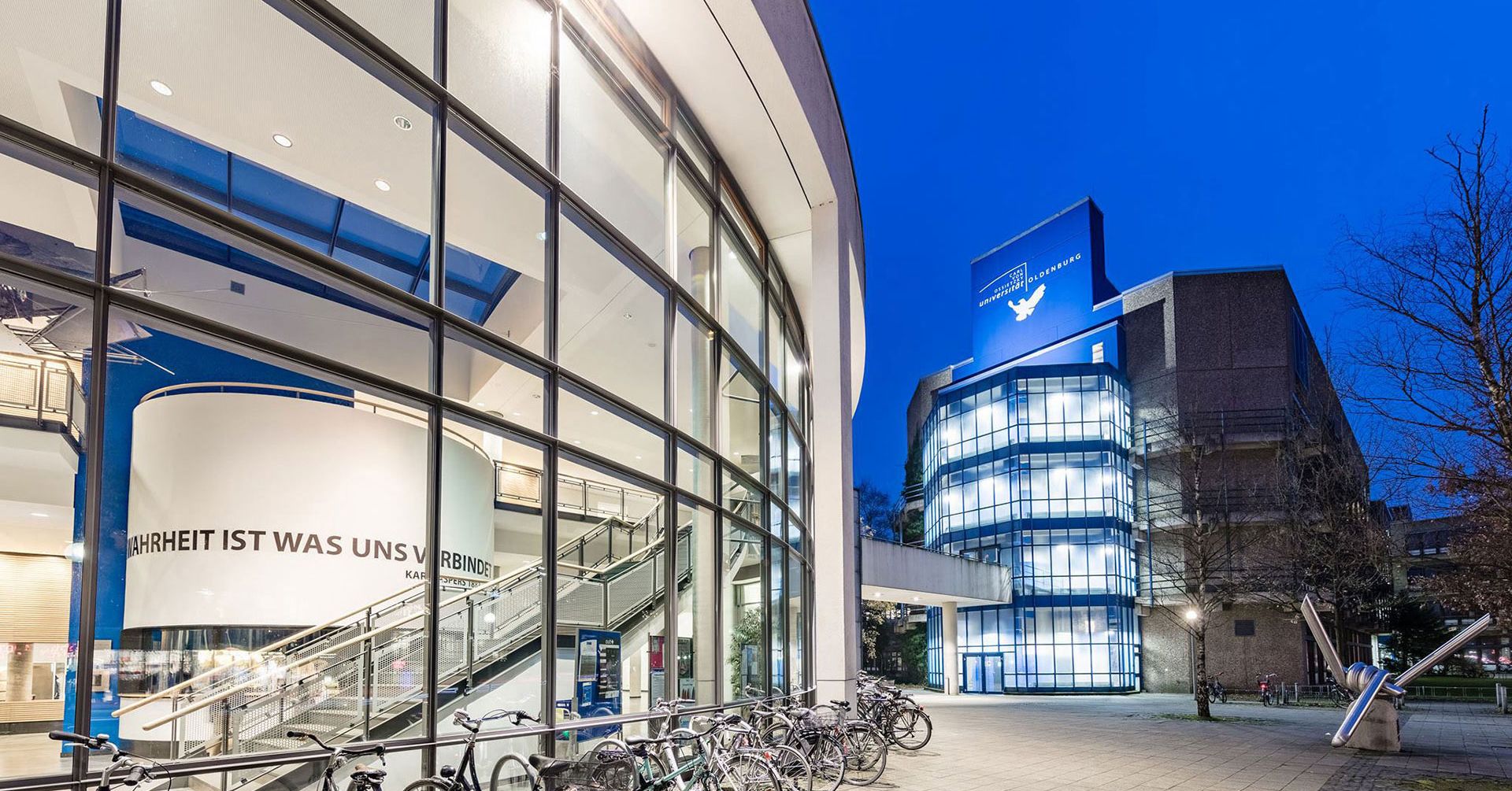
The university is spread over the Haarentor campus (the central location), the Wechloy campus (mathematics and natural sciences), the Institute for Chemistry and Biology of the Marine Environment (ICBM) in Wilhelmshaven and the Johann-Justus-Weg site. The Library and Information System (BIS) serves both main campuses. Student life includes cultural and sports offers, a culture ticket, a semester ticket, student councils and an International Office with welcome and orientation events for newcomers.
The international student community numbers over 1,700 students from about 130 countries. International degree students are supported through the International Study Entry Phase (INSTEP), tutors and advisers, and programmes taught in English are available. Studying is free of tuition for most programmes; all students pay a semester contribution. The university is an institutional member of ACQUIN, the accreditation agency for Bachelor's and Master's programmes.
The University of Oldenburg is state financed and most degree programmes do not charge tuition fees. All students pay a semester contribution, which is not tuition: EUR 457.90 for winter semester 2026/27 (semester ticket EUR 230.80, Studierendenwerk EUR 118.00, student body EUR 24.80, administration EUR 75.00, bicycle workshop EUR 2.60, culture ticket EUR 2.92, hardship fund EUR 3.78). Doctoral candidates with a scholarship from public funds pay EUR 382.90. A long-term study fee of EUR 500 per semester applies once the study credit (standard period plus six semesters) is exceeded. Fee-based and professional development programmes charge their own tuition, for example EUR 4,500 per semester for the European Master in Migration and Intercultural Relations and EUR 8,000 programme costs for the European Master in Renewable Energy.
The Servicepoint Scholarships manages the Deutschlandstipendium, the Landesstipendium Niedersachsen, the Dr. Dettling Foundation, the Dr. h. c. Peter und Doris Waskönig Foundation, the Heinz Neumüller Foundation (PhD scholarships) and the Lower Saxony Science Prize (Category IV). Enrolment is required to apply.
The International Office offers scholarships for international students and doctoral candidates (DAAD STIBET, Jakob Mann Foundation, Oscar-Romero scholarship), the DAAD Award, and Rotary scholarships; the Deutschlandstipendium, Dr. Dettling Foundation and Lower Saxony Scholarship are also open to international students. Emergency support includes interest-free AStA loans of up to EUR 1,000, the Studierendenwerk one-off study start-up grant of EUR 1,000 for students from low-income households, the Studierendenwerk emergency fund and one-off International Office grants. Students are advised to budget about EUR 1,000 per month for accommodation (EUR 200 to 450), health insurance (about EUR 140) and food (EUR 250 to 350); the uni-assist application fee is EUR 75 and the DSH exam EUR 80.
Details: Scholarships | Finances for international students | Fees and financing.
Deutschlandstipendium at the University of Oldenburg →
Lower Saxony Scholarship (Landesstipendium Niedersachsen) →
Dr. h. c. Peter Waskönig Foundation Scholarship →
Dr. Dettling Foundation Scholarship →
Browse the scholarships listed for University of Oldenburg and check each award’s eligibility.
View scholarships for University of Oldenburg →The general university entrance qualification (usually the Abitur) gives access to all degree programmes; a subject-related entrance qualification from a vocational upper secondary school (BOS) restricts holders to corresponding subject areas, and applicants without Abitur may qualify through vocational routes. Each programme has its own deadline and may have restricted (Numerus clausus) or open admission; the state examination in Medicine runs through hochschulstart.de with deadlines of 31 May for 'old' A-level students and 15 July for 'new' A-level students.
Applicants with an international university entrance qualification or a first degree from outside Germany, including EU applicants, apply online through uni-assist e.V., which cooperates with the admissions office. Applicants with qualifications from China, Vietnam or India must submit the original APS certificate, otherwise uni-assist rejects the application. Applicants educated in Germany, and those for the European Master in Renewable Energy and Erasmus Mundus programmes (EMMIR, EWEM), apply directly to the university. Applicants who need the Studienkolleg or the preparatory German course apply by 15 July (winter semester) or 15 January (summer semester).
For German-taught programmes, accepted proof includes DSH (level 2), TestDaF (level 4 in all four areas), the Feststellungsprüfung at a Studienkolleg (German part), DSD II, Goethe-Zertifikat C2 and telc Deutsch C1 Hochschule. Some Master's programmes accept C1 (Goethe-Zertifikat C1, telc Deutsch C1, ÖSD C1, UNIcert III), DSH-1 or TestDaF level 3 in all areas, or B2. The Master's programmes German as a Foreign Language / German as a Second Language and German Studies require DSH 3 or TestDaF level 5 in all four areas. Studienkolleg applicants need at least B1 German, submitted to uni-assist before the deadline.
Applicants with at least A2 German can join the INSTEP study preparation programme: intensive German courses plus academic work preparation, ending with the DSH exam (offered in February and July). Participants are enrolled as regular students and pay the semester contribution, but are not entitled to statutory student health insurance during this phase. No preparatory courses are offered for the state examination in Medicine, the Bachelor's in Engineering Physics, the Master's in German Studies, the Master's in German as a Foreign Language / German as a Second Language, and English-language programmes.
English-taught programmes and some German-taught programmes require proof of English at the CEFR level set in the admission requirements of the individual programme.
A first university degree is required. Programme-specific admission requirements, language levels and deadlines apply, and early application is recommended for Master's programmes without admission restrictions (not Master of Education).
Applicants must first be accepted by the responsible doctoral committee, then enrol online. Doctoral candidates may enrol at any time, with standard enrolment deadlines of 15 April (summer semester) and 15 October (winter semester).
Facilities include the Library and Information System (Uhlhornsweg 49-55), the Language Centre, a canteen run by the Studierendenwerk, the Botanical Garden and the Schlaues Haus Oldenburg science centre. Campus accommodation and student housing are arranged with the Studierendenwerk Oldenburg.
Study programmes offered at University of Oldenburg.
Experiences shared by students of University of Oldenburg.
Studied here? Share your experience to help other applicants.

Book a free consultation with our expert counsellors and take the first step towards your dream university.
Copyrights © 2026 StudyMapped. All rights reserved.

Enter your credentials to continue.
Join us and start your study abroad journey.


