

University in Canada
Prince George, British Columbia, Canada
University profile
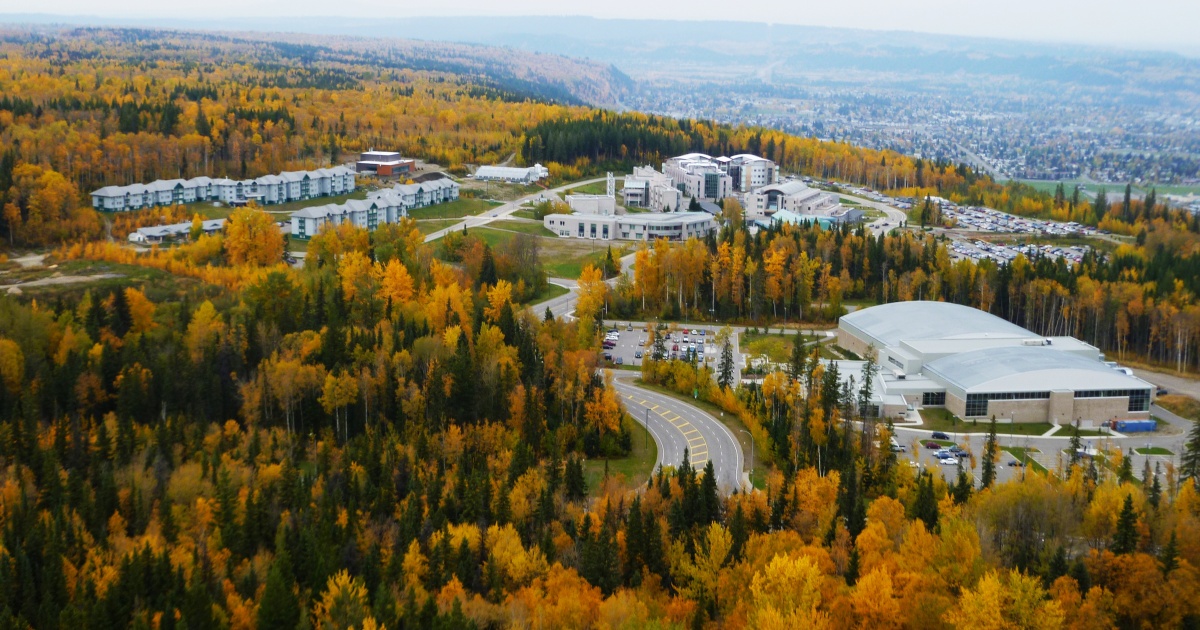
The University of Northern British Columbia (UNBC) is a public university in Prince George, British Columbia, established by the provincial legislature in 1990 and opened in 1994. Its main campus is at 3333 University Way on a site set aside as a university reserve in the 1960s, and the university serves northern B.C. through regional campuses in Fort St. John (Peace River-Liard), Terrace and Prince Rupert (Northwest) and Quesnel (South-Central), plus an affiliated institution, the Wilp Wilxo'oskwhl Nisga'a Institute.
Academic programs are organised in five faculties and one division: the Faculty of Business and Economics; the Faculty of Environment; the Faculty of Human and Health Sciences; the Faculty of Indigenous Studies, Social Sciences and Humanities; the Faculty of Science and Engineering; and the Division of Medical Sciences, which focuses on rural health care education. In 2023/24 UNBC had 3,819 students in academic programs, of whom 3,060 were undergraduate and 763 graduate. About 59% came from northern B.C., 826 (22%) were international and 500 self-declared as Indigenous.
Classes are small and combine lectures with laboratories, field schools across northern B.C., seminars, intensive courses and web courses. In 2024/25 UNBC offered 1,380 academic courses: 1,032 face-to-face in Prince George, 83 face-to-face in Terrace, Fort St. John, Quesnel and other sites, 43 hybrid and 222 online. Continuing Studies served 3,227 students in 243 course deliveries.
Campus life is centred on the Northern University Student Centre, which houses student society offices, campus radio, student media, clubs, a cafe and the Thirsty Moose Pub. The Charles Jago Northern Sport Centre is the home of the Timberwolves teams in Canada West. UNBC Housing offers fully furnished apartment-style residences, Neyoh and Keyoh, home to over 500 students within a five-minute walk of the campus centre; first-year undergraduates with fewer than 60 UNBC credit hours must take a five- or seven-day meal plan.
UNBC International supports international students with immigration and study permit guidance, health insurance, housing and academic and career support. UNBC recognises Indigenous students from nations in what became Canada and the United States as domestic for application and tuition purposes. Graduates number 18,373 as of 2025.
UNBC awarded 1,289 scholarships and bursaries worth $4.37 million in 2025/26. Registered students apply through the Awards and Financial Aid section of their myUNBC student account. See the Awards and Financial Aid page and the undergraduate awards overview.
Early Entrance Awards for new undergraduates entering directly from high school need no separate application; students apply for admission by January 15 and recipients are notified in early March. Leadership Awards for new undergraduates also have a January 15 deadline and are applied for through myUNBC. Entrance Awards and General Awards close April 1. Applicants must first be admitted and receive a myUNBC user ID; international students must pay the International Tuition Deposit before accessing the online awards application.
The UNBC Scholars program waives full tuition (to a maximum of 120 credits) for the student with the highest Grade 11 average, minimum 80%, at each participating high school in Northern BC and Yukon. Students do not apply. Recipients must keep at least an 80% Grade 12 average, and the award is renewable with a B average and 24 credit hours per year. Student society and athletics fees, books and residence fees are the recipient's responsibility.
The main awards competition for 2027-2028 opens October 15 with an April 1 deadline; a smaller fall competition for 2026/27 runs September 15 to October 14, 2026. Graduate awards include the Graduate Entrance Research Scholarship (GERS) and the British Columbia Graduate Scholarships program. Academic excellence is normally a minimum A- average (3.67 GPA).
UNBC Early Entrance and Entrance Awards →
Browse the scholarships listed for University of Northern British Columbia and check each award’s eligibility.
View scholarships for University of Northern British Columbia →First-year students are admitted by degree group (for example Bachelor of Arts or Bachelor of Science) or to a first-entry professional program. Enrolment in some areas is limited by available space.
Applicants from BC and Yukon need an approved Grade 12 program leading to graduation with an acceptable average on the five best Grade 12 courses from the list for the chosen degree group or first-entry professional program. Grade 12 students planning to start the following September can apply for Special Early Provisional Admission by the end of February; the offer is conditional on maintaining the minimum average, completing required courses and graduating. Exceptional Grade 11 students may apply for Head Start entry with an autobiographical letter, recommendation letters and a transcript. Grade 12 students may take up to three first-year UNBC courses for dual credit. Equivalent English, Math, science courses are listed for other provinces (for example ELA 30-1 and Math 30-1 in Alberta; ENG4U and MHF4U in Ontario). Adults 19 or older may enter with the BC Adult Graduation Diploma at an overall 65% or better.
An IB diploma with an overall standing of four and no course below three (three higher-level and three subsidiary subjects) can earn up to 30 transfer credit hours. AP courses with a grade of four or above receive transfer credit, and a grade of three may qualify for advanced standing (UNBC institution code 2023). GCE applicants need at least two A-level and three O-level subjects with an overall C or higher, and every A level at C or better; two AS levels may replace one A level.
International secondary and post-secondary credentials are considered, and applicants must meet the equivalent of BC high school and university transfer criteria. Admission is based on comparison with standards and grading in the country of origin.
Applicants whose first language is not English must show proficiency. Accepted evidence includes TOEFL iBT 90 or higher with at least 20 in each component (institution code 0320); IELTS Academic 6.5 overall with no band below 6.0; Duolingo English Test 125 or higher with at least 115 in each component; PTE Academic 65 overall with at least 60 in each skill; CAEL 70 with no subtest below 60; MELAB 80 with a minimum of 3 on speaking; Cambridge C1 Advanced grade B or better; a C or better in UNBC English Language Studies 50 and 170; 50% in BC English Studies 12; 75% in CBSE/CISCE Class XII English Core; or two full years of full-time degree-level study in English. Exempt are applicants with five consecutive years of instruction and examination entirely in English immediately before admission, and those whose secondary education was entirely in English at a recognized institution. Scores are valid for two years. The Northern Collaborative Baccalaureate Nursing Program requires English Studies 12 at 70% and an IELTS Academic or CELBAN result at the scores set by BCCNM.
Transfer students are admitted to a declared major on the basis of space and eligibility. Other routes include second undergraduate degree (minimum 60 credit hours), Diverse Qualifications admission for applicants with life experience who do not meet regular requirements (clear, conditional or probationary admission; probationary students need a 2.0 GPA in their first semester), audit-only status and interest-only study.
Applications are made online through EducationPlannerBC with documents sent to the Office of the Registrar. Undergraduate application deadlines for 2027 entry: Engineering March 1; Health Sciences May 15; Nursing (Northern Collaborative) March 31; Education February 15; Northern Baccalaureate Nursing January 15; Social Work February 1. For general-entry programs, domestic applicants are accepted continually; international deadlines are July 11 for September, November 8 for January and March 9 for May. International applicants to competitive-entry programs can be considered only if seats remain after domestic applicants.
Graduate application fee: $76.50 CAD domestic, $153.00 CAD international. Estimated first-year undergraduate tuition for 30 credit hours is $6,230 for domestic students and $31,200 for international students, with student fees of $1,120 and $1,500 respectively; international tuition can increase by 8% each year.
Experiences shared by students of University of Northern British Columbia.
Studied here? Share your experience to help other applicants.

Book a free consultation with our expert counsellors and take the first step towards your dream university.
Copyrights © 2026 StudyMapped. All rights reserved.

Enter your credentials to continue.
Join us and start your study abroad journey.


