
University in United States
Lincoln, NE, United States
University profile
The University of Nebraska–Lincoln (UNL, also called Nebraska) was chartered as a land-grant university on February 15, 1869, to create opportunity for the state of Nebraska. It is a member of the Big Ten Conference, the Big Ten Academic Alliance and the Association of Public and Land-grant Universities, is classified in the Carnegie category "R1: Doctoral Universities – Highest Research Activity", and is accredited by the Higher Learning Commission.
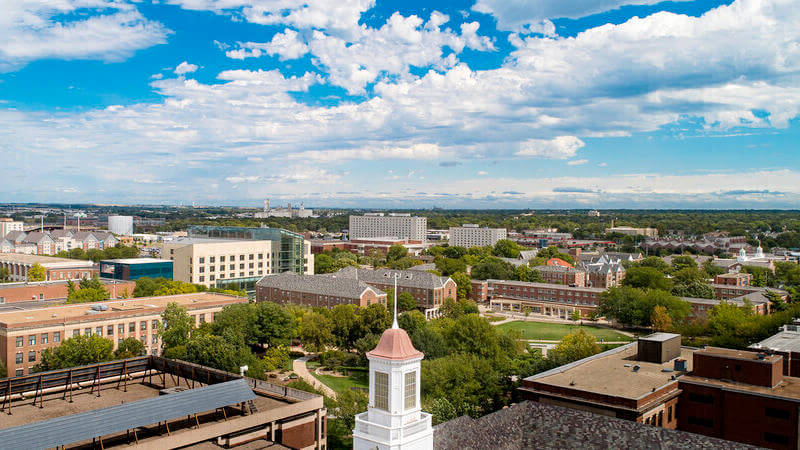
The university occupies three campuses in Lincoln: City Campus in downtown Lincoln, East Campus just east of downtown, and Nebraska Innovation Campus just north of City Campus. City Campus is the main campus and houses departments including the College of Arts and Sciences and the College of Business; East Campus focuses on agricultural and life sciences; Innovation Campus is a hub for entrepreneurship, technology and industry partnerships.
Academic units are the colleges of Agricultural Sciences and Natural Resources, Architecture, Arts and Sciences, Business, Education and Human Sciences, Engineering, the Hixson-Lied College of Fine and Performing Arts, Journalism and Mass Communications and Law, together with Graduate Studies. Students choose from more than 100 majors. Signature programmes include the University Honors Program, the Jeffrey S. Raikes School of Computer Science and Management, the Nebraska Business Honors Academy, the Johnny Carson Center for Emerging Media Arts and the Undergraduate Creative Activities and Research Experiences (UCARE) programme.
University Housing offers traditional halls with two-person rooms, suite-style halls for four students per unit, and apartment-style housing for upper-division students; first-year Honors and learning-community students can live in suite-style rooms. Support services for students include the Center for Academic Success and Transition, the Writing Center, Big Red Resilience and Well-Being, the Office of Student Culture and Community and the University Health Center. The Sheldon Museum of Art, Prairie Schooner literary magazine and University of Nebraska Press are based at the university.
Nebraska enrols students from all 50 states and more than 126 countries. The International Student and Scholar Office provides immigration support and events, University Career Services offers coaching and guidance on F-1 Optional Practical Training, and the Intensive English Program is available to applicants who have not yet met English proficiency requirements.
Tuition is charged by residency. Estimated annual tuition and fees for full-time undergraduates are $11,472 (Nebraska resident, $303 per credit hour), $31,542 (non-resident, $972 per credit hour) and $31,942 (international). Estimated total annual cost for an international student, including housing and food ($13,950), health insurance ($4,578), books, travel and personal expenses, is $53,922. Business, Architecture and Engineering have differential tuition rates.
International admits are automatically considered for scholarships of up to US$15,000 per year; applicants who apply by the deadline with all materials (fall 2027: May 1; spring 2027: December 1) are reviewed. Renewal requires a 3.000 GPA and 24 credit hours per year. See official scholarships page.
Need-based financial aid (grants, loans and work-study) through the FAFSA is available to eligible domestic students. Domestic scholarships include the President's Scholarship, Chancellor's Tuition Scholarships and Nebraska Promise, which covers in-state tuition for qualifying in-state students with family income of $65,000 or less or Pell eligibility. Graduate students may obtain assistantships and fellowships through Graduate Studies.
Global Excellence Scholarship (International Scholarship Program Agreements) →
Browse the scholarships listed for University of Nebraska-Lincoln and check each award’s eligibility.
View scholarships for University of Nebraska-Lincoln →Admission is guaranteed to applicants who meet the core course requirements and at least one performance requirement; others are reviewed by a committee. Applications are accepted through the Common Application or Nebraska's own application.
Transfer applicants should have a 2.0 cumulative GPA on college-level coursework and a 2.0 GPA for the most recent term; those with fewer than 24 semester hours must also meet the 16-unit core course requirement. Transfer students apply through Nebraska's application. Test scores are not required.
Applicants need a four-year U.S. bachelor's degree from a regionally accredited institution or an equivalent degree evaluated by the Office of Graduate Studies, and apply online through Graduate Studies; international applicants should apply no later than 30 days before the start of the term. Non-native English speakers must verify English proficiency.
Facilities include the University Health Center (medical clinic, pharmacy, dental clinic, counselling), University Libraries, Sheldon Museum of Art, Memorial Stadium and residence halls such as Abel, Harper, Sandoz, Selleck Quadrangle, University Suites, Eastside Suites and The Village.
Study programmes offered at University of Nebraska-Lincoln.
Experiences shared by students of University of Nebraska-Lincoln.
Studied here? Share your experience to help other applicants.

Book a free consultation with our expert counsellors and take the first step towards your dream university.
Copyrights © 2026 StudyMapped. All rights reserved.

Enter your credentials to continue.
Join us and start your study abroad journey.


