
University in Germany
Münster, Nordrhein-Westfalen, Germany
University profile
The University of Münster (Westfälische Wilhelms-Universität Münster, branded WWU) is one of the largest universities in Germany. It has some 41,200 students, 16 faculties and some 120 degree programmes, and its slogan is "living.knowledge". Teaching began in 1773, the first university was inaugurated in 1780, and the institution was elevated to university status again on 1 July 1902. It is a signatory of the Magna Charta Universitatum.
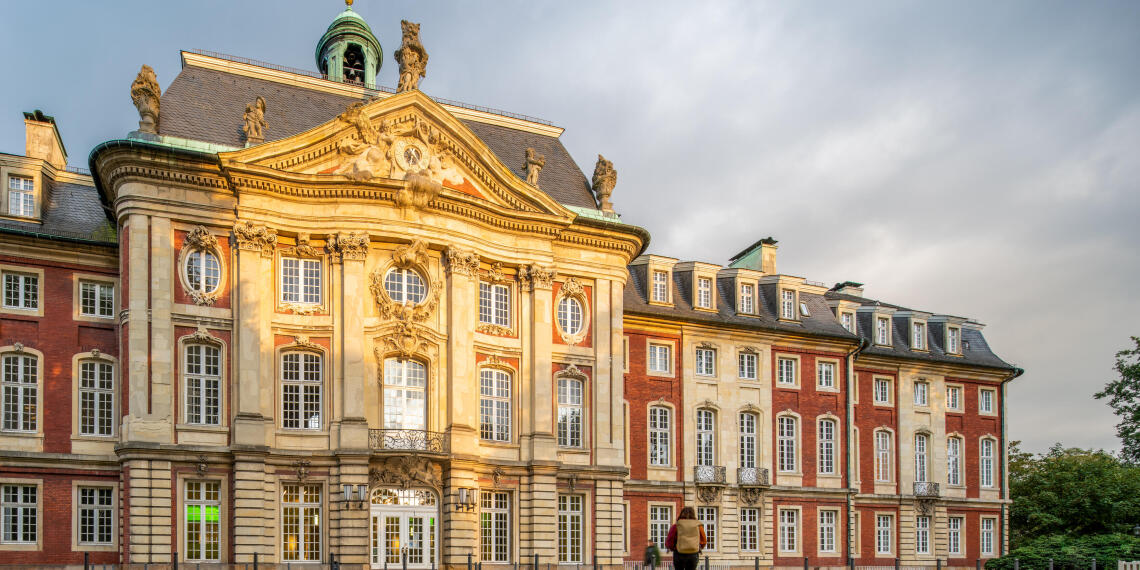
The university has no central campus. Its buildings are spread across the city of Münster in North Rhine-Westphalia, from the Schloss (the main building since the end of the Second World War) and the Domplatz area to the Leonardo-Campus and the Centre for Natural Sciences, with the hospitals of the Faculty of Medicine forming a further site. The Hüffer Campus, being developed with Münster University of Applied Sciences, is to bring the theological disciplines together.
Faculties.
Research strengths include mathematics (Cluster of Excellence Mathematics Münster), religion and politics, cell dynamics and imaging (Cells in Motion Interfaculty Centre), nanoscience, catalysis and battery research (MEET Battery Research Center). The university is known for large faculties such as Law and Medicine as well as small subjects such as Scandinavian Studies.
Student life centres on the Studierendenwerk Münster canteens and accommodation, some 150 types of sport through University Sports, student clubs and groups, international student groups, the campus radio and the University and State Library. Students make up one-sixth of the city's population, over 55,000 people. The university does not operate its own student residence halls; the Studierendenwerk Münster and private providers offer rooms. About 9% of students are international (winter semester 2025/26), and the International Office advises those applying from abroad. Most programmes are taught in German, with a number of English-taught Master's programmes and one English-taught Bachelor's, Human Movement in Sports and Exercise (B.Sc.). The university is a public institution of the state of North Rhine-Westphalia and belongs to the European university network Ulysseus.
Students at the University of Münster pay no tuition fees for regular degree programmes; the exception is in-service continuing education programmes. Every student pays a semester fee (Semesterbeitrag), which is not tuition: 369.50 euros in winter semester 2026/27. It includes the Studierendenwerk Münster (119.77 euros), the semester ticket (226.80 euros), the semester ticket for cultural events (3.40 euros), student body tasks (17.50 euros), University Sports (1.40 euros), the university radio station (0.40 euros) and supplementary student insurance (0.23 euros). Living costs of around 1,000 euros per month are quoted for Münster, including a room at about 400 to 500 euros.
ProTalent awards 300 euros per month to students of all faculties each winter semester for the funding year from 1 October to 30 September, financed with private sponsors and federal funds. Applicants must be enrolled or about to enrol at Münster, be within the standard period of study and have at least one more year of study within it; doctoral students and those receiving merit-based funding above 30 euros a month are excluded. Selection rests on academic achievement, with extra points for social engagement or personal circumstances. Applications are made online in May and June for the following funding year; the 2026/27 round is closed. Details: ProTalent.
The university states that there are no full scholarship programmes at universities because tuition is free, and points to partial schemes. The DAAD awards scholarships to Master's and doctoral students from all countries, generally applied for from the home country. Information on BAföG, student loans, part-time work and AStA social counselling and the crisis fund is on the costs and financing page and student scholarships page. The International Office advises on financial aid for international students.
Browse the scholarships listed for University of Münster and check each award’s eligibility.
View scholarships for University of Münster →Applicants need a university entrance qualification recognised in Germany. Applicants from non-EU/EEA countries without a European entrance qualification must apply for each degree programme and, for restricted-admission programmes, in the first semester; the DAAD admission database and anabin are used to check country-specific equivalence. Places in restricted-admission (numerus clausus) programmes go primarily by the grade point average of the entrance qualification, with foreign grades converted using KMK criteria (1.0 highest, 4.0 lowest pass). Medicine and Dentistry applicants with a TestAS certificate receive bonus grade points. Aptitude tests are mandatory for Sport and Physical Education and for Music bachelor's programmes.
Applications are made online through the university's application portal; Medicine, Pharmacy and Dentistry (and the Law state examination and other restricted programmes via the dialogue-oriented service procedure) are allocated through hochschulstart.de. Winter semester 2026/27, non-EU applicants: restricted-admission Bachelor's and state examination programmes from the beginning of May to 31 May 2026; non-restricted Bachelor's programmes from the beginning of May to 15 July 2026; Master's programmes from the beginning of May to 15 July 2026 (some to 15 September 2026); DSH language course from the beginning of May to 31 May 2026. Summer semester 2027, non-EU applicants: restricted Bachelor's programmes from the beginning of November to 30 November 2026; non-teaching Master's programmes from the beginning of November 2026 to 15 January 2027. Germany/EU/EEA applicants: restricted Bachelor's programmes from the beginning of May to 15 July 2026 (winter) and from the beginning of November 2026 to 15 January 2027 (summer).
German-language programmes require very good German, usually DSH-2. DSH-2 equivalents are TestDaF level 4 in all four skills, Goethe-Zertifikat C2, telc C1 Hochschule ("befriedigend" or "gut"), UNIcert level III, the Deutsches Sprachdiplom level II or the Feststellungsprüfung. DSH-1 (some programmes such as Physics, Geophysics and Mathematics B.Sc. and some music programmes) accepts TestDaF level 3 in all skills; DSH-3 (Medicine, Dentistry) requires TestDaF level 5, Goethe C2 with at least 82% or telc C1 Hochschule "sehr gut". The Language Centre offers a preparatory German as a Foreign Language course ending in the DSH examination for those who have reached B1; it takes one to three semesters, and the course fee is 500 euros per semester, reimbursed to participants who pass the DSH and enrol in a degree programme at Münster. Participants also pay the semester fee. Passing DSH together with the preparatory orientation course can improve the entrance GPA by up to 0.5 grade points.
German proficiency is not required for English-taught programmes; the English-language requirement is set in each programme's admission regulations. The only undergraduate programme admitting without German is Human Movement in Sports and Exercise (B.Sc.); most other English-taught programmes are advanced Master's programmes.
Applicants need a Bachelor's degree of at least three years from a state-accredited institution, in the same or a related subject, as almost all Master's programmes are consecutive. A selection committee for each programme assesses subject-specific aptitude, including for non-restricted programmes. Up to three Master's programmes can be applied for in one online application. Required uploads are the transcript of records including GPA, proof of German and/or English proficiency as the programme requires, and an APS certificate for applicants from China, India or Vietnam, plus programme-specific documents listed in the Study Guide. Documents not in German or English need an official translation.
Candidates with a Master's degree with above-average marks propose a research topic and a doctoral supervisor, and the respective faculty decides on admission under its doctoral regulations (Promotionsordnung). Enrolment is online with confirmation of doctoral supervision: winter semester from August to 15 November, summer semester from February to 15 May. Structured PhD programmes accept applications directly through the respective graduate school. The Münster Centre for Emerging Researchers (CERes) advises international doctoral candidates.
Students needing a study visa must prove access to at least 11,904 euros per year, usually through a blocked account.
The university has no central campus and its facilities are distributed across Münster.
Facilities include the University and State Library of Münster (Central Library, Krummer Timpen 3, which is also the state library for Westphalia), canteens and cafés run by the Studierendenwerk Münster, University Sports with about 150 types of sport, and the Bible Museum (established 1979). About 100 guest flats in five guest accommodations are available for international researchers through the Welcome Centre.
Study programmes offered at University of Münster.
Experiences shared by students of University of Münster.
Studied here? Share your experience to help other applicants.

Book a free consultation with our expert counsellors and take the first step towards your dream university.
Copyrights © 2026 StudyMapped. All rights reserved.

Enter your credentials to continue.
Join us and start your study abroad journey.


