
University in United States
Minneapolis, MN, United States
University profile
The University of Minnesota Twin Cities is the flagship of the University of Minnesota System and Minnesota's only land-grant university. It was founded in 1851 near Saint Anthony Falls on the banks of the Mississippi River, in the Minneapolis and Saint Paul area, and describes itself as one of the most prestigious public research universities in the United States. Its mission combines education, research and outreach to communities across Minnesota.
The Twin Cities campus is one of five universities in the nation with an engineering school, medical school, law school, veterinary medicine school and agricultural school on a single campus. It offers more than 300 majors and minors for undergraduates and more than 550 graduate and professional degrees, with about 17:1 student-faculty ratio and some 25,000 faculty and staff.
Academic work is organised in 16 colleges and schools, including Biological Sciences, Dentistry, Design, Education and Human Development, Extension, Food, Agricultural and Natural Resource Sciences, Law, Liberal Arts, the Carlson School of Management, Medicine, Nursing, Pharmacy, Public Affairs, Public Health, Science and Engineering, and Veterinary Medicine. The College of Continuing and Professional Studies also runs online and continuing programmes.
Research is a defining strength: the university reports 2.1 million square feet of research space, more than 300 centers and institutes, and 25 Nobel Prize recipients associated with it. Students in all majors can take part in research alongside faculty, and the university highlights internship and research opportunities across fields from engineering to medicine, business, law and the liberal arts.
Student life is built around a large urban campus. On-campus housing is guaranteed for all admitted freshmen who apply for housing and confirm enrolment by May 1, and transfer students have a limited number of on-campus options. Study abroad includes 180+ options in 50+ countries. More than 50,000 undergraduate students and about 16,000 graduate and professional students study on campus, and the university counts more than 600,000 living alumni.
International students number about 5,400 from 140 countries, supported by International Student and Scholar Services (ISSS) and international admissions counselors. The Minnesota English Language Program (MELP) offers intensive English study, including conditional admission for a limited number of international freshmen. The Twin Cities campus does not use agents or educational consultants to recruit or enrol international students.
Tuition is a flat rate for 13 or more credits per semester, and credits beyond 13 are not charged extra. Estimated 2026-27 international undergraduate cost of attendance: tuition and fees $44,743; books and supplies $1,000; mandatory health insurance $3,590; living expenses $17,752 (9 months) or $23,669 (12 months, required for the I-20); total $67,085 (9 months) or $73,002 (12 months). Carlson, Science and Engineering and some Liberal Arts majors carry an additional tuition surcharge. Manitoba residents pay Minnesota resident tuition under a reciprocity agreement. The university reports that 75 percent of students receive financial aid or work-study and 43 percent of bachelor's students graduate debt free.
Competitive, merit-based tuition waiver for international freshmen (about $5,000 to $20,000 per year for up to four years) and fall transfers ($10,000 per year for up to three years). All international students who apply by the deadline are automatically considered; no separate application. See Global Excellence Scholarships.
U.S. citizens and eligible non-citizens apply for federal aid with the FAFSA (available from December). Freshmen who apply by the deadlines receive full consideration for scholarships and the University Honors Program. Details: costs, scholarships and visas for international students.
Browse the scholarships listed for University of Minnesota Twin Cities and check each award’s eligibility.
View scholarships for University of Minnesota Twin Cities →Freshman applicants are admitted directly to a freshman-admitting college (Carlson School of Management, Biological Sciences, Design, Education and Human Development, Food, Agricultural and Natural Resource Sciences, Liberal Arts, Science and Engineering, or Nursing). The application needs only an application form, a $55 application fee and a self-reported academic record; no letters of recommendation or essays are required. ACT or SAT scores are not required for freshman applicants through fall 2027 admission (test-optional); applicants who report a score must submit official scores by July 1. Final high school transcripts, or GED, are due by July 1.
Deadlines: Early Action I on November 1 (decision by January 31), Early Action II on December 1 (decision by February 28) and Regular on January 1 (decision by March 31). Applicants completing by these dates receive full consideration for the University Honors Program and scholarships; later applicants are considered on a space-available and funds-available basis. Enrolment is confirmed with a nonrefundable fee by May 1.
Profile of admitted students, Fall 2026 (middle 50 percent): high school rank percentile 75 to 95, unweighted core GPA 3.51 to 3.96, ACT 27 to 33 and SAT 1350 to 1490 among those who submitted scores. About 50,000 applications were received for a class of about 7,200. These ranges describe admitted students and are not admission criteria.
Each college or program sets its own transfer requirements. Fall and spring entry are available, except Carlson School of Management, Science and Engineering, Biological Sciences, Dental Hygiene, Medical Laboratory Science and Nursing, which take fall transfers only. No essay or recommendation letters are needed; Acting, Dance, Dental Hygiene, Medical Laboratory Sciences, Music, Nursing and Mortuary Science applicants submit a supplemental application. Final transcripts from all colleges attended are required, and Transferology shows how credits transfer.
International applicants are those on or needing a temporary visa. Undergraduate applicants complete a Certification of Finances form through Application Tracker. English proficiency is required of international students from non-exempt countries and of other applicants whose first language is not English or who have studied in U.S. schools for less than four years; it may be met by test, ACT/SAT results, specific high school curriculum, country of origin or U.S. transfer coursework. Minimum scores (overall and writing) for the Spring 2027 application period: TOEFL iBT 4.5 and 4.5 (AZ hold 4.0; MyBest scores not accepted; test code 6874), IELTS Academic 6.5 and 6.5 (AZ hold 6.0), PTE Academic 59 and 59 (AZ hold 50-58), Cambridge C1 Advanced 180 and 180 (AZ hold 170-179) and Duolingo 120 and 120 (AZ hold 105-115). Carlson requires both the overall and writing minimums. The Medical School does not currently accept international applications.
The university offers more than 550 graduate and professional degrees to applicants holding a bachelor's degree; requirements and applications are set by each programme.
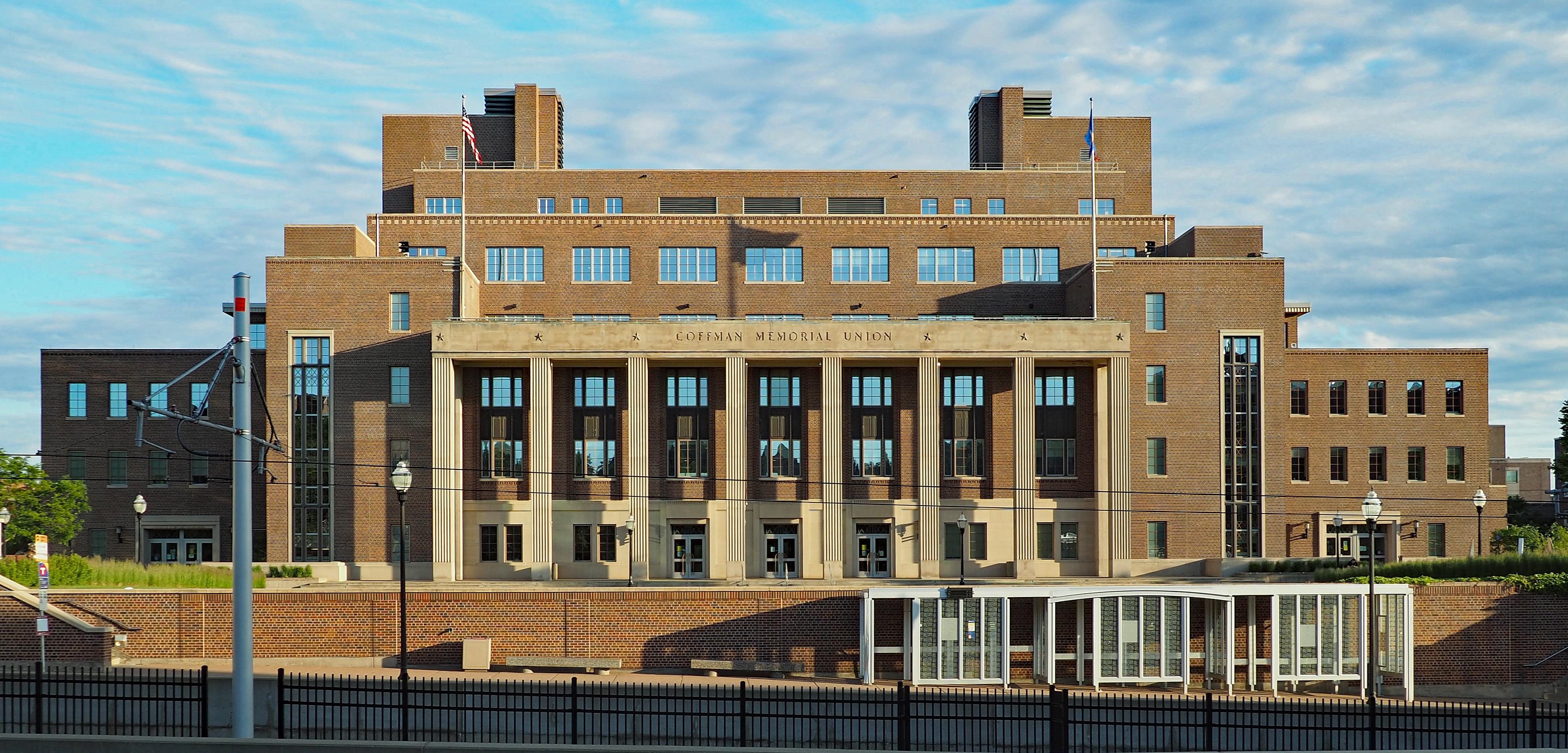
The University of Minnesota Twin Cities was founded in 1851 near Saint Anthony Falls on the banks of the Mississippi River. It is Minnesota's only land-grant university and is one of five universities in the nation with an engineering school, medical school, law school, veterinary medicine school and agricultural school all on one campus.
The campus is located in the cities of Minneapolis and St. Paul. The Minneapolis campus is divided into the East Bank and West Bank, which span a 100-foot gorge along the Mississippi River. The St. Paul campus lies about four miles east of the Minneapolis campus and grew from the agricultural experiment station established in the late 1880s.
Together the East Bank, West Bank and St. Paul areas comprise about 23 million square feet of buildings on 1,292 acres. Major open spaces include the Knoll and Northrop Mall on the East Bank, the plaza on the West Bank, and the Lawn and Bowl on the St. Paul campus. The West Bank plaza is anchored by the Washington Avenue Bridge and the arts district.
Study programmes offered at University of Minnesota Twin Cities.
Experiences shared by students of University of Minnesota Twin Cities.
Studied here? Share your experience to help other applicants.

Book a free consultation with our expert counsellors and take the first step towards your dream university.
Copyrights © 2026 StudyMapped. All rights reserved.

Enter your credentials to continue.
Join us and start your study abroad journey.


