

University in Ghana
South Legon, Accra, Ghana
University profile
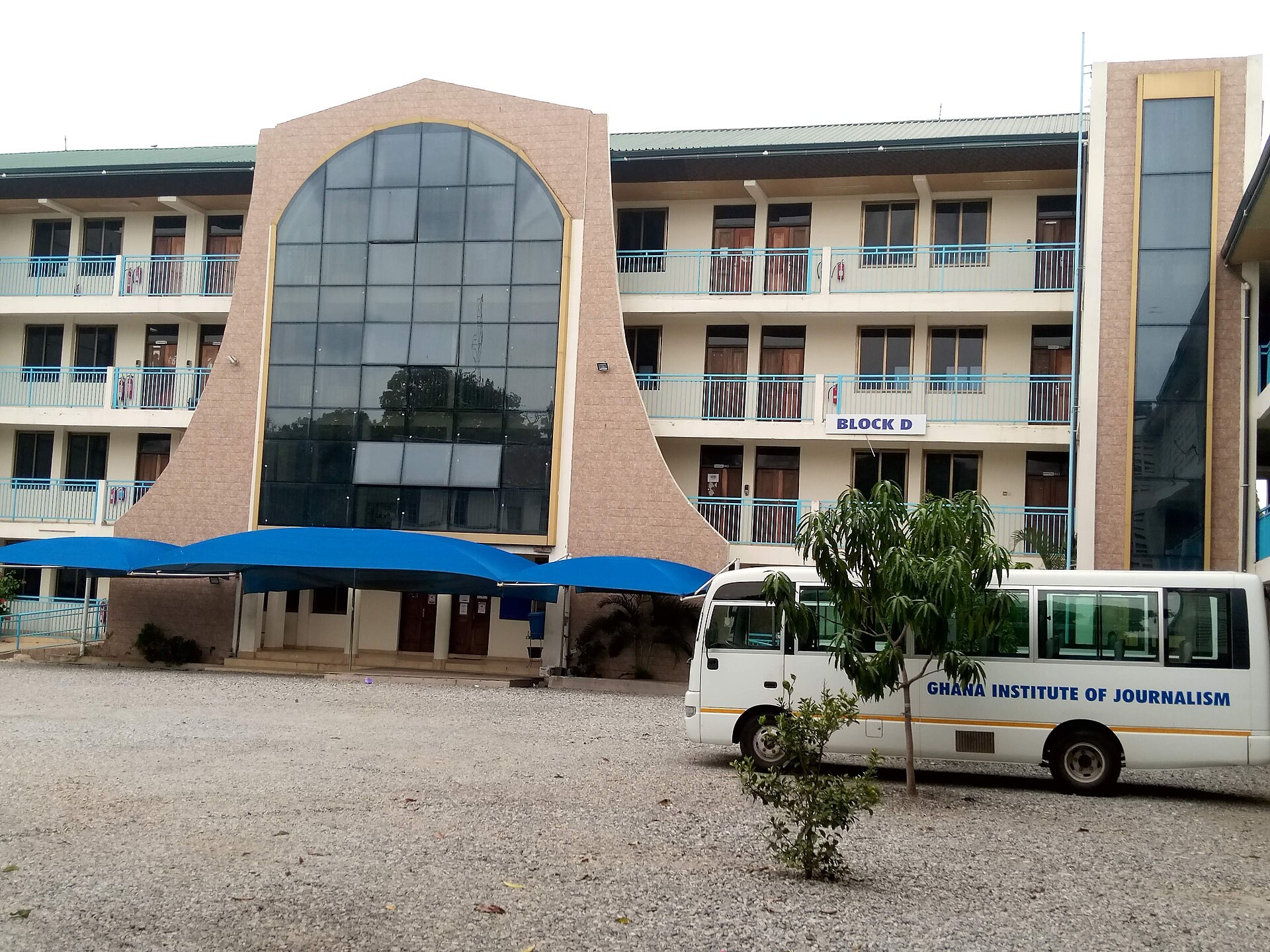
The University of Media, Arts and Communication (UniMAC) is a public university in Accra, Ghana, established by an Act of Parliament, Act 1059 of 2020. The Act merged three existing institutions: the Ghana Institute of Journalism (GIJ, 1959), the Ghana Institute of Languages (1961) and the National Film and Television Institute (NAFTI, 1978). It is described by its Vice-Chancellor as the first public university in Ghana established by an Act that merges three specialised institutions, and it is built around media, arts and communication.
The Act created a holding university with constituent institutes that operate autonomously and have the power to award the degrees of the holding university. The institutes named in the Act are the Institute of Journalism, the Institute of Film and Television and the Institute of Languages, with provision for an Institute of Theatre and Performing Arts, an Institute of Digital Media Arts and any other institute, school or centre the Council may determine. The university's stated mandate is to provide higher education, disseminate knowledge related to the development of the media, arts and communication industry in Ghana, undertake research and build relationships with persons outside the university.
The main campus is at No. 5 Alboran Street, South Legon, Accra. The Institute of Film and Television (the former NAFTI) is a separate constituent with its own Faculty of Cinematic and TV Arts (departments of Production Techniques, TV and Radio Production, Film and Business Studies, and Film Artistic) and Faculty of Digital Media and Design (departments of Animation and Game Development, Broadcast Technology, and Multimedia and Design).
Programmes run from two-year diplomas through four-year bachelor's degrees (BA and BFA) with two-year top-up routes, to MA, MPhil and PhD degrees. Undergraduate areas include communication studies (journalism and public relations options), broadcast journalism, development communication, business and communication, bilingual business administration, translation, Arabic, French with business communication, and BFA degrees in animation, film directing, television production, editing, production design, motion picture photography, sound production and multimedia production. A PhD in Media and Communication was launched in November 2024, delivered in blended mode with scholars from Virginia Tech University (USA) and Nelson Mandela University (South Africa).
The university's vision is to become a first-rate university that pursues excellence in research and professional education and training in communication and the creative arts. Its values are excellence, integrity, transparency in unity, discipline, accountability, and industrial and community relevance. Student services include a Counselling Unit offering psychosocial support, preventive mental health education and academic success support, a Dean of Students office, a Students' Representative Council and a university library. UniMAC reports that it graduates more women than men and holds a distinctive graduation custom in which women keep their mortar boards on. Foreign applicants are considered after evaluation of their certificates by the Ghana Tertiary Education Commission (GTEC).
UniMAC supports needy and brilliant students through scholarships and bursaries. Each scheme has its own criteria and application window.
Applicants are generally expected to be enrolled full time, demonstrate financial need or strong academic performance, and provide supporting documents.
These schemes support tuition and living costs for needy students. Consult student affairs notices and the admissions pages for the current call, deadlines and documents.
Browse the scholarships listed for University of Media, Arts and Communication and check each award’s eligibility.
View scholarships for University of Media, Arts and Communication →Passes (A1-C6) in six subjects comprising three core subjects, including English and Mathematics, and three elective subjects. Applicants to the BA in Translation must offer French among their electives. Final-year WASSCE candidates may apply as awaiting-results applicants and must upload their results when released by WAEC.
Passes (A-D) in six subjects comprising three core subjects, including English and Mathematics, and three electives. BA Translation applicants should have French as an elective.
GCE Advanced Level: Grade E or better in three subjects, at least one at Grade D or better, plus credit passes (Grade 6 or better) in five GCE Ordinary Level subjects including English, Mathematics and a Science subject for non-science students. Advanced Business Certificate Examination: passes in three subjects (at least one at Grade D or better) plus credit passes in five subjects, including English Language, Mathematics, and Integrated Science or Social Studies, in the General Business Certificate Examination; such applicants may be admitted to Level 200.
A UniMAC Diploma with a final CGPA of 2.5 or above, or an equivalent diploma from an accredited communications training institution with a CGPA of 3.0 or above or an average of Grade B. UniMAC diploma holders with a final CGPA between 1.80 and 2.49, or equivalent diploma holders from accredited communications institutions, may be considered for a fee-paying option. Diploma holders with a CGPA of 1.79 or below can apply for Level 200. UniMAC diploma holders with NABPTEX/CTVET certification may apply for Level 200 top-up. Diploma holders with a final GPA of 3.00 from other disciplines and HND holders with at least Second Class (Lower Division) may apply. Final-year diploma students may apply as awaiting-results applicants and must supply certificates and transcripts to complete the application.
SSSCE: six passes (A-D) in all subjects including English and Mathematics, with three passes in subjects relevant to the area of specialisation. WASSCE: six passes (A1-D7) in all subjects including English and Mathematics, with at least C6 in three passes relevant to the area of specialisation. HND Bilingual Secretaryship applicants should have French among their electives.
SSSCE: six passes (A-D) including English and Mathematics, with three passes relevant to the area of specialisation. WASSCE: six passes (A1-D7) including English and Mathematics, with at least C6 in three passes relevant to the area of specialisation.
Applicants must be at least 25 years old and provide a birth certificate or other documentary proof of date of birth that is at least five years old at the time of application. Candidates sit a special entrance examination in English Language, Mathematics, Aptitude Test/General Paper and French, and successful candidates may be admitted to a degree or diploma depending on performance.
A bachelor's degree in communication studies from UniMAC or any accredited or recognised university with at least Second Class Lower Division; or a bachelor's degree in another discipline from a reputable university with at least Second Class Lower Division; or a bachelor's degree with Third Class plus three years of relevant working experience.
Political Communication Management: a bachelor's degree with at least Second Class Lower Division and a Master of Arts degree from an accredited university, a pass in an entrance examination and/or selection interview, a transcript and a 4 to 5 page research proposal. Strategic Public Relations Management: an MA in Communication (Public Relations option) with a CGPA of at least 3.5, or 3.0 where the applicant has shown strong research acumen, and a pass in a selection interview.
A master's degree in a communication-related field from an accredited university with a CGPA of 3.0 or above (applicants without a research component may be required to audit additional courses), or an MA/MSc with research, an MPhil in a communication-related field, or an MFA in Film and Television Production; at least a grade B in the master's dissertation or thesis; a 3,000-word research proposal; and a selection interview. Foreign applicants with equivalent qualifications are considered after GTEC evaluates their certificates.
Applicants pay the application fee at any Prudential Bank branch by giving their name and telephone number, or electronically by mobile money (all networks), Visa or Mastercard through app.ropaygh.com. The receipt gives a serial number and PIN for the Online Admission Portal, where the application is completed. The completed form is then printed and submitted to the university with one passport photograph and supporting documents. Enquiries: [email protected]; No.5 Alboran Street, South Legon (GA-194-3855), P. O. Box GP 667, Accra; office hours Monday to Friday 8:30 AM to 4:30 PM.
The library, established in 1960, holds about 9,000 reference textbooks and 4,000 student dissertations, has seating for 100, 70 computers, a graduate students' library with seven computers, and an automated circulation system. About 70% of holdings are on communication studies and the English language. It is a member of the Consortium of Academic and Research Libraries in Ghana (CARLIGH) and has more than 5,000 registered users. Opening hours are 8:30 AM to 7:30 PM on weekdays and 9:00 AM to 5:00 PM on Saturdays.
Study programmes offered at University of Media, Arts and Communication.
Experiences shared by students of University of Media, Arts and Communication.
Studied here? Share your experience to help other applicants.

Book a free consultation with our expert counsellors and take the first step towards your dream university.
Copyrights © 2026 StudyMapped. All rights reserved.

Enter your credentials to continue.
Join us and start your study abroad journey.


