
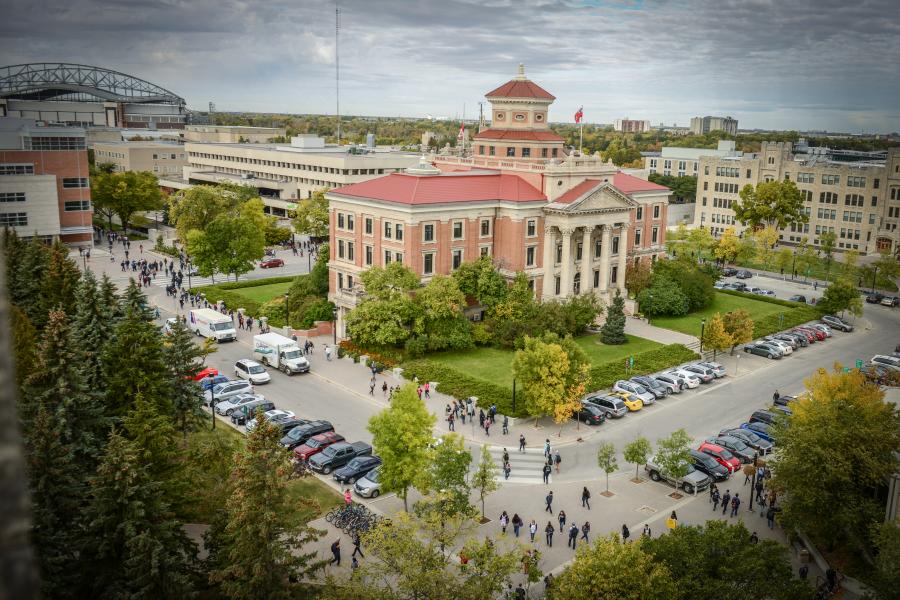

University in Canada
Winnipeg, Manitoba, Canada
University profile
The University of Manitoba (UM) is a public research university in Winnipeg, Manitoba, founded in 1877. It describes itself as Manitoba's largest and most research-intensive university and is a member of the U15 group of research-intensive Canadian universities. Its mission is to advance learning by creating, sharing, preserving and applying knowledge in partnership with diverse communities, and its stated values are belonging, curiosity, impact, integrity and well-being.
UM has two main campuses in Winnipeg, Fort Garry and Bannatyne, plus other Winnipeg locations and satellite sites and research stations across Manitoba. The Fort Garry campus covers more than 280 hectares beside the Red River, about 20 minutes from the city centre. The Bannatyne campus is a nine-building downtown complex next to the Health Sciences Centre and trains doctors, nurses and other health professionals.
Teaching is organised into 13 faculties, 4 schools and 9 colleges. Faculties include Agricultural and Food Sciences, Architecture, Arts, Education, the Price Faculty of Engineering, the Clayton H. Riddell Faculty of Environment, Earth, and Resources, Graduate and Postdoctoral Studies, the Rady Faculty of Health Sciences, Kinesiology and Recreation Management, Law, the Desautels Faculty of Music, Science and Social Work, together with the I. H. Asper School of Business, the School of Art and Extended Education. The Rady Faculty of Health Sciences brings together the Max Rady College of Medicine, the Dr. Gerald Niznick College of Dentistry and the Colleges of Nursing, Pharmacy and Rehabilitation Sciences. Affiliated colleges include St. Andrew's, St. John's, St. Paul's and University College. UM offers more than 250 programs, over 100 of them undergraduate and nearly 150 graduate, and more than 50 programs offer co-op education. University 1 (U1) lets first-year students explore subjects before choosing a program.
In Fall Term 2025 UM enrolled 31,922 students: 27,372 undergraduates and 3,771 graduate students. International students number 6,278 from 123 countries, 19.7 percent of the student body. Six residence buildings on the Fort Garry campus house more than 1,350 students a year, with furnished rooms and high-speed internet, and St. John's College and St. Andrew's College also offer residence accommodation. The Bisons varsity teams have more than 400 student-athletes on 15 teams in 9 sports, and more than 35,000 students, staff and community members use UM recreation facilities each year.
International pathways include the English Language Centre's Intensive Academic English Program, where completing Level 5 can lead directly into an undergraduate program for conditionally accepted students, and the International College of Manitoba, whose graduates can transfer into second year of a UM undergraduate degree.
UM awards about $40 million in scholarships and bursaries a year, with more than $3.5 million in entrance scholarships going to about 1,600 first-year students. Most entrance scholarships are based on academic achievement in the last one or two years of high school, and applicants who apply for admission and submit transcripts by March 1 are automatically considered for the General Entrance Scholarships. Full-time enrolment (at least 24 credit hours over fall and winter) is generally required. The searchable awards database lists Senate-approved awards. See Financial aid and awards and entrance awards.
One award of $25,000 and two awards of $10,000 each go to international high school graduates entering University 1 or a direct entry faculty, college or school full-time. The $25,000 award requires a minimum admission average of 90% across five senior-level courses and strong leadership and community involvement; the $10,000 awards require the minimum admission requirements for the program and the same leadership qualities. Apply for admission, pay the application fee and submit the scholarship application with one recommendation letter from a current teacher or principal by December 1. Official page.
For graduates of Canadian high schools with a best-five-course average of at least 85%: Queen Elizabeth II Entrance Scholarship (95% or above, $3,000), Guertin Centennial Entrance Scholarship (90% or above, $2,000), Hogg Centennial Entrance Scholarship (85% or above, $1,000). Candidates from outside Manitoba and Canada are assessed on a comparable level of academic standing.
For students entering university on the full IB Diploma, from any province or country, with seven tiers by points. In 2024/25 these ranged from $3,500 (43-44 points) to $1,100 (25-27 points).
The Alumni Association Entrance Scholarship (minimum $1,000, essay-based, August 1 deadline); Fairfax Financial Holdings Entrance Bursaries (three of $6,000 for Canadian citizens or permanent residents with financial need, July 15 deadline); Chown Centennial Scholarship ($1,000, nominated by high schools); BMO Leader of Tomorrow and BMO Indigenous Leader of Tomorrow Scholarships (December 1 deadline); and Schulich Leader Scholarships for Canadian high school students.
UM provides over $13 million in funding to graduate students through aid, stipends, scholarships and fellowships. The International Graduate Student Entrance Scholarship requires a minimum GPA of 3.75 on a 4.5 scale over the last two full years of study. See graduate funding and awards.
University of Manitoba International Excellence Entrance Scholarship →
University of Manitoba International Undergraduate Student Entrance Scholarship →
Browse the scholarships listed for University of Manitoba and check each award’s eligibility.
View scholarships for University of Manitoba →Undergraduate applications are made online through the UM application portal (apply.umanitoba.ca) and take about 30 minutes to complete. To start classes in September, apply and pay the application fee by March 1; winter and summer starts are also available. Deadlines vary by program, and the application fee must be received by the deadline. The application fee is $100 for Canadian citizens, permanent residents and refugees and $130 for international students, non-refundable, payable by Visa or MasterCard or through Convera or PayMyTuition (the latter take about five to ten business days). Depending on program, applicants may also need transcripts, proof of English proficiency, a personal statement, portfolio, audition or interview and references. The portal shows the document checklist and the offer, which is accepted online.
Applicants from high school with fewer than 24 credit hours of post-secondary study are direct entry students. They must show English language proficiency, meet the general entrance requirement for their country or curriculum of study (including International Baccalaureate and British-patterned GCE), and meet the program-specific requirements. For West African Examinations Council WASSCE applicants (Ghana), University 1, Arts, Agriculture and Food Sciences, Earth Sciences, Environmental Studies and Geography require an average of C5 (70%) over four senior-level courses (English, Mathematics, and two other academic courses) with no grade lower than C6 (60%). Commerce and Engineering require an average of B3 (80%) with no grade lower than C5 (70%); Commerce needs English, Pre-Calculus Mathematics and two other academic courses, and Engineering needs English, Pre-Calculus Mathematics, Chemistry and Physics. Health Sciences, Health Studies, Kinesiology and Recreation Management require an average of B2 (85%) with no grade lower than C6 (60%), with Biology and Chemistry required for Health Sciences. Fine Arts additionally requires a digital portfolio with a written statement. Questions go to [email protected].
Manitoba applicants must hold five full Grade 12 credits in courses designated S, G, U or C and meet their program's direct entry requirements. Applicants from other provinces follow the provincial high school course requirements for the program. Advanced Placement and International Baccalaureate standing is treated as equivalent to 40S courses for admission and awards.
Applicants whose primary language is not English must meet one of: IELTS Academic 6.5 overall with at least 6.0 in each of listening, reading, speaking and writing; TOEFL iBT 86 overall with at least 20 in each section (tests taken before January 20, 2026), or, for tests taken from January 21, 2026, an overall score of 4.5 with at least 4.0 in each section; CAEL 60; Pearson Test of English 58; Cambridge C1 Advanced or C2 Proficiency 180; Duolingo English Test 120 overall with at least 105 in Literacy, Comprehension, Production and Conversation (not accepted for Law or the International Dentist Degree Program); or a pass at Level 5 of the English Language Centre's Intensive Academic English Program. Results expire two years from the test date. Waivers are available with documentation after ten consecutive years of residency in Canada, or three years of secondary or post-secondary study in Canada. Law and the International Dentist Degree Program have their own tests and scores.
Applicants with 24 or more post-secondary credit hours apply as advanced entry students; requirements vary by program and transfer credit is assessed under faculty regulations. Mature student status applies to Canadian citizens or permanent residents aged at least 21 who do not meet regular requirements and have completed fewer than 24 credit hours; options include University 1 and other direct entry programs.
Graduate applicants need English language proficiency and at least an Honours (four-year bachelor's) degree or equivalent, with a minimum GPA of 3.0 (B) or equivalent over the last 60 credit hours (calculated on the most recent two years of full-time study for non-Canadian and non-US transcripts). Some departments require additional criteria such as the GRE or GMAT or a statement of research interests. From January 1, 2026 master's and doctoral students at public universities such as UM are exempt from the provincial attestation letter requirement, while pre-master's applicants still need it. International students need a Canadian study permit.
International students: Arts $24,000; University 1 $25,800; Education $25,800; Business $26,700; Science $28,000; Engineering $31,400; Law $39,900. Canadian citizens and permanent residents: Arts $6,900; University 1 $7,400; Science $8,200; Engineering $9,700. Fees depend on credit hours and faculty and are estimates.
Residences (Fort Garry): Arthur V. Mauro Student Residence (316 students in 155 suites), Mary Speechly Hall, Pembina Hall (built 2011, 360 students), University College Residence (236 single and 10 double rooms), plus residences at St. John's College and St. Andrew's College. Rooms are furnished with free high-speed internet; meal plans, study spaces, lounges and laundry are available. Rooms are allocated first-come, first-served.
Study programmes offered at University of Manitoba.
Experiences shared by students of University of Manitoba.
Studied here? Share your experience to help other applicants.

Book a free consultation with our expert counsellors and take the first step towards your dream university.
Copyrights © 2026 StudyMapped. All rights reserved.

Enter your credentials to continue.
Join us and start your study abroad journey.


