

University in United Kingdom · Featured
Manchester, England, United Kingdom
University profile
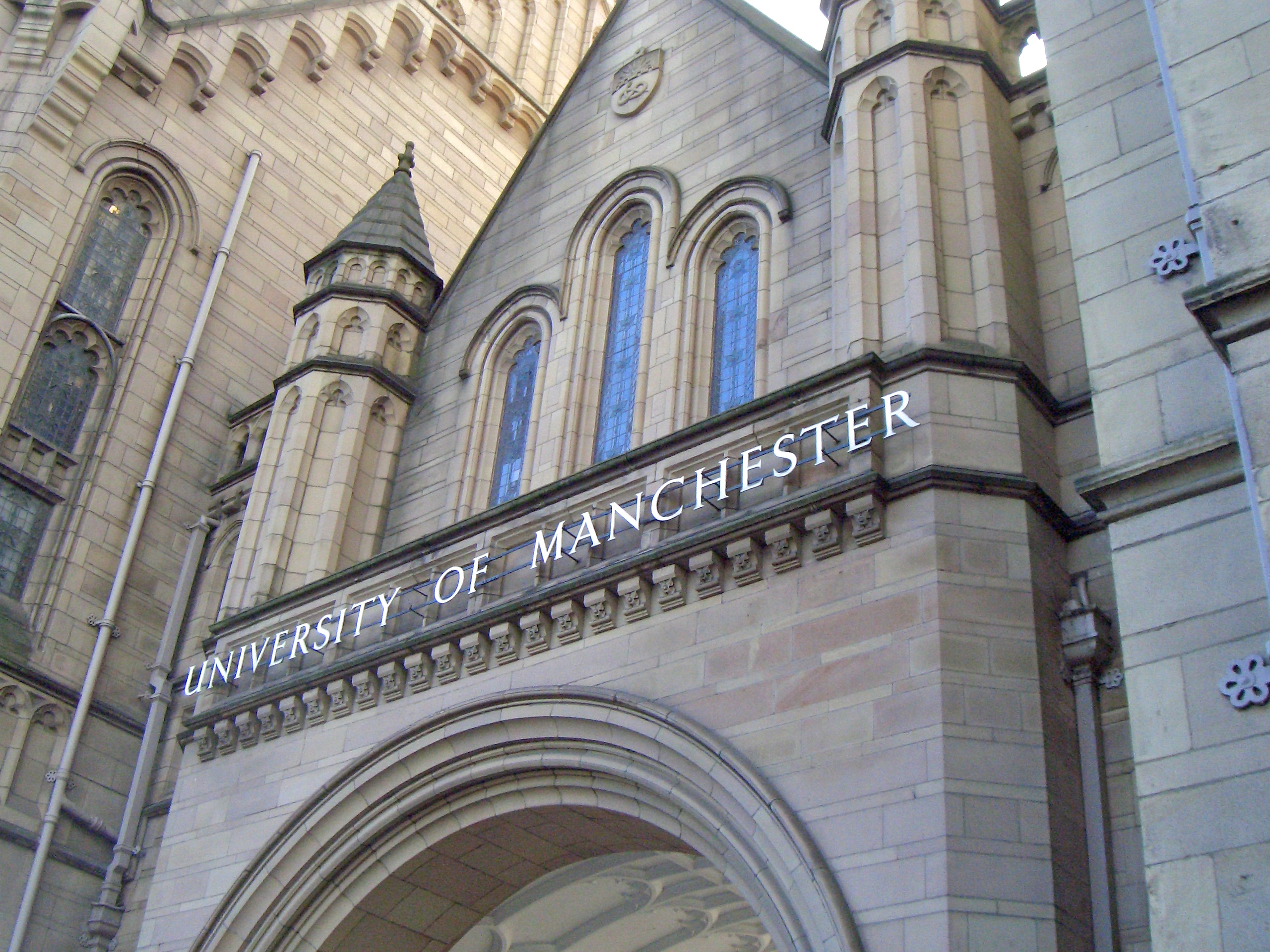
The University of Manchester is a research-intensive university on Oxford Road in Manchester city centre and a member of the Russell Group. It traces its origins to the Manchester Mechanics' Institution of 1824 and took its present form in 2004, when the Victoria University of Manchester and UMIST combined under a royal charter granted by Queen Elizabeth II to create the largest single-site university in the UK. It has more than 44,000 students, 12,000 staff and 26 Nobel Prize winners in its history.
Teaching and research are organised in three faculties on one campus. The Faculty of Biology, Medicine and Health comprises the School of Biological Sciences, the School of Medical Sciences and the School of Health Sciences. The Faculty of Science and Engineering contains the School of Engineering (Civil Engineering and Management, Chemical Engineering, Computer Science, Electrical and Electronic Engineering, Mechanical and Aerospace Engineering) and the School of Natural Sciences (Chemistry, Earth and Environmental Sciences, Materials, Mathematics, Physics and Astronomy). The Faculty of Humanities brings together Alliance Manchester Business School, the School of Arts, Languages and Cultures, the School of Environment, Education and Development and the School of Social Sciences.
The University is known for the first artificially induced nuclear reaction (Ernest Rutherford, 1917), the Manchester 'Baby', the first computer to run a stored program (1948), and the isolation of graphene by Andre Geim and Kostya Novoselov (2004), which earned the 2010 Nobel Prize in Physics. Its institutes include the National Graphene Institute, the Henry Royce Institute and the Dalton Nuclear Institute. It also runs the Jodrell Bank Observatory, a UNESCO World Heritage Site since 2019 and home of the 76-metre Lovell Telescope.
New full-time undergraduates and international postgraduates are guaranteed the offer of a room in University-owned or arranged halls, which are grouped into three residential areas: City, Victoria Park and Fallowfield. Students can join hundreds of clubs and societies and take part in the Stellify programme of extracurricular activities. The University Library is one of five national research libraries in the UK, and the Alan Gilbert Learning Commons is open for study 24 hours a day.
The University has more than 10,000 international students, and its student body comes from over 170 countries. Integrated foundation years in science and engineering and in biosciences, and pathway programmes with INTO Manchester, offer routes for students whose school systems do not lead directly to UK degree entry. The University is a member of the Northern Consortium (NCUK). It received a Silver overall rating in the 2023 Teaching Excellence Framework.
The undergraduate tuition fee for Home students starting in 2026 is £9,790 per year. Eligible UK students can cover it with a government tuition fee loan, and maintenance loans for 2026 entry go up to £10,830 a year for students living away from home outside London. International tuition fees are set course by course and shown on each course page, and the University may increase them by up to 7% a year for later years of study. Fees cover registration, tuition, supervision, examinations and graduation, as well as membership of the Library and the Students' Union. UK student finance | International fees
The University's funding search tool lists its own schemes. Examples include the Accommodation Bursary, a partial hall fee waiver for students from low-income households (150 awards); the Article 26 Scholarship for UK-based sanctuary seekers, covering tuition, cash and accommodation support; the Foundation Year Bursary; the Beatrice Shilling Scholarship for women starting engineering degrees; the Cowrie Foundation Scholarship; the Laura Nuttall Scholarship for students with long-term illness or disability; and the Lemn Sissay Law Bursary. Funding and financial support
For September 2027 entry, the University offers more than 350 partial merit-based scholarships worth over £6 million in total to undergraduate and master's offer-holders living in selected countries, including Ghana, Nigeria, Kenya, India and Pakistan. Undergraduate awards for Africa (Botswana, Ghana, Kenya, Mauritius, Nigeria, South Africa and Zimbabwe) are £12,000 a year for three years, up to £36,000, applied as a discount on international fees. Continuation requires 60% in each year's assessments. Applicants must be self-funded, must be taking A-levels, the IB, the South African NSC/IEB, the NCUK IFY or the Bridge House College Foundation, and must make Manchester their UCAS Firm choice by 15 May 2027. Medicine, dentistry, architecture and integrated foundation courses are excluded. Application forms are emailed to eligible offer-holders. Round one closes on 25 February 2027 and round two on 8 April 2027. Global Futures Scholarships
Equity and Merit Scholarships are 30 awards (20 full-time on campus and 10 online) for residents of Ethiopia, Malawi, Rwanda, Tanzania, Uganda and Zimbabwe with at least two years' professional experience. They cover full tuition and, for on-campus study, return airfares, living expenses and visas. The University also offered three GREAT Scholarships for 2026, run with the British Council: £18,000 for Ghana and £15,000 each for Bangladesh and Pakistan, for one-year taught master's courses, with a closing date of 23 April 2026. Carbon Reduction and Women in STEM scholarships are also available. Equity and Merit Scholarships | GREAT Scholarships | International funding
The President's Doctoral Scholar Award is the University's flagship doctoral scheme, with 100 studentships a year open to all nationalities. For 2026/27, fully funded places are offered in all three faculties under the theme 'Environmental challenges to human health, society, and productivity'. Other funding comes from Centres for Doctoral Training, research councils, industry and charities, and doctoral loans are available to eligible students. President's Doctoral Scholar Award | Postgraduate research funding
Sport Scholarships are open to students at all levels. Sport Scholarships
Global Futures Scholarship (Undergraduate, Africa) →
Equity and Merit Scholarships →
GREAT Scholarships at The University of Manchester →
British Council Women in STEM Scholarships at Manchester →
Browse the scholarships listed for University of Manchester and check each award’s eligibility.
View scholarships for University of Manchester →All undergraduates, from the UK and overseas, apply through UCAS. The University's institution code is M20 MANU, and course codes are shown on each course page. Applications for 2027 entry can be submitted from 1 September 2026. The deadline for medicine, dentistry, and applications that include Oxford or Cambridge is 15 October 2026 at 18:00 (UK time). The equal consideration deadline for all other courses is 13 January 2027 at 18:00. Applications received after that date are considered where vacancies remain, until 30 June 2027. Later applications go into Clearing, which opens on 2 July 2027. University decisions on on-time applications are due by 12 May 2027.
Entry requirements, including A-level, IB and other grades and any required subjects, are set course by course. Some courses add interviews, admissions tests (UCAT for medicine and dentistry), DBS checks or medical fitness assessments. Direct entry to year two is considered where the applicant has normally met the standard A-level requirements and completed the equivalent of the first year. Deferred entry is at the discretion of admissions teams.
The University reviews UCAS applications in the context of applicants' circumstances, and no separate application is needed. Eligibility factors include living in an area of disadvantage or low progression to higher education, attending a lower-performing school, care experience, refugee or asylum-seeker status, free school meals and being a young adult carer. Applicants may receive a WP, WP+ or WP++ flag. Holders of a WP Plus flag are usually offered one grade below the standard requirement, and holders of a WP Plus PLUS flag two grades below, on courses with standard requirements of ABB or higher. Aspirational offers and travel support for interviews are also available.
International applicants apply through UCAS and must meet the general entry requirements and the English language level for their course. Students from school systems with fewer than 13 years of schooling who have not taken A-levels or the IB Diploma may need a foundation course first. Options include the University's integrated foundation years in science and engineering and in biosciences, pathway programmes with INTO Manchester, and the NCUK International Foundation Year. For Ghanaian applicants, the WASSCE/SSSCE plus a recognised foundation course, three A-levels or the IB, or an ND or HND at Upper Credit are accepted. Entry to the science and engineering foundation year requires B3 in five relevant subjects, including Maths and Physics, and C6 in English Language.
Requirements vary by course and are listed on each course profile. Typical IELTS overall scores range from 5.5 to 7.5+, with corresponding TOEFL iBT scores from 72 to 109–120. Accepted tests include IELTS Academic or IELTS UKVI taken in a test centre, Pearson PTE Academic, test-centre LanguageCert Academic, Trinity ISE II–IV, Cambridge C1 Advanced and C2 Proficiency, and TOEFL iBT. Online and home editions are not accepted. Most results are valid for two years and must still be valid on the first day of Welcome Week. Courses below degree level require a UKVI-approved Secure English Language Test. Nationals of majority English-speaking countries listed by UKVI may be exempt. For postgraduates, typical requirements are the equivalent of IELTS 6.0–7.5.
Applications go through the University's online application portal. Applications for 2027/28 master's programmes open on 10 October 2026. Many courses have no fixed closing date, but some do. Supporting documents include transcripts and certificates, evidence of English language ability, references (often two), and a personal statement or research proposal where required, with official English translations of non-English documents. Applicants from Ghana generally need a bachelor's degree with at least a 2:1 or a GPA of 3.5/5.0, and a good 2:2 may be acceptable for some courses.
Research applicants apply online after contacting a potential supervisor. Applications typically include academic transcripts, English language evidence, two referees, and a research proposal, personal statement or CV where the School requires them. Funded projects often close in early December or earlier for September entry. A master's degree from a good university normally gives access to MPhil or PhD study.
Students on the Student Route visa must show at least CEFR B2 English. Integrated programmes with a joint CAS require a UKVI-approved SELT such as IELTS UKVI.
The University occupies a single campus along Oxford Road in central Manchester, where all three faculties are based. A £1 billion, ten-year Campus Masterplan has added new buildings and green spaces.
Reasons students choose University of Manchester for their study abroad journey.
Study programmes offered at University of Manchester.
Experiences shared by students of University of Manchester.
Studied here? Share your experience to help other applicants.
A glimpse of campus life and the academic environment.




Book a free consultation with our expert counsellors and take the first step towards your dream university.
Copyrights © 2026 StudyMapped. All rights reserved.

Enter your credentials to continue.
Join us and start your study abroad journey.


