

University in South Africa
Polokwane (Mankweng), Limpopo, South Africa
University profile
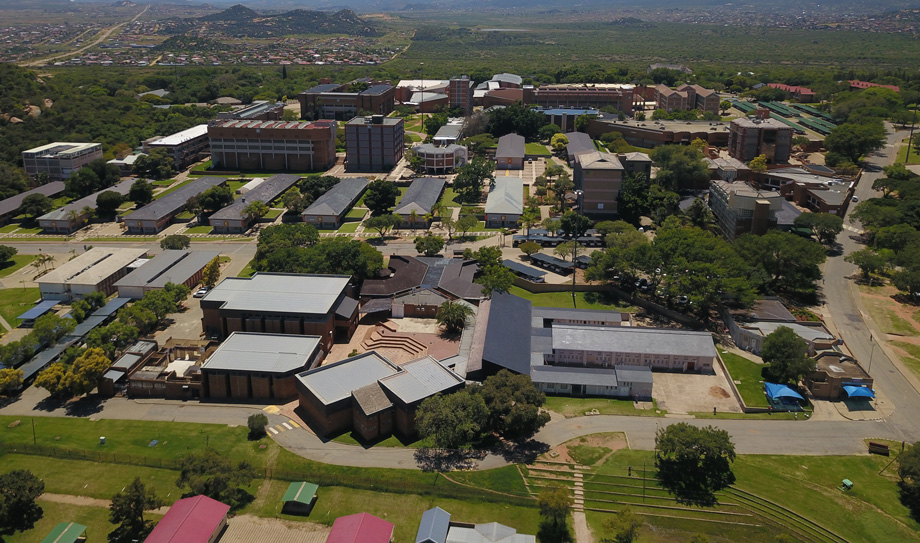
The University of Limpopo (UL) is a public university whose main campus is at Mankweng (Turfloop, postal address Sovenga) near Polokwane, in the foothills of the Wolkberg range near Magoebaskloof. It was established with college status in 1959 as the University of the North. Its stated vision is to be a leading African university focused on the developmental needs of its communities, and its mission includes widening access to higher education, especially for under-prepared and socially or economically disadvantaged students.
Teaching is organised in four faculties. Health Sciences has the School of Health Care Sciences (Pharmacy, Human Nutrition and Dietetics, Public Health, Optometry and Nursing Science) and the School of Medicine. Humanities has the Schools of Education, Languages and Communication Studies, and Social Sciences. Science and Agriculture has the Schools of Agricultural and Environmental Sciences, Mathematical and Computer Sciences, Molecular and Life Sciences, and Physical and Mineral Sciences. Management and Law has the Schools of Accountancy, Economics and Management, and Law. The Turfloop Graduate School of Leadership (TGSL) is the business school, offering the MBA, Master of Development in Planning and Management and Master of Public Administration and Management.
Units named on the university site include the Limpopo Agro-Food Technology Station, an Experimental Farm and the Larry Leach Herbarium (described as the largest in Limpopo Province) in Science and Agriculture, the Centre for Rural Community Empowerment, a Science Education Centre, the Legal Aid Clinic of the School of Law, a Technology Transfer Office, and the Reakgona Disability Centre. The university also describes a cathode materials centre and a manganese beneficiation pilot plant backed by a R30-million investment.
Student life centres on the Turfloop campus. The residences page lists 31 residences, grouped as first-entering students, undergraduates (including residences for students with disabilities) and honours and postgraduate students, with Wi-Fi and security listed for all of them. A campus health clinic next to pedestrian Gate 2 offers nursing care, doctor appointments, counselling and voluntary HIV counselling and testing. The Centre for Academic Excellence runs academic support and the Extended Degree Programmes, first-year students are assigned a senior peer mentor, and the campus offers sport, clubs and cultural and religious societies. Residence places are limited and admission to a programme does not guarantee a place.
SADC students are treated like South African students for admission. The Office of International Affairs handles study visa support, compulsory South African medical aid cover, annual pre-registration and orientation.
First-year bursary: full-time students registering for a first degree for the first time who obtained an average of 70% or more in the Grade 12 final examination (excluding Life Orientation under the NSC) receive tuition fees only. Performance bursaries for senior undergraduates: an overall pass of 70 to 75% at first attempt in the previous year (full curriculum passed) earns the full upfront registration fee; 76 to 100% earns full tuition fees. The award is reversed if the student obtains other funding that covers the amount, and bursaries are not automatic, so students must apply every year. University Merit Bursaries (PDF)
Up to R10,000 for the duration of study, capped at the tuition fee for the year; administration fees remain payable. First-time master's and doctoral students qualify; first-time honours and BEd honours students need 60% in the final undergraduate year in the relevant subject. Per the university notice it is awarded on completion of study within the stipulated time. Students whose tuition is paid by an employer or another source, or who already hold an equivalent qualification, do not qualify; no retrospective applications. Required documents: acceptance letter from the School, academic transcript, degree certificates and certified ID.
Founded by the 1995/96 SRC to support financially needy and academically deserving students, with a focus on Management, Health, Agriculture, Medicine and Natural Sciences. Maximum R10,000 per student per academic year. Beneficiaries are selected at annual general meetings held in August, and continuing students must reapply yearly. ULSTF page
The Financial Aid Office assists with funder information. The university also lists an MQA Projects Bursary application form and a general bursary application page. NSFAS is described on the financial support page (South African citizens; household income up to R350,000 a year, R600,000 for persons with disabilities; deadlines mid-March for first-years). Sponsored students ask their funder to send a promissory note by registration day ([email protected] or [email protected]). Financial support page
University of Limpopo Merit Bursary for First-Year Students →
University of Limpopo Tuition Fee Bursary for Postgraduate Studies →
Browse the scholarships listed for University of Limpopo and check each award’s eligibility.
View scholarships for University of Limpopo →Applicants need an NSC with Bachelor endorsement, Life Orientation at achievement level 3 or higher, English (language of learning and teaching) at level 3 or higher, four 20-credit subjects at level 4 or higher, the minimum levels in specific subjects set in each faculty's calendar, and the programme APS. Meeting the minimum does not guarantee admission. Diploma programmes require four 20-credit subjects at level 3 or higher.
The APS adds achievement levels from six recognised 20-credit subjects as specified by each faculty, excluding Life Orientation. The university's example: levels 4, 4, 6, 6, 7 and 2 give an APS of 29. Conversion tables are published for IGCSE/GCSE, HIGCSE/NSSC, A-Level, AS Level and IB qualifications.
NC(V) applicants are subject to faculty specifications and placement tests: for degrees, three fundamental subjects at 60% (including Life Orientation) and four vocational subjects at 70%; for diplomas, three fundamental subjects at 50% and three compulsory vocational subjects at 60%. Pre-2008 Senior Certificate holders with full exemption apply by converting symbols to an APS.
Applicants write the NBTs at UL. Results are used to allocate support and are especially important for Extended Curriculum Programmes, which add a year.
Only holders of a qualification giving bachelor study access may apply. Non-SA secondary qualifications need a Universities South Africa (HESA) certificate; foreign tertiary qualifications for postgraduate study need a SAQA evaluation. Applicants from non-English-speaking countries must show English proficiency (TOEFL is named). SADC students are treated as South African students for admission under the SADC Protocol on Education; others must meet each faculty's requirements. MBChB is open only to South African students. A study visa is required and is the student's own responsibility; compulsory South African medical aid cover (confirmation letter) is required for the whole study period. Certified documents must not be older than three months and self-funded students send proof of payment four working days before registration.
Applicants must meet the minimum requirements of the programme, and places are limited; see the Postgraduate Prospectus. The international students page states that postgraduate students cannot apply online and that international postgraduate applicants submit a SAQA certificate.
Apply online through the university's application portal. The non-refundable handling fee is R200 for South African and R750 for international applicants, paid into the university's bank account with the ID or passport number as reference and proof attached. Undergraduate applications open in March and close in September each year, per the international students page. Registration is fully online. Enquiries: [email protected], +27 15 268 3332.
Undergraduate admissions | International students | Postgraduate admissions
Mankweng (Turfloop) campus, near Polokwane, Limpopo. The main campus houses all four faculties, the Turfloop Graduate School of Leadership, administration and the Turfloop campus library (information desk 015 268 2492, with an Ask-A-Librarian service, subject librarians, interlibrary loans, repository and electronic theses). Health Sciences faculty offices are in Old Q Block; Humanities offices in New K Block; the Office of International Affairs is in the New Admin Building, 2nd Floor.
The former Ga-Rankuwa (MEDUNSA) campus north of Pretoria was part of the university from the 2005 merger until January 2015, when UL became a standalone institution.
Study programmes offered at University of Limpopo.
Experiences shared by students of University of Limpopo.
Studied here? Share your experience to help other applicants.

Book a free consultation with our expert counsellors and take the first step towards your dream university.
Copyrights © 2026 StudyMapped. All rights reserved.

Enter your credentials to continue.
Join us and start your study abroad journey.


