
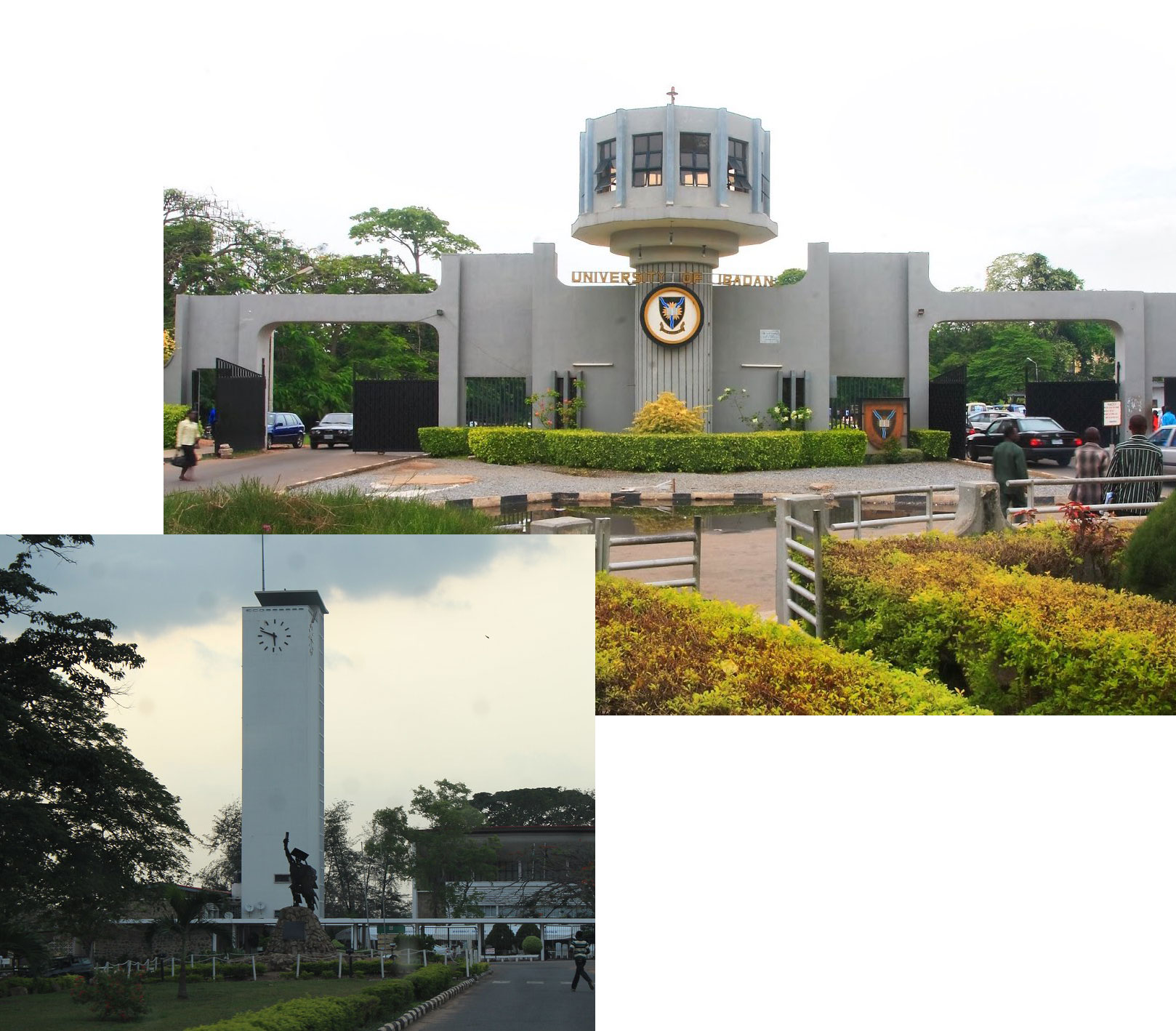

University in Nigeria
Ibadan, Oyo State
University profile
The University of Ibadan (UI) is the first university in Nigeria. It was established in 1948 as a College of the University of London under a special relationship scheme and became a full-fledged independent university in 1962. It began with programmes in Arts, Science and Medicine and is now a comprehensive university in Ibadan, Oyo State, with a stated vision of being a world-class institution for academic excellence geared towards meeting societal needs.
Academic work is organised in seventeen faculties: Arts, Science, Basic Medical Sciences, Clinical Sciences, Agriculture, the Social Sciences, Education, Veterinary Medicine, Pharmacy, Technology, Law, Public Health, Dentistry, Economics, Renewable Natural Resources, Environmental Design and Management, and Multidisciplinary Studies. Faculties of the Basic Medical Sciences, Clinical Sciences, Public Health and Dentistry are organised as the College of Medicine. The university also has faculty-level units in Computing and Nursing, and a School of Business is being established. The Postgraduate College is the flagship of postgraduate education and takes about 50% of the total student enrolment; the university produces an average of 3,000 master's and 250 PhD graduates a year.
Institutes and centres include the Institute of Child Health, the Institute of Education, the Institute of African Studies, the Institute for Advanced Medical Research and Training (IAMRAT), the Institute for Peace and Strategic Studies (IPSS), the Centre for Child, Adolescent and Mental Health, the African Regional Centre for Information Science (ARCIS), the Centre for Peace and Conflict Studies (CEPACS), the Centre for Petroleum, Energy, Economics and Law (CPEEL), the Centre for Sustainable Development (CESDEV), the Centre for Entrepreneurship and Innovation (CEI), the Centre for Drug Discovery, Development and Production, and the Centre for Control and Prevention of Zoonosis. A National Institute for Maternal, Child and Neonatal Health and an Institute for Infectious Diseases are under construction. UI also hosts the African Union's Pan African University Life and Earth Sciences Institute on behalf of the West African subregion.
Student life centres on the Ibadan campus, where twelve halls of residence accommodate about 30% of students in the regular mode, with three more built with Federal Government revitalisation funds. The university provides electricity, water, security and health facilities to staff and students, and has 1,212 staff housing units. The Kenneth Dike Library, in operation since 1965, holds more than 2 million printed volumes and over 10 million digital resources. A Distance Learning Centre and eCampus extend programmes beyond the campus.
International students are admitted at postgraduate level through the Postgraduate College, with English as the language of instruction; language immersion programmes are available for candidates from non-English-speaking countries. Governance follows a committee system in which boards and committees report to Council and Senate.
The university invests in doctoral funding each year and attracts sponsorship for research students from research councils, industries, trusts and charities. Tuition fees cover registration, tuition, supervision, examinations and graduation, and entitle students to library and Students' Union membership. Fee schedules by faculty and programme are on the Postgraduate College fees and funding page.
University of Ibadan Postgraduate College Scholarship Award →
Browse the scholarships listed for University of Ibadan and check each award’s eligibility.
View scholarships for University of Ibadan →Candidates apply through the undergraduate admissions portal using their JAMB registration number. Five O-Level credits at one sitting, or six credits at two sittings, are required in relevant subjects including English Language; Mathematics is required for all science-based disciplines, Economics and Educational Management. The College of Medicine and the Faculty of Pharmacy require five credits at one sitting. Post-UTME screening applies: a portal access fee of N3,000 and a screening fee of N2,000 are paid through the admission portal.
Cut-off marks are set per programme for Merit, Catch and ELDS admissions. Examples: Medicine and Surgery 80.00 (Merit), Dentistry 72.875, Nursing Science 74.5, Law 71.00, Pharmacy 70.375, Electrical and Electronics Engineering 71.25, Mechanical Engineering 70.00, Computer Science 74.125, Software Engineering 75.375, Accounting 69.5, Economics 54.25, Veterinary Medicine 55.00; many Arts, Education, Agriculture and Science programmes are at 50.00.
Direct Entry registration for 2026/2027 ran from 3 to 16 August 2026 through the admission portal, with a portal access fee of N3,000 and screening fee of N2,000. Accepted qualifications are WAEC, NECO, Cambridge Advanced Level, NCE, ND, HND and degree certificates from recognised institutions; IJMB and JUPEP are not accepted. Candidates with two O-Level results need at least six credits in relevant subjects. Credentials are uploaded to [email protected].
The basic qualification is a first degree of UI or a degree or HND from a recognised institution in a relevant discipline, together with the UI O-Level matriculation requirements (five credits at one sitting or six at two sittings, including English Language, and Mathematics for science-based disciplines). Applicants without a previous higher degree in the discipline are admitted to a master's or professional master's programme; M.Phil and PhD candidates are admitted first to a master's programme unless they hold an acceptable postgraduate degree. Master's and Postgraduate Diploma applicants sit a Test of Proficiency in English and must score at least 40%. Three e-letters of recommendation and official transcripts are required. Applicants may apply to one department or programme only. Application forms cost N20,000 for academic and N25,000 for professional programmes, plus N5,000 for the English proficiency test; applications are online and fees are paid through any bank with the portal payment advice or e-channels. Successful indigenous candidates pay an acceptance fee of N30,200 and complete physical clearance at the Postgraduate College.
International postgraduate applicants are expected to hold a bachelor's degree with at least Second Class Upper Division from a university recognised by Senate. English proficiency is required, and language immersion programmes are available for candidates from non-English-speaking countries. A visa requires an admission letter and a letter of introduction from the Postgraduate College; applications follow the procedure of the Nigerian mission in the applicant's country. Separate fee schedules for international master's and PhD students apply.
Ibadan, Oyo State is the university's main campus, where the faculties, the College of Medicine, institutes and centres, the Postgraduate College and administration are based.
Study programmes offered at University of Ibadan.
Experiences shared by students of University of Ibadan.
Studied here? Share your experience to help other applicants.

Book a free consultation with our expert counsellors and take the first step towards your dream university.
Copyrights © 2026 StudyMapped. All rights reserved.

Enter your credentials to continue.
Join us and start your study abroad journey.


