

University in United Kingdom
Hatfield, England, United Kingdom
University profile
The University of Hertfordshire (Herts) is a public university in Hatfield, Hertfordshire, and the only university in the county. It began in 1952 as Hatfield Technical College, training engineers for the de Havilland aircraft industry, and gained university status in 1992. Its community numbers nearly 34,000 students from more than 110 countries, studying across more than 700 career-focused courses, with a strong emphasis on employability, industry links and professional accreditation.
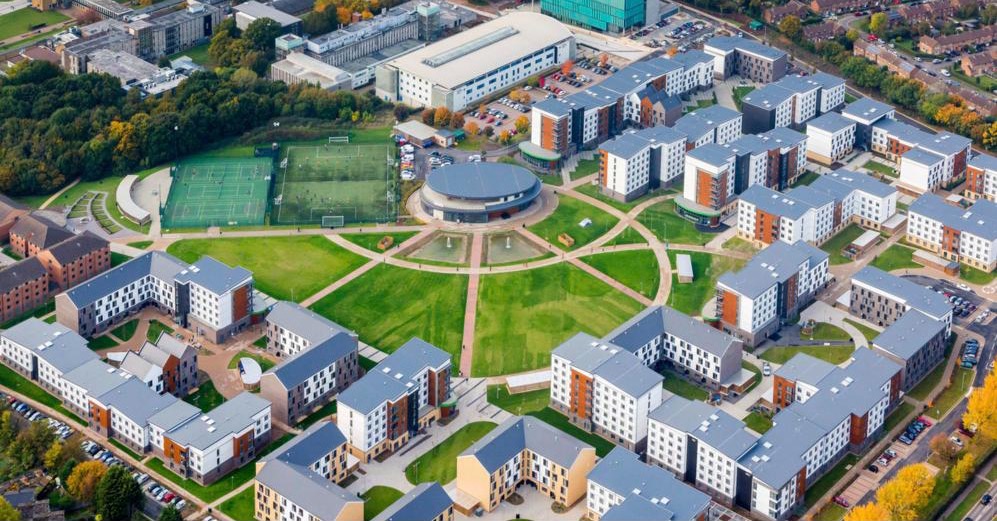
Teaching is concentrated on two main campuses in Hatfield, College Lane and de Havilland, which sit within a 125-acre green estate about 25 minutes by train from central London. The university also runs the Bayfordbury Observatory, and landmarks from the former de Havilland airfield, including the restored beacon and a de Havilland Goblin engine, remain on site.
Academic work is organised through Schools of Study:
Notable facilities include Spectra, a building of more than £100 million opened in 2024 for physics, engineering and computer science; a full-size replica Crown Court used by the Law School; the Clinical Simulation Centre; the Institute of Sport; the Enterprise Hub; and Hertfordshire Sports Village. Sixteen formal research centres cover fields such as astrophysics, climate change, AI and robotics, biodetection, public health and drug delivery.
On-campus halls on both campuses range from standard singles and twin rooms to en suite, premium, townhouse and studio rooms, with bills, contents insurance and 24/7 security included and a dedicated postgraduate block at de Havilland. Students who apply by the deadline are guaranteed a room. Student life centres on Herts SU, The Forum entertainment venue, the Oval gym, the College Lane medical centre, a day nursery and a non-denominational chaplaincy.
International students make up a large part of the community, supported by about 170 international partner universities and study-abroad and exchange options. The university received the King's Award for Enterprise in 2024 for overseas growth, holds a Silver rating in the Teaching Excellence Framework (TEF 2023), and is rated 5 stars by QS Stars.
Full fee details are on the tuition fees page.
See undergraduate funding opportunities and postgraduate funding opportunities.
External awards include Chevening Scholarships and regional and government schemes. Details are on the international scholarships page.
Chancellor's International Scholarship →
University of Hertfordshire Graduate Scholarship (20% fee reduction) →
University of Hertfordshire MBBS International Scholarship →
Browse the scholarships listed for University of Hertfordshire and check each award’s eligibility.
View scholarships for University of Hertfordshire →Undergraduate degrees, including extended and foundation degrees, are applied for through UCAS, with up to five course choices on one application, a personal statement and a school or college reference. For September 2027 entry, applications open on 1 September 2026 and the equal-consideration deadline is 18.00 on 13 January 2027. For September 2026 entry, Clearing applications run until 19 October, and non-UCAS applications submitted after 30 June 2026 enter Clearing automatically.
Most courses state requirements in UCAS Tariff points; applicants usually need at least two A levels (or equivalent) for a degree, or one A level for a foundation degree. T levels are accepted for all courses. BTEC Diplomas and Extended Diplomas are accepted alone or combined with other qualifications, while the Certificate, Subsidiary Diploma and 90-Credit Diploma must be combined to equal a full Diploma. Most courses also require GCSE English language and mathematics at grade 4/C or above, with some needing science.
Contextual offers are typically up to one grade lower than the standard requirement (equivalent to eight UCAS points). They apply to UK-domiciled Home fee applicants who meet at least one criterion: free school meals in the last six years of secondary education, care experience before age 16, unpaid caring responsibilities, estrangement from both parents, refugee status, a home postcode in IMD Quintile 1, or Gypsy, Roma, Traveller, Showmen or Boater background (by email to the Student Success team). Grade adjustments are not available for part-time, deferred or Clearing applicants.
International applicants normally need 12 years of school education and a school-leaving certificate equivalent to UK A levels; country-specific equivalences are assessed against each course's entry requirements. Applicants under 18 must declare their age, provide parental consent and have a UK-based guardian.
Some subjects, including humanities, nursing and social work, require IELTS 6.5, and others require 7.0 or 7.5. Tests are valid for two years and must remain valid up to the date the CAS is issued. Pre-sessional English courses are available for applicants below the required level, and several online tests (Oxford International English Language Test, Password, IELTS Indicator, Kaplan Test of English, LanguageCert Academic Online) are accepted.
Taught postgraduate applications are made through the university's online form and are accepted throughout the year, with decisions usually communicated within five working days. Most taught master's degrees require an honours degree or equivalent; international applicants normally need a bachelor's degree equivalent to a UK second-class honours degree. A reference and personal statement are required, and some courses (such as MSc Nursing, MSc Social Work, MSc Advancing Clinical Pharmacy Practice and MA Art Therapy) require a DBS check. Herts undergraduates with Home fee status can use a fast-track application.
Research degrees normally require a first-class or upper-second-class (2:1) honours degree in the subject area, although applicants with significant publications or professional responsibilities may be considered. International research applicants usually need IELTS 6.5.
Applicants who need Student visa sponsorship must pay a minimum deposit of £5,000 (higher for some courses) before the CAS is released; the deposit counts towards first-year tuition fees.
Other facilities include the University Day Nursery, a non-denominational chaplaincy, a Clinical Simulation Centre and a planned Health building (2028, subject to planning) for nursing, midwifery, paramedic science, physiotherapy, social work and optometry.
Study programmes offered at University of Hertfordshire.
Experiences shared by students of University of Hertfordshire.
Studied here? Share your experience to help other applicants.

Book a free consultation with our expert counsellors and take the first step towards your dream university.
Copyrights © 2026 StudyMapped. All rights reserved.

Enter your credentials to continue.
Join us and start your study abroad journey.


