

University in Canada
Guelph, Ontario, Canada
University profile
The University of Guelph is a comprehensive, research-intensive university in Guelph, Ontario, established in 1964. Its reputation dates back more than 150 years to its founding colleges: the Ontario Veterinary College, the Ontario Agricultural College and the Macdonald Institute. Its shared commitment is summarised in the motto "Improve Life". The university enrols more than 36,000 undergraduate and graduate students and has more than 215,000 alumni living in over 150 countries.
Teaching and research are organised in eight colleges: the College of Arts, the College of Biological Science, the Gordon S. Lang School of Business and Economics, the College of Computational, Mathematical and Physical Sciences, the College of Engineering, the College of Social and Applied Human Sciences, the Ontario Agricultural College and the Ontario Veterinary College. Departments and schools within them include the School of Computer Science, the School of Hospitality, Food and Tourism Management, the School of Environmental Sciences, the School of Environmental Design and Rural Development, and the School of Fine Art and Music. Graduate studies are coordinated by the Office of Graduate Studies, and the School of Continuing Studies and Open Learning offer additional pathways.
The university has three campuses: the main campus in Guelph; the University of Guelph-Humber in Toronto, offered in collaboration with Humber College so that students earn both a university degree and a college diploma; and the Ridgetown Campus in southwestern Ontario, a centre for applied agriculture, animal sciences and environmental sciences. More than 75 undergraduate programs are offered, including co-operative education options.
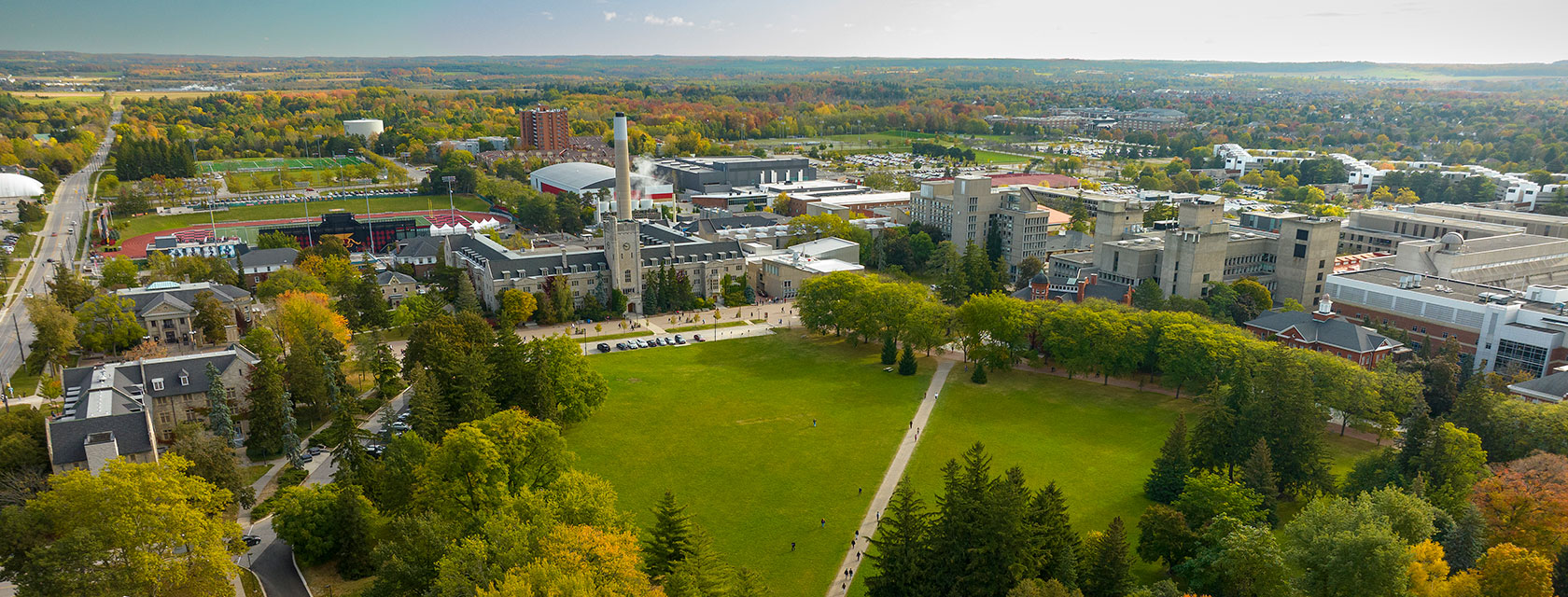
The Guelph campus has 20 dining facilities and 13 coffee houses, 18 lecture halls seating up to 600, McLaughlin Library, the Summerlee Science Complex, the Gryphons Athletic Centre with a 22,000 sq. ft. fitness centre, 19 intramurals, 20 varsity teams and 22 sports clubs, and the 400-acre Arboretum with trails. Student Housing Services operates 16 residence communities with about 5,000 beds, grouped in South, East and North residence areas; South Residence is described as the largest residence complex in Canada, housing over 1,800 students a year. Meal plans are mandatory in residence except in the East residences, which have full kitchens.
More than 1,900 international students from over 140 countries study at the university. International undergraduates entering in 2027 are guaranteed university housing for the duration of their studies if they accept their offer, apply to residence and pay the residence deposit by the deadline. The university's Designated Learning Institution number is O19305391192. The Gordon S. Lang School of Business and Economics holds AACSB accreditation.
Guaranteed on admission average with no separate application, payable over four years: 95.0%+ $20,000 in year 1 and $7,500 in years 2-4 (total $42,500); 90.0-94.9% $16,000 then $7,500 (total $38,500); 85.0-89.9% $13,000 then $7,500 (total $35,500); 70.0-84.9% $10,000 then $7,500 (total $32,500). Renewal requires full-time registration and a minimum 80.0% average in the previous year, with continued payment of international fees.
President's Scholarships and Lincoln Alexander Chancellor's Scholarships ($42,500 CAD; application deadline January 22 for 2026-27); Board of Governors' Scholarships ($20,000, no application); entrance scholarships of $2,000 (95.0%+) or $1,000 (90.0-94.9%); Registrar's Entrance Bursaries (550 awards of $4,000) and Accessibility Bursaries (200 awards of $14,000), applications by April 15 via the Entrance Financial Need Assessment Form. In 2024-25, 7,870 students received $21.96 million in awards.
Co-op work terms pay $500-$2,500 CAD per week; more than 4,000 on-campus jobs; Work Study for students with financial need (international students from second year); International Student Undergraduate Research Assistantships of 16 paid weeks earning upwards of $10,250 CAD; payment plans through Student Financial Services. The university guarantees tuition increases will not exceed 5% in subsequent years. Estimated international annual tuition ranges from $46,780 (e.g. Arts, Science) to $57,112 (Commerce), $58,807 (Computing) and $66,099 (Engineering), based on 2025-26. Deadline for scholarships requiring an application: April 15.
Details: International funding and Canadian funding.
University of Guelph Entrance Scholarship →
Lincoln Alexander Chancellor's Scholarship →
Browse the scholarships listed for University of Guelph and check each award’s eligibility.
View scholarships for University of Guelph →The secondary school graduation certificate that would admit a student to an internationally recognized university in the home country is normally acceptable, provided program prerequisite courses are met. Examples of country minimums: Afghanistan, Baccalauria with a minimum of B in all subjects; Argentina, Bachillerato with a minimum of 8; Bangladesh, Higher Secondary Certificate with first division pass (60-100); Bolivia, 5.5/7 or 75/100; Brazil, Certificado de Conclusao de Ensino Medio minimum 7.5 plus vestibular or national exam; Caribbean, CAPE Diploma with a minimum of six unique subjects including at least two Unit 2 courses. Predicted, interim or midterm Grade 12 results may lead to a conditional offer if prerequisite courses are completed or in progress and minimum grades are met. Meeting minimums does not guarantee admission. Applicants with GCE and CAPE results submit final results between August 20 and 31.
Requirements are set by province and program. Co-operative education programs normally require a minimum admission average of 80%, with cut-offs determined by the applicant pool and space; applicants not admitted to co-op are considered for the regular program. IB Diploma applicants should present a minimum score of 28 (many programs require more), six subjects (3 Higher Level, 3 Standard Level) with program-specific subject requirements and predicted scores on the 7-point scale. IB transfer credit is awarded for Higher Level courses with a final grade of 5 or higher, to a maximum of 2.0 credits. IB Mathematics Analysis and Approaches HL is accepted for MHF4U, MCV4U and MDM4U.
Proof is required if English is not the first language and fewer than four years of full-time study in an English-language secondary or post-secondary school were completed. Accepted tests: IELTS Academic overall 6.5 with no band below 6; TOEFL iBT total 89 with no individual score below 21; Duolingo English Test overall 110; PTE overall 60 with no component below 60; Cambridge C1 Advanced/C2 Proficiency overall 176 with no band below 169; CAEL overall 70; or completion of the Advanced Level (levels 9 and 10) of the university's English Language Certificate Program. The IB Diploma taught in English also satisfies the requirement. Scores must be no more than two years old; the TOEFL institution code is 0892. Applicants not meeting English or grade requirements may consider the English Language Communication and Culture Guaranteed Admission Pathway into the Bachelor of Commerce or Bachelor of Arts, requiring an overall average of 80% or higher in ELCP levels 7 and 8 or 8 and 9 and no previous post-secondary study.
Options are the direct application (for those applying only to Guelph), the Ontario Universities' Application Centre (OUAC) for those applying to more than one Ontario university, or the Common App. The non-refundable fee is $100 CAD for the direct application and $75 USD for the Common App. Canadian citizens and permanent residents must use OUAC. After applying, applicants upload transcripts and documents through an Admission Portal and submit proof of English proficiency; international students may need a Provincial Attestation Letter and a study permit.
Canadian high school applicants: January 15 application deadline (later applications considered); June 1 deadline to accept an offer and apply for residence with a $750 deposit; July 16 to meet offer conditions. International: November 1 for winter 2027 entry; May 15 for fall 2027 for students studying outside Canada, with documents due May 22; March 1 soft deadline for English proficiency; February 1 for early admission documents; June 1 offer acceptance; $2,000 CAD international tuition deposit due by June 15 (December 15 for winter intake, November 2 for early deposit and Provincial Attestation Letter request). Bachelor of Landscape Architecture and Associate Diploma in Turfgrass Management close February 1 and require a Background Information Form.
Applicants currently or previously registered at another college or university: winter (January) entry application deadline November 1, documents December 1; fall entry application deadline April 1, documents May 1. Landscape Architecture and Turfgrass Management close February 1.
Applicants out of full-time high school for two years or more who have never attended post-secondary education need the 4U/4M subject requirements for the program and a minimum admission average of 75%. Apply through OUAC by April 1 for fall admission only.
Residences: South Residence (Mountain, Prairie and Maritime Halls, over 1,800 students) and Gordon Hall in the south, East Residences with full kitchens, and North Residences; optional Living Learning Communities including International House.
Study programmes offered at University of Guelph.
Experiences shared by students of University of Guelph.
Studied here? Share your experience to help other applicants.

Book a free consultation with our expert counsellors and take the first step towards your dream university.
Copyrights © 2026 StudyMapped. All rights reserved.

Enter your credentials to continue.
Join us and start your study abroad journey.


