

University in United Kingdom
Glasgow, Scotland, United Kingdom
University profile
The University of Glasgow, founded in 1451, is the fourth oldest university in the UK and a member of the Russell Group of leading UK research universities. It is a registered Scottish charity (SC004401) with a long civic mission tied to the city, holds University of Sanctuary status for its support of refugees and asylum seekers, and was the first European university to declare it would divest from fossil fuels and the first in Scotland to declare a climate emergency.
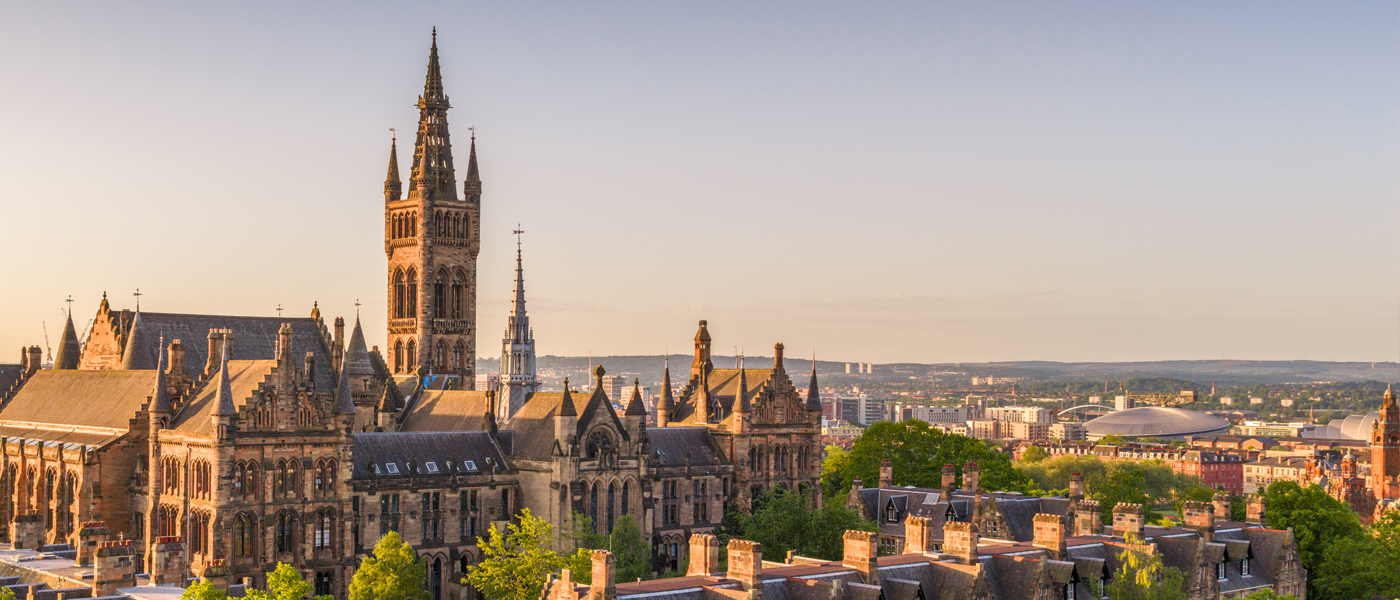
The main Gilmorehill campus sits in Glasgow's West End, centred on the Gilbert Scott building and its bell tower, and holds most teaching and research facilities. The Garscube estate, four miles away, hosts Veterinary Medicine, the Wolfson Hall of Residence and outdoor sport, while the Dumfries campus in south-west Scotland is home to the School of Social & Environmental Sustainability. Glasgow degrees are also taught through transnational partnerships in China and Singapore, which account for 10% of the total student population.
Teaching and research are organised in four colleges: the College of Arts & Humanities, the College of Medical, Veterinary & Life Sciences, the College of Science & Engineering and the College of Social Sciences. Their schools include the Adam Smith Business School, the James Watt School of Engineering, the School of Law, the School of Medicine, Dentistry & Nursing, the School of Biodiversity, One Health & Veterinary Medicine, the School of Computing Science, the School of Physics & Astronomy, the School of Education and the School of Social & Political Sciences.
Research is framed by six Glasgow Research Beacons, from Precision Medicine & Chronic Diseases to The Nano & Quantum World, and anchored by the £116 million Advanced Research Centre. The £90m James McCune Smith Learning Hub, with space for 2,500 students and a 500-seat lecture theatre, is the first building of a £1 billion campus development programme. The Hunterian, at the heart of the University since 1807, is its museum and art gallery.
Student life runs through four independent student bodies: the Students' Representative Council (over 300 clubs and societies), the Glasgow University Sports Association (over 50 sports clubs), the Queen Margaret Union and the Glasgow University Union, plus the Gilchrist Postgraduate Club. Undergraduates are offered a 39-week contract in University residences such as Murano Street Student Village, Queen Margaret Residence and Maclay Residences, and the University community draws students and staff from over 140 countries. International applicants can prepare through the Glasgow International College foundation and pre-Masters programmes or BALEAP-accredited pre-sessional English courses.
Postgraduate fees vary by programme; for example, the MSc Computing Science is £13,092 (Home and RUK) and £34,815 (International and EU) for 2027/28.
University scholarships cannot be combined with each other or with external sponsorship discounts, except the Alumni Discount; where more than one is offered, the lower-value award is removed. Chevening Scholarships are also listed for eligible Masters applicants.
All awards can be searched by country and level in the University scholarships database.
World Changers Global Excellence Scholarship →
Global Leadership Scholarship (September 2027) →
Global Leadership Scholarship (January 2027 entry) →
World Changers Glasgow Scholarship (Postgraduate Taught) →
Browse the scholarships listed for University of Glasgow and check each award’s eligibility.
View scholarships for University of Glasgow →All full-time undergraduate applicants apply through UCAS. International applicants to Arts, Engineering, Law, Nursing, Science and Social Sciences may instead use the Common App; Dentistry, Education, Medicine and Veterinary Medicine applications must go through UCAS. UCAS applicants receive login details for the Applicant Self Service portal shortly after applying, and a personal statement is required.
Entry requirements, including Scottish Highers, A-level and International Baccalaureate grades and any additional requirements, are set for each degree in the Degree Programme A-Z. Two offer types are made: unconditional (requirements already met) and conditional. For Scottish Highers, all applicants must hold at least four different Highers, and where Advanced Highers are not required, Advanced Higher grades A and B count as an A at Higher and grade C as a B. General Studies is not accepted at A-level. BTEC National qualifications may give direct entry to some degrees or substitute for one or two A-levels depending on subject and grade, and a list of BTEC subjects is not accepted.
Applications after these deadlines are not usually accepted. Many decisions are made after all on-time applications are reviewed, usually before the end of March but possibly up to early May; highly qualified applicants to some programmes may receive earlier offers. Interviews form part of selection for Community Development, Dentistry, Medicine, Nursing, Teaching and Veterinary Medicine & Surgery, and may be used for entry to Year 2 in any subject. Medicine offer holders pay a £5,000 deposit.
Adjusted Entry Requirements apply to widening participation applicants. Priority 1 applicants (living in SIMD deciles 1–2 postcodes, care experienced, carers, estranged, asylum seekers or refugees) are guaranteed an offer at the minimum of the adjusted range; Priority 2 applicants (SIMD deciles 3–4) at the maximum of the range. Offers require completion of pre-entry programmes such as Top-Up, Reach (Access to Medicine, Veterinary Medicine, Dentistry and Law) and summer schools. Adults returning to education can enter through Open Studies or SWAP Access routes, and Access to Higher Education courses provide a route into certain degrees.
Country-specific entry criteria and grade equivalences are available on the international student hub for each country or region. Foundation and pre-Masters programmes are offered through partner Glasgow International College. Transfer applications into Year 2 or 3 of listed programmes are considered through UCAS; transfer into final year is not possible.
Applicants from non-English-speaking countries must meet a programme-specific minimum. For example, MA History requires IELTS Academic 6.5 with no subtest below 6.0, TOEFL iBT 92 (tests from 21 January 2026) with subtest minimums, PTE Academic 59 in all subtests, or Cambridge CPE/CAE 176 with no subtest below 169; tests must be taken within 2 years 5 months of the start date. IELTS Academic, Academic Online, Academic for UKVI and One Skill Retake are accepted, but not IELTS General or Indicator. The University makes its own assessment of English for degree-level visas; BALEAP-accredited pre-sessional courses are available for those below the requirement.
Applications open in October through the University's online application system, and applications are free to submit. Applicants need degree certificates, transcripts (with official translations), references, English evidence if required, and a passport photo page; most programmes do not require a CV or personal statement. Applicants may apply before finishing their degree and before meeting English requirements, receiving a conditional offer. Entry is typically stated as a 2.1 Honours degree or non-UK equivalent in a relevant subject. International and EU taught applicants pay a £2,000 deposit after accepting an offer.
PhD applications are accepted all year round. Applicants identify potential supervisors, choose a programme from the research opportunities A-Z or FindAPhD listings, and apply online.
CAS issue normally begins in June for undergraduate offer holders who are Unconditional Firm and for postgraduate offer holders who have accepted an unconditional offer and paid the deposit, usually within 5–10 working days of becoming unconditional.
Glasgow residences include Cairncross House, Kelvinhaugh Gate, Kelvinhaugh Street, Maclay Residences, Murano Street Student Village (1,175 students), Queen Margaret Residence, Student Apartments and Winton Drive, with partner residences at Havannah House (iQ), Kelvin Court (Unite) and Thurso Street (Unite).
Transnational education: University of Glasgow degrees are delivered with partners at the UofG–Nankai University Joint Graduate School (Tianjin, China), Glasgow College UESTC (Chengdu, China), Glasgow College Hainan, UESTC (Hainan, China) and University of Glasgow Singapore with the Singapore Institute of Technology, in subjects including computing science, engineering, environmental science, international relations, translation studies, nursing and urban and regional planning.
Study programmes offered at University of Glasgow.
Experiences shared by students of University of Glasgow.
Studied here? Share your experience to help other applicants.

Book a free consultation with our expert counsellors and take the first step towards your dream university.
Copyrights © 2026 StudyMapped. All rights reserved.

Enter your credentials to continue.
Join us and start your study abroad journey.


